
Effects of Geomagnetic Storm with Coronal Mass Ejections Driven on Infrared Emissions of Carbon Dioxide in Lower Thermosphere
Article Sidebar
Main Article Content
Abstract
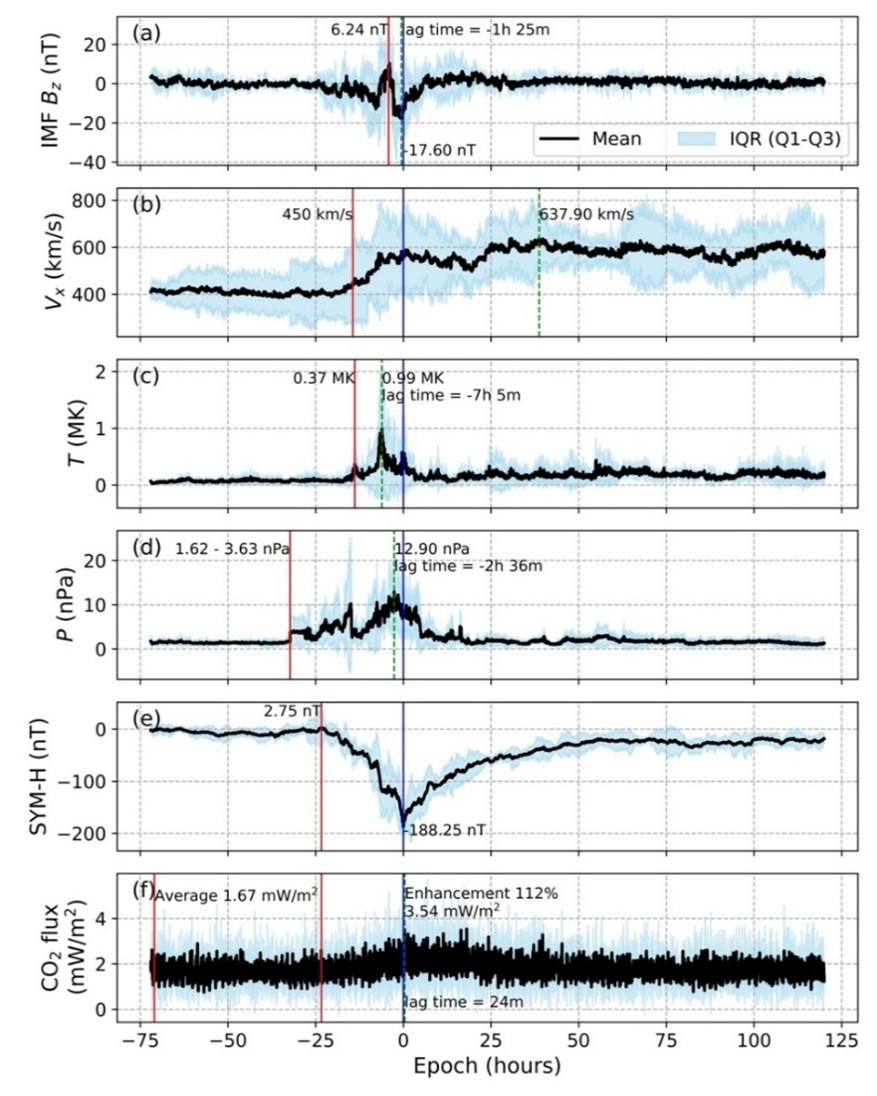
This study examines the response of CO2 infrared radiation (IR) flux in the upper atmosphere to four moderate geomagnetic storms driven by Coronal Mass Ejections (CMEs) during 2023. Using data from the SABER instrument aboard the TIMED satellite and space weather parameters from OMNIWeb. The analysis utilized Superposed Epoch Analysis (SEA) and cross-correlation techniques to examine the relationship between solar wind parameters and CO2 IR flux. Results reveal that the CO2 infrared flux increased significantly by 112% from pre-storm levels, peaking at 3.54 mW/m² approximately 24 minutes after the SYM-H minimum, compared to a baseline average of 1.67 mW/m². A strong negative correlation was found between SYM-H and CO2 IR flux (r = –0.812 for hourly data), while plasma temperature exhibited a positive correlation (r = 0.425 at a 5-hour lag). The response time of the CO2 flux aligns with the storm duration, taking 72-96 hours to return to baseline levels. These findings confirm that CO2 plays a vital role in thermospheric cooling during geomagnetic storms, serving as a key mechanism in maintaining the energy balance of the lower thermosphere. The results are consistent with prior research highlighting the importance of CO2 in the thermospheric energy budget and its response to space weather disturbances.
Article Details

This work is licensed under a Creative Commons Attribution-NonCommercial-NoDerivatives 4.0 International License.
References
Bag, T., Rout, D., Ogawa, Y., and Singh, V. (2023). Distinctive response of thermospheric cooling to ICME and CIR-driven geomagnetic storms. Frontiers in Astronomy and Space Sciences 10: 1107605. doi: 10.33 89/fspas.2023.1107605
Bakhmetieva, N.V., Zhemyakov, I.N., Grigoriev, G.I. and Kalinina, E.E. (2023). Impact of Natural Factors on the Temperature in the Lower Thermosphere. Russian Journal of Physical Chemistry B 17: 1202 - 1215. doi: 10.1134/S1990793123050160.
Emmert, J.T., Stevens, M.H., Bernath, P.F., Drob, D.P. and Boone, C.D. (2012). Observations of increasing carbon dioxide concentration in Earth’s thermosphere. Nature Geoscience 5(12): 868 - 871. doi: 10. 1038/ngeo1626.
Hudson, M.K., Paral, J., Kress, B.T., Wiltberger, M., Baker, D.N., Foster, J.C., Turner, D.L. and Wygant, J.R. (2015). Modeling CME-shock-driven storms in 2012 - 2013: MHD test particle simulations. Journal of Geophysical Research: Space Physics 120(2): 1168 - 1181.
Hutchinson, J.A., Wright, D.M., and Milan, S.E. (2011). Geomagnetic storms over the last solar cycle: A superposed epoch analysis. Journal of Geophysical Research: Space Physics 116(A9): A09211.
Knipp, D.J., Pette, D.V., Kilcommons, L.M., Isaacs, T.L., Cruz, A.A., Mlynczak, M.G., Hunt, L.A. and Lin, C.Y. (2017). Thermospheric nitric oxide response to shock-led storms. Space Weather 15(2): 325 - 342. doi: 10.1002/2016SW001567
Mertens, C.J., Winick, J.R., Picard, R.H., Evans, D.S., López-Puertas, M., Wintersteiner, P.P., Xu, X., Mlynczak, M.G. and Russell III, J.M. (2009). Influence of solar-geomagnetic disturbances on SABER measurements of 4.3 m emission and the retrieval of kinetic temperature and carbon dioxide. Advances in space research 43(9): 1325 - 1336.
Mlynczak, M., Martin-Torres, F.J., Russell, J., Beaumont, K., Jacobson, S., Kozyra, J., Lopez-Puertas, M., Funke, B., Mertens, C., Gordley, L., Picard, R., Winick, J., Wintersteiner, P. and Paxton, L. (2003). The natural thermostat of nitric oxide emission at 5.3 m in the thermosphere observed during the solar storms of April 2002. Geophysical Research Letters 30(21): 2100.
Mlynczak, M.G., Hunt, L.A., Thomas Marshall, B., Martin-Torres, F.J., Mertens, C.J., Russell III, J.M., Remsberg, E.E., López-Puertas, M., Picard, R., Winick, J., Wintersteiner, P., Thompson, R.E. and Gordle, L.L. (2010). Observations of infrared radiative cooling in the thermosphere on daily to multiyear timescales from the TIMED/SABER instrument. Journal of Geophysical Research: Space Physics 115: A03309. doi: 10.1029/2009JA014713.
Mlynczak, M.G., Daniels, T.S., Kratz, D.P., Feldman, D.R., Collins, W.D., Mlawer, E.J., Alvarado, M.J., Lawler, J.E., Anderson, L.M., Fahey, D.W., Hunt, L.A. and Mast, J.C. (2016). The spectroscopic foundation of radiative forcing of climate by carbon dioxide. Geophysical research letters 43(10): 5318 - 5325. doi: 10.1002/2016GL068837
Mlynczak, M.G., Hunt, L.A., Garcia, R.R., Harvey, V.L., Marshall, B.T., Yue, J., Mertens, C.J. and Russell III, J.M. (2022). Cooling and contraction of the mesosphere and lower thermosphere from 2002 to 2021. Journal of Geophysical Research: Atmospheres 127: e2022JD036767. doi: 10.1029/2022JD036767.
Panpiboon, P., Noysena, K., and Yeeram, T. (2023). Variations in thermospheric density during two consecutive geomagnetic storms of different solar wind conditions in November 2022. Journal of Physics: Conference Series 2653: 012017. doi:10.1088/1742-6596/2653/1/012017.
Qian, L., Burns, A. and Yue, J. (2017). Evidence of the lower thermospheric winter-to-summer circulation from SABER CO2 observations. Geophysical Research Letters 44(10): 100 - 107. doi: 10.1002/2017GL0 75643
Rezac, L., Jian, Y., Yue, J., Russell III, J. M., Kutepov, A., Garcia, R., Walker, K. and Bernath, P. (2015). Validation of the global distribution of CO2 volume mixing ratio in the mesosphere and lower thermosphere from SABER. Journal of Geophysical Research: Atmospheres 120(23): 67 - 81.
Salinas, C.C.J.H., Chang, L.C., Liang, M.C., Yue, J., Russell III, J. and Mlynczak, M. (2016). Impacts of SABER CO2-based eddy diffusion coefficients in the lower thermosphere on the ionosphere/thermosphere. Journal of Geophysical Research: Space Physics 121(12): 80 - 92. doi: 10.1002/2016JA023161.
Walton, S.D. and Murphy, K.R. (2022). Superposed epoch analysis using time-normalization: A Python tool for statistical event analysis. Frontiers in Astronomy and Space Sciences 9: 1000145.
Wang, N., Yue, J., Wang, W., Qian, L., Jian, L., and Zhang, J. (2021). A Comparison of the CIR- and CME-Induced Geomagnetic Activity Effects on Mesosphere and Lower Thermospheric Temperature. Journal of Geophysical Research: Space Physics 126(6): e2020JA029029.
Weimer, D.R., Mlynczak, M.G., Emmert, J.T., Doornbos, E., Sutton, E.K. and Hunt, L.A. (2018). Correlations between the thermosphere's semiannual density variations and infrared emissions measured with the SABER instrument. Journal of Geophysical Research: Space Physics 123(10): 8850 - 8864.
Werner, A.L.E., Yordanova, E., Dimmock, A.P., and Temmer, M. (2019). Modeling the multiple CME interaction event on 6 - 9 September 2017 with WSA-ENLIL+Cone. Space Weather 17(2): 357 - 369.
Zebende, G.F. (2011). DCCA cross-correlation coefficient: Quantifying level of cross-correlation. Physica A: Statistical Mechanics and its Applications 390(4): 614 - 618.
Zesta, E., and Oliveira, D.M. (2019). Thermospheric Heating and Cooling Times During Geomagnetic Storms, Including Extreme Events. Geophysical Research Letters 46(22): 12739 - 12746.
Zhang, H.X., Lu, J.Y. and Wang, M. (2023). Energy transfer across magnetopause under dawn-dusk IMFs. Scientific Reports 13(1): 7409.
Zhang, Y., Paxton, L.J., Lu, G. and Yee, S. (2019). Impact of nitric oxide, solar EUV and particle precipitation on thermospheric density decrease. Journal of Atmospheric and Solar-Terrestrial Physics 182: 147 - 154. doi: 10.1016/j.jastp.2018.11.016.
