
ผลกระทบของพายุแม่เหล็กโลกที่ขับเคลื่อนด้วยการพ่นมวลคอโรนาต่อการแผ่รังสีอินฟราเรดของก๊าซคาร์บอนไดออกไซด์ในเทอร์โมสเฟียร์ชั้นล่าง
Article Sidebar
Main Article Content
บทคัดย่อ
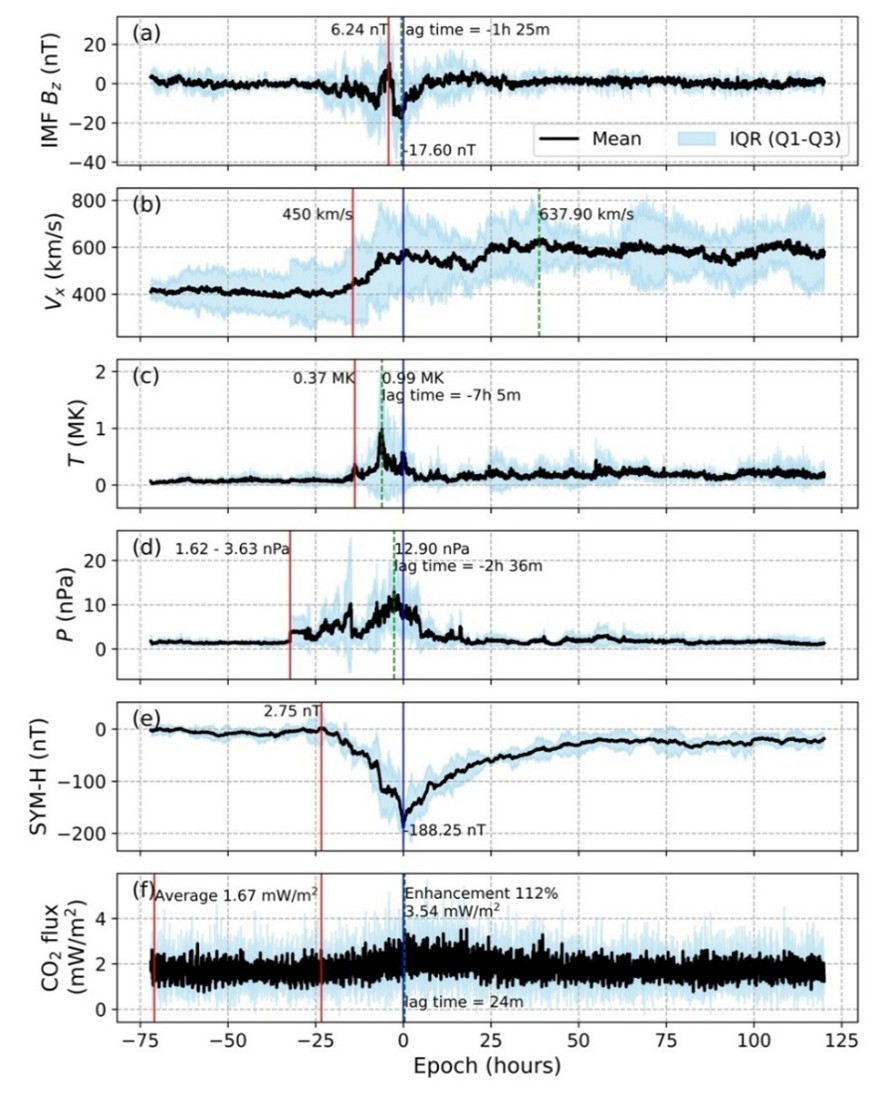
การศึกษานี้ตรวจสอบการตอบสนองฟลักซ์รังสีอินฟราเรดของ CO2 ในชั้นบรรยากาศส่วนบนต่อพายุแม่เหล็กโลกระดับปานกลาง 4 เหตุการณ์ที่ขับเคลื่อนด้วยการพ่นมวลคอโรนา (Coronal Mass Ejection; CME) ในปี ค.ศ. 2023 โดยใช้ข้อมูลจากเครื่องมือ SABER บนดาวเทียม TIMED และพารามิเตอร์ลมสุริยะจาก OMNIWeb ใช้การวิเคราะห์ยุคซ้อนทับ (Superposed Epoch Analysis; SEA) และการหาค่าสัมประสิทธิ์สหสัมพันธ์ไขว้ (Cross-correlation) ระหว่างพารามิเตอร์ลมสุริยะและค่าฟลักซ์รังสีอินฟราเรดของ CO2 ผลการศึกษาพบว่าฟลักซ์รังสีอินฟราเรดของ CO2 เพิ่มขึ้นโดยเฉลี่ยประมาณร้อยละ 112 จากค่าเฉลี่ยก่อนเกิดเหตุการณ์พายุ โดยมีค่าสูงสุด 3.54 mW/m² ซึ่งปรากฏภายใน 24 นาทีหลังจุดต่ำสุดของดัชนี SYM-H ขณะที่ค่าเฉลี่ยช่วงปกติอยู่ที่ 1.67 mW/m² นอกจากนี้ยังพบความสัมพันธ์เชิงลบที่แข็งแกร่งระหว่าง ค่าฟลักซ์รังสีอินฟราเรดของ CO2 กับดัชนี SYM-H (r = –0.812 สำหรับข้อมูลรายชั่วโมง) ขณะที่อุณหภูมิพลาสมาแสดงความสัมพันธ์เชิงบวก (r = 0.425) การตอบสนองทางเวลาชี้ให้เห็นว่า CO2 มีบทบาทสำคัญในการระบายความร้อนของชั้นบรรยากาศ โดยใช้เวลา 3-4 วันในการกลับคืนสู่สภาวะปกติ กลไกนี้สอดคล้องกับแนวคิดด้านสมดุลพลังงานของเทอร์โมสเฟียร์ และสนับสนุนบทบาทของ CO2 ในการควบคุมการระบายความร้อนของบรรยากาศในช่วงที่เกิดพายุแม่เหล็กโลก
Article Details

อนุญาตภายใต้เงื่อนไข Creative Commons Attribution-NonCommercial-NoDerivatives 4.0 International License.
เอกสารอ้างอิง
Bag, T., Rout, D., Ogawa, Y., and Singh, V. (2023). Distinctive response of thermospheric cooling to ICME and CIR-driven geomagnetic storms. Frontiers in Astronomy and Space Sciences 10: 1107605. doi: 10.33 89/fspas.2023.1107605
Bakhmetieva, N.V., Zhemyakov, I.N., Grigoriev, G.I. and Kalinina, E.E. (2023). Impact of Natural Factors on the Temperature in the Lower Thermosphere. Russian Journal of Physical Chemistry B 17: 1202 - 1215. doi: 10.1134/S1990793123050160.
Emmert, J.T., Stevens, M.H., Bernath, P.F., Drob, D.P. and Boone, C.D. (2012). Observations of increasing carbon dioxide concentration in Earth’s thermosphere. Nature Geoscience 5(12): 868 - 871. doi: 10. 1038/ngeo1626.
Hudson, M.K., Paral, J., Kress, B.T., Wiltberger, M., Baker, D.N., Foster, J.C., Turner, D.L. and Wygant, J.R. (2015). Modeling CME-shock-driven storms in 2012 - 2013: MHD test particle simulations. Journal of Geophysical Research: Space Physics 120(2): 1168 - 1181.
Hutchinson, J.A., Wright, D.M., and Milan, S.E. (2011). Geomagnetic storms over the last solar cycle: A superposed epoch analysis. Journal of Geophysical Research: Space Physics 116(A9): A09211.
Knipp, D.J., Pette, D.V., Kilcommons, L.M., Isaacs, T.L., Cruz, A.A., Mlynczak, M.G., Hunt, L.A. and Lin, C.Y. (2017). Thermospheric nitric oxide response to shock-led storms. Space Weather 15(2): 325 - 342. doi: 10.1002/2016SW001567
Mertens, C.J., Winick, J.R., Picard, R.H., Evans, D.S., López-Puertas, M., Wintersteiner, P.P., Xu, X., Mlynczak, M.G. and Russell III, J.M. (2009). Influence of solar-geomagnetic disturbances on SABER measurements of 4.3 m emission and the retrieval of kinetic temperature and carbon dioxide. Advances in space research 43(9): 1325 - 1336.
Mlynczak, M., Martin-Torres, F.J., Russell, J., Beaumont, K., Jacobson, S., Kozyra, J., Lopez-Puertas, M., Funke, B., Mertens, C., Gordley, L., Picard, R., Winick, J., Wintersteiner, P. and Paxton, L. (2003). The natural thermostat of nitric oxide emission at 5.3 m in the thermosphere observed during the solar storms of April 2002. Geophysical Research Letters 30(21): 2100.
Mlynczak, M.G., Hunt, L.A., Thomas Marshall, B., Martin-Torres, F.J., Mertens, C.J., Russell III, J.M., Remsberg, E.E., López-Puertas, M., Picard, R., Winick, J., Wintersteiner, P., Thompson, R.E. and Gordle, L.L. (2010). Observations of infrared radiative cooling in the thermosphere on daily to multiyear timescales from the TIMED/SABER instrument. Journal of Geophysical Research: Space Physics 115: A03309. doi: 10.1029/2009JA014713.
Mlynczak, M.G., Daniels, T.S., Kratz, D.P., Feldman, D.R., Collins, W.D., Mlawer, E.J., Alvarado, M.J., Lawler, J.E., Anderson, L.M., Fahey, D.W., Hunt, L.A. and Mast, J.C. (2016). The spectroscopic foundation of radiative forcing of climate by carbon dioxide. Geophysical research letters 43(10): 5318 - 5325. doi: 10.1002/2016GL068837
Mlynczak, M.G., Hunt, L.A., Garcia, R.R., Harvey, V.L., Marshall, B.T., Yue, J., Mertens, C.J. and Russell III, J.M. (2022). Cooling and contraction of the mesosphere and lower thermosphere from 2002 to 2021. Journal of Geophysical Research: Atmospheres 127: e2022JD036767. doi: 10.1029/2022JD036767.
Panpiboon, P., Noysena, K., and Yeeram, T. (2023). Variations in thermospheric density during two consecutive geomagnetic storms of different solar wind conditions in November 2022. Journal of Physics: Conference Series 2653: 012017. doi:10.1088/1742-6596/2653/1/012017.
Qian, L., Burns, A. and Yue, J. (2017). Evidence of the lower thermospheric winter-to-summer circulation from SABER CO2 observations. Geophysical Research Letters 44(10): 100 - 107. doi: 10.1002/2017GL0 75643
Rezac, L., Jian, Y., Yue, J., Russell III, J. M., Kutepov, A., Garcia, R., Walker, K. and Bernath, P. (2015). Validation of the global distribution of CO2 volume mixing ratio in the mesosphere and lower thermosphere from SABER. Journal of Geophysical Research: Atmospheres 120(23): 67 - 81.
Salinas, C.C.J.H., Chang, L.C., Liang, M.C., Yue, J., Russell III, J. and Mlynczak, M. (2016). Impacts of SABER CO2-based eddy diffusion coefficients in the lower thermosphere on the ionosphere/thermosphere. Journal of Geophysical Research: Space Physics 121(12): 80 - 92. doi: 10.1002/2016JA023161.
Walton, S.D. and Murphy, K.R. (2022). Superposed epoch analysis using time-normalization: A Python tool for statistical event analysis. Frontiers in Astronomy and Space Sciences 9: 1000145.
Wang, N., Yue, J., Wang, W., Qian, L., Jian, L., and Zhang, J. (2021). A Comparison of the CIR- and CME-Induced Geomagnetic Activity Effects on Mesosphere and Lower Thermospheric Temperature. Journal of Geophysical Research: Space Physics 126(6): e2020JA029029.
Weimer, D.R., Mlynczak, M.G., Emmert, J.T., Doornbos, E., Sutton, E.K. and Hunt, L.A. (2018). Correlations between the thermosphere's semiannual density variations and infrared emissions measured with the SABER instrument. Journal of Geophysical Research: Space Physics 123(10): 8850 - 8864.
Werner, A.L.E., Yordanova, E., Dimmock, A.P., and Temmer, M. (2019). Modeling the multiple CME interaction event on 6 - 9 September 2017 with WSA-ENLIL+Cone. Space Weather 17(2): 357 - 369.
Zebende, G.F. (2011). DCCA cross-correlation coefficient: Quantifying level of cross-correlation. Physica A: Statistical Mechanics and its Applications 390(4): 614 - 618.
Zesta, E., and Oliveira, D.M. (2019). Thermospheric Heating and Cooling Times During Geomagnetic Storms, Including Extreme Events. Geophysical Research Letters 46(22): 12739 - 12746.
Zhang, H.X., Lu, J.Y. and Wang, M. (2023). Energy transfer across magnetopause under dawn-dusk IMFs. Scientific Reports 13(1): 7409.
Zhang, Y., Paxton, L.J., Lu, G. and Yee, S. (2019). Impact of nitric oxide, solar EUV and particle precipitation on thermospheric density decrease. Journal of Atmospheric and Solar-Terrestrial Physics 182: 147 - 154. doi: 10.1016/j.jastp.2018.11.016.
