
Development of Protein-enriched Dried Noodles from Giant Cricket (Brachytrupes portentosus) Powder
Article Sidebar
Main Article Content
Abstract
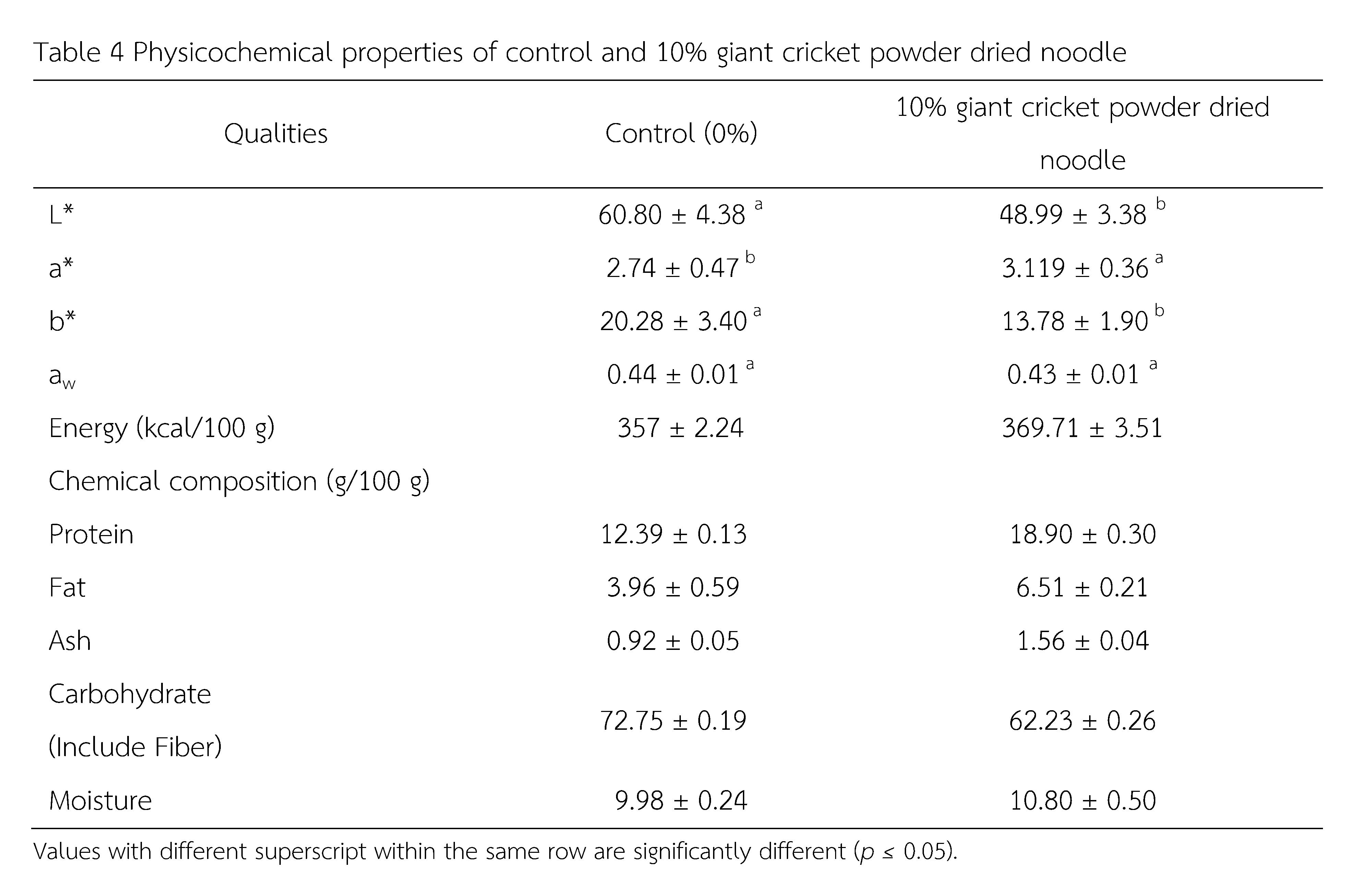
The giant cricket is an edible insect that is widely consumed and rich in nutritional value. This study aimed to develop high-protein dried noodles fortified with giant cricket powder. Giant cricket powder contained the percentages of protein, fat, ash, carbohydrate and moisture of 60.13, 24.49, 5.47, 5.98 and 3.93, respectively. To determine the optimal level of giant cricket powder supplementation, four substitution levels including 0% (as the control), 5%, 10% and 15% were tested by replacing wheat flour with giant cricket powder. Sensory evaluation results indicated that the dried noodles with 10% giant cricket powder received the highest overall acceptability score. The sensory evaluation scores for color, aroma, taste and texture were 7.53, 6.17, 6.67 and 6.47 respectively, resulting in an overall acceptability score of 6.47, which was categorized within the ‘slightly liked’ to ‘moderately liked’ range. These scores were not significantly different (p > 0.05) from the control noodles without giant cricket powder. The addition of 10% giant cricket powder reduced lightness and yellowness while increasing redness compared to the control noodles. The percentages of protein, fat, ash, carbohydrate and moisture were 18.90, 6.51, 1.56, 62.23 and 10.80, respectively, yielding an energy value of 369.71 kcal/100 g. These noodles exhibited higher protein, fat, ash, and energy content than the control noodles due to the giant cricket powder supplementation. The 10% giant cricket fortified dried noodles met the chemical quality standards for instant noodles set by the Thai Industrial Standard Institute (TISI 271-2563), which require a moisture content of no more than 12.5% and a minimum protein content of 10%. Furthermore, this product can be regarded as a source of protein, as their protein content exceeded 10% of the Thai Recommended Daily Intake (RDI).
Article Details

This work is licensed under a Creative Commons Attribution-NonCommercial-NoDerivatives 4.0 International License.
References
กองอาหาร. (2566). ประกาศกระทรวงสาธารณสุข ฉบับที่ 445 พ.ศ. 2566 เรื่องฉลากโภชนาการ. สำนักงานคณะกรระมการอาหารและยา กระทรวงสาธารณสุข, แหล่งข้อมูล: https://food.fda.moph.go.th/food-law/announ-moph-445. ค้นเมื่อวันที่ 5 มกราคม 2568.
ทัทยา อนุสสร. (2554). มังสโภชนา สารพัดเนื้อเพื่อสุขภาพ. กรุงเทพฯ: สำนักพิมพ์มติชน 320 หน้า.
ธนาวุฒิ จิโน และสุทัศน์ สุระวัง. (2564). องค์ประกอบทางเคมีและสภาวะที่เหมาะสมในการสกัดโปรตีนเข้มข้นจากจิ้งหรีดทางการค้า. Thai Journal of Science and Technology 9(1): 64 - 73.
เบญจวรรณ ฤกษ์เกษม. (2563). ถั่วเกษตร. เชียงใหม่: คณะเกษตรศาสตร์ มหาวิทยาลัยเชียงใหม่ 316 หน้า.
พัชรพล อุดมผล. (2554). เรื่องน่ารู้ กรดูกและโภชนาการบำรุง. กรุงเทพฯ: สำนักพิมพ์ Feel Good 288 หน้า.
ฟงหวิน ศักดิ์อัศวิน. (2563). จิ้งหรีดโปรตีนแห่งอนาคต วัตถุดิบใหม่ในการผลิตอาหารยุคปัจจุบัน. สำนักข่าวคมชัดลึก, แหล่งข้อมูล: https://www.komchadluek.net/news/434462. ค้นเมื่อวันที่ 28 พฤษภาคม 2565.
สำนักงานมาตรฐานผลิตภัณฑ์อุตสาหกรรม. (2563). มาตรฐานผลิตภัณฑ์อุตสาหกรรมบะหมี่กึ่งสำเร็จรูป (มอก. 271-2563). กระทรวงอุตสาหกรรม.
สุภกาญจน์ พรหมขันธ์, สุกัญญา สายธิ และชนิษฎา วงศ์บาสก์. (2563). ผลของสภาวะอบแห้งและอายุการเก็บรักษาผลิตภัณฑ์จิ้งหรีดอบกรอบ. แก่นเกษตร 48(1): 1 - 12.
สุวรรณี กาญจนภูสิต. (2564). กรมปศุสัตว์ยกระดับมาตรฐานส่งออกจิ้งหรีด แมลงเศรษฐกิจ มุ่งไทยเป็นฮับแมลงโลก แหล่งโปรตีนไทยส่งออกทั่วโลกใน 3 ขั้นตอนจบ. แหล่งข้อมูล: https://dld.go.th/th/index.php/th/newsflash/354-hotnews-cat/23747-3. ค้นเมื่อวันที่ 28 พฤษภาคม 2565.
องุ่น ลิ่ววานิช, ยงยุทธ ไวคกุล, อาจินต์ รัตนพันธุ์ และยุพา หาญบุญทรง. (2544). การสำรวจแมลงกินได้ในภาคตะวันออกเฉียงเหนือ. แก่นเกษตร 29(1): 35 - 44.
อรดาพร กองแสง. (2545). ชีววิทยาและอาหารที่เหมาะสมในการเพาะเลี้ยงจี้กุ่ง (Brachytrupes portentosus Lichtenstein). บัณฑิตวิทยาลัย มหาวิทยาลัยเชียงใหม่. เชียงใหม่. doi: 10.14457/CMU.the.2002.355.
Andrea, M.L. (2022). Edible insects, a valuable protein source from ancient to modern times. Advances in Food and Nutrition Research 101: 129 - 152.
Anjum, F.M., Ahmad, I., Butt, M.S., Sheikh, M.A. and Pasha, I. (2005). Amino acid composition of spring wheats and losses of lysine during chapati baking. Journal of Food Composition and Analysis 18: 523 - 532.
AOAC. (2019). Official Methods of Analysis of the Association of Official Analytical Chemists: Official Methods of Analysis of AOAC International. 21st edition. Washington DC.
Burt, K.G., Kotao, T., Lopez, I., Koeppel, J., Goldstein, A., Samuel, L. and Stopler, M. (2019). Acceptance of using cricket flour as a low carbohydrate, high protein, sustainable substitute for all-purpose flour in muffins. Journal of Culinary Science & Technology 18(3): 201 - 213.
Cavalheiro, C.P., Ruiz-Capillas, C., Herrero, A.M., Pintado, T., Cruz, T. da M.P. and da Silva, M.C. (2023). Cricket flour as meat replacer in frankfurters: Nutritional, technological, structural, and sensory characteristics. Innovative Food Science & Emerging Technologies 83: 103245.
Cheng, K.M., Leong, K.N. and Chan, S.W. (2022). Cricket as an alternative source of protein in the development of nutritions baked chips. Food Research 6(Suppl.2): 74 - 82. doi: 10.26656/fr.2017 .6(S2).018
Chitrakar, B., Zhang, M. and Adhikari, B. (2019). Dehydrated foods: Are they microbiologically safe?. Critical Reviews in Food Science and Nutrition 59(17): 2734 - 2745. doi: 10.1080/10408398.2018.1466265.
Darryl, M.S. and Donald, E.C. (1993). Methods of Analysis for Nutrition Labeling. Chapter 6: 105 - 107.
Duda, A., Adamczak, J., Chelminska, P., Juszkiewcz, J. and Kowalczewski, P. (2019). Quality and Nutritional/Textural Properties of Durum Wheat Pasta Enriched with Cricket Powder. Foods 8(2): 46. doi: 10.3390/foods8020046.
Nogueira, A.C., de Oliveira, R.A. and Steel., C.J. (2020). Protein enrichment of wheat flour doughs: empirical rheology using protein hydrolysates. Food Science and Technology 40: 97 - 105.
Finke, M.D. (2007). Estimate of chitin in raw whole insects. Zoo Biology 26: 93 - 104.
Iko-Ojo, Dignity, E.S., John, O.O., Awodi, Y.P. and Aminat, Y. (2018). Production and evaluation of the physicochemical and sensory properties of biscuit from wheat and cricket flours. Acta Scientific Nutritional Health 2(1): 3 - 7.
Liu, P., Piao, X.S., Thacker, P.A., Zeng, Z.K., Wang, P.F. and Kim, S.W. (2010). Chitooligosaccharide reduces diarrhea incidence and attenuates the immune response of weaned pigs challenged with Escherichia coli K881. Journal of Animal Science 88: 3871 - 3879. doi: 10.2527/jas.2009-2771.
Murugu, D.K., Onyango, A.N., Ndiritu, A.K., Osuga, I.M., Xavier, C., Nakimbugwe, D. and Tanga, C.M. (2021). From Farm to Fork: Crickets as Alternative Source of Protein, Minerals, and Vitamins. Frontiers in Nutrition 8: 704002. doi: 10.3389/fnut.2021.704002.
Magara, H.J.O., Niassy, S., Ayieko, M.A., Mukundamago, M., Egonyu, J.P., Tanga, C.M., Kimathi, E., Ongere, J.O., Fiaboe, K.K.M., Hugel, S., Orinda, M.A., Roos, N. and Ekesi, S. (2021). Edible Crickets (Orthoptera) Around the World: Distribution, Nutritional Value, and Other Benefits-A Review. Frontiers in Nutrition 7: 537915. doi: 10.3389/fnut.2020.537915.
Osimani, A., Milmanovic, V., Cardinali, F., Roncolini, A., Garofalo, C., Clementi, F., Pasquini, M., Mozzon, M., Foligni, R., Raffaelli, N., Zamporlini, F. and Lucia, A. (2018). Bread enriched with cricket powder (Acheta domesticus): A technological, microbiological and nutritional evaluation. Innovative Food Science & Emerging Technologies 48: 150 - 163. doi: 10.1016/j.ifset.2018.06.007.
Ramos-Bueno, R.P., González-Fernández, M.J., Sánchez-Muros-Lozano, M.J., García-Barroso, F. and Guil-Guerrero, J.L. (2016). Fatty acid profiles and cholesterol content of seven insect species assessed by several extraction systems. European Food Research and Technology 242(9): 1471 - 1477. doi: 10.1007/s00217-016-2647-7.
Shaviklo, A.R., Azaribeh, M., Moradi, Y. and Zangeneh, P. (2015). Formula optimization and storage stability of extruded puffed corn-shrimp snacks. LWT - Food Science and Technology 63: 307 - 314. doi: 10.1016/j.lwt.2015.03.093
Zafar, A., Shaheen, M., Tahir, A.B., da Silva, A.P.G., Manzoor, H.Y. and Zia, S. (2024). Unraveling the nutritional, biofunctional, and sustainable food application of edible crickets: A comprehensive review. Trends in Food Science & Technology 143: 104254.
