
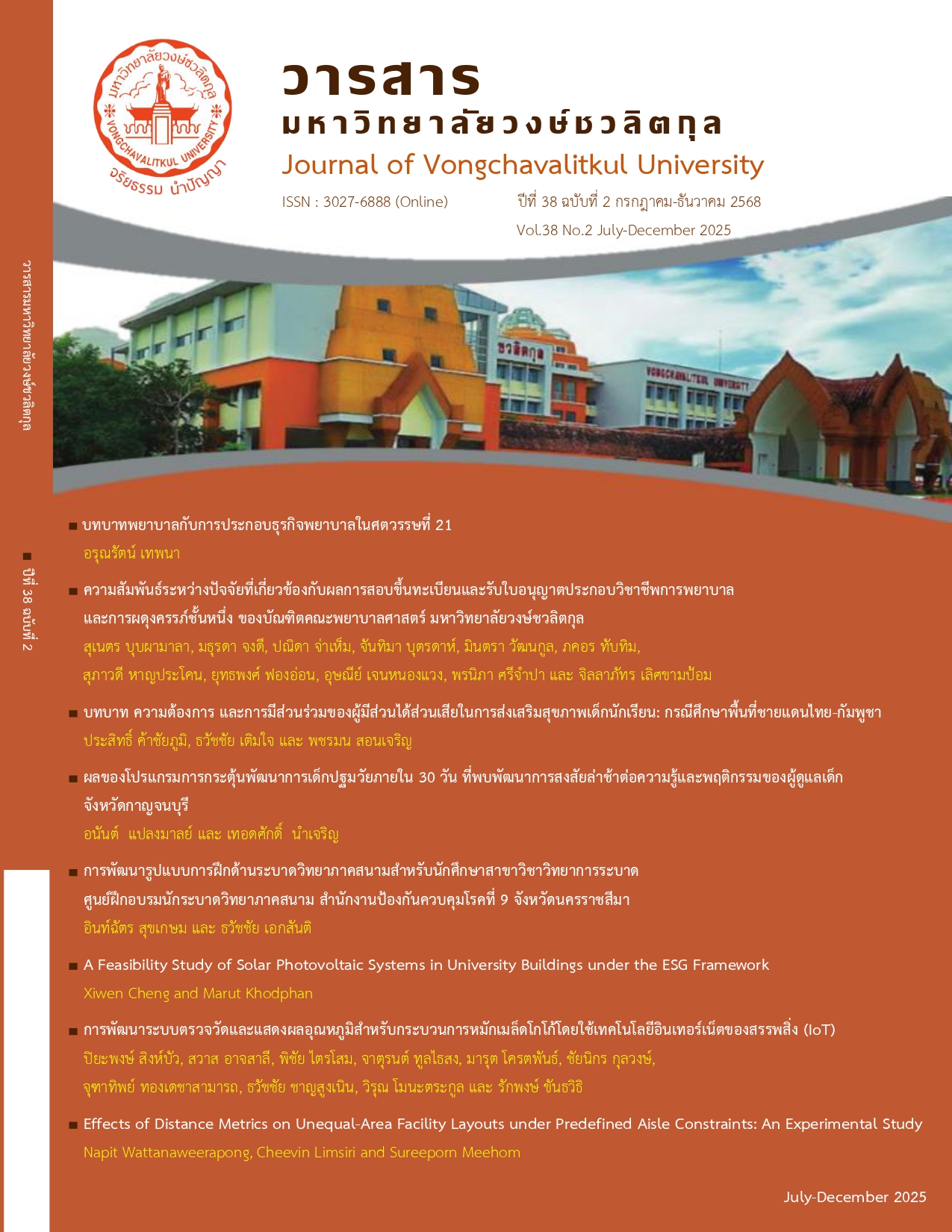
Roles, Needs, and Participation of Stakeholders in Student Health Promotion: A Case Study from Thai-Cambodian Border Communities
Article Sidebar
Main Article Content
Abstract
Objective: To examine the roles, needs, and participation approaches of stakeholders in school health promotion programs in the Thai-Cambodian border community.
Methods: A sequential explanatory mixed-methods research design was employed with 50 participants from five stakeholder groups: healthcare personnel, teachers, parents, community leaders, and Buddhist monks (10 participants per group). Data were collected through in-depth interviews and focus group discussions. Qualitative data were analyzed using thematic content analysis, while quantitative data were analyzed using descriptive statistics. Triangulation was employed for validation, and data integration followed the ACTIVE framework.
Results: Stakeholders exhibited distinct yet complementary roles. Healthcare personnel provided services and health education, requiring integrated surveillance systems (90%). Teachers managed health education and student care, requiring culturally appropriate learning materials (95%). Parents served as primary caregivers, requiring accessible health information (90%). Community leaders coordinated and mobilized resources, requiring clear structural mechanisms (85%). Buddhist monks provided spiritual guidance and raised health awareness, requiring integration of health messages into religious activities (85%). Four participation strategies emerged: (1) multi-sectoral networks at sub-district level (92%), (2) integrated communication systems (88%), (3) culturally-responsive health activities (85%), and (4) monitoring and evaluation frameworks (90%).
Conclusion: Effective school health promotion in Thai-Cambodian border communities requires integrated stakeholder participation through culturally-appropriate mechanisms. This study presents an evidence-based framework for developing sustainable health promotion interventions in similar cross-cultural border contexts.
Article Details

This work is licensed under a Creative Commons Attribution-NonCommercial-NoDerivatives 4.0 International License.
References
Antonio, C. A. T., Bermudez, A. N. C., Cochon, K. L., Reyes, M., Torres, C. D. H., Liao, S., Ortega, D. J. N., Silang, A., Uezono, D. R., Roxas, E. A., & Salamat, M. S. S. (2020). Recommendations for Intersectoral collaboration for the prevention and control of vector-borne diseases: Results from a modified Delphi process. The Journal of Infectious Diseases, 222(Suppl 8), S726-S731.
Biermann, O., Nordenstam, A., Muwonge, T., Kabiri, L., Ndeezi, G., & Alfvén, T. (2023). Sustainable preventive integrated child health care: Reflections on the importance of multidisciplinary and multisectoral stakeholder engagement. Glob Health Action, 16(1), 2173853.
Brummaier, T., Tun, N. W., Min, A. M., Gilder, M. E., Archasuksan, L., Proux, S., Kiestra, D., Charunwatthana, P., Utzinger, J., Paris, D. H., Nacher, M., Simpson, J. A., Nosten, F., & McGready, R. (2021). Burden of soil-transmitted helminth infection in pregnant refugees and migrants on the Thailand-Myanmar border: Results from a retrospective cohort. PLOS Neglected Tropical Diseases, 15(3), e0009219.
Charoensuk, L., Chedtabud, K., Chaipibool, S., Laothong, U., Suwannatrai, A., Pinlaor, S., & Prakobwong, S. (2024). Integrated One-Health approach for prevention and control of Opisthorchis viverrini infection in rural Thailand: A 3-year study. Parasitology Research, 123(7), 258.
Collins, S. E., Clifasefi, S. L., Stanton, J., The Leap Advisory, B., Straits, K. J. E., Gil-Kashiwabara, E., Rodriguez Espinosa, P., Nicasio, A. V.,
Andrasik, M. P., Hawes, S. M., Miller, K. A., Nelson, L. A., Orfaly, V. E., Duran, B. M., & Wallerstein, N. (2018). Community-based participatory research (CBPR): Towards equitable involvement of community in psychology research. American Psychologist, 73(7), 884-898.
Eichinger, M., Görig, T., Georg, S., Hoffmann, D., Sonntag, D., Philippi, H., König, J., Urschitz, M. S., & De Bock, F. (2022). Evaluation of a complex intervention to strengthen participation-centred care for children with special healthcare needs: Protocol of the stepped wedge cluster randomised PART-CHILD trial. International Journal of Environmental Research and Public Health, 19(24), 16865.
Freeman, R. E., & McVea, J. (2001). A stakeholder approach to strategic management. SSRN Electronic Journal.
Haldane, V., Chuah, F. L. H., Srivastava, A., Singh, S. R., Koh, G. C. H., Seng, C. K., & Legido-Quigley, H. (2019). Community participation in health services development, implementation, and evaluation: A systematic review of empowerment, health, community, and process outcomes. PLOS ONE, 14(5), e0216112.
Helldén, D., Sok, S., Chea, T., Nordenstedt, H., Kuruvilla, S., Alvesson, H. M., & Alfvén, T. (2023). Sustainable development goals and multisectoral collaborations for child health in Cambodia: A qualitative interview study with key child health stakeholders. BMJ Open, 13(11), e073853.
Irwin, M., Lazarevic, B., Soled, D., & Adesman, A. (2022). The COVID-19 pandemic and its potential enduring impact on children. Current Opinion in Pediatrics, 34(1), 107-115.
Jin, H., Ryu, K., Lee, D., Vonghachack, Y., Choi, M. H., Hong, S. T., & Song, H. B. (2021). Prevalence and risk factors of intestinal helminthiasis in remote mountainous villages of northern Lao PDR: A cross-sectional study. Korean Journal of Parasitology, 59(2), 131-138.
Kijsanayotin, B., Ratchatorn, A., & Suwanthaweemeesuk, K. (2024). Finding digital health governance mechanism to support the country’s health systems: Thailand case study. Oxford Open Digital Health, 2, oqac019.
Kuruvilla, S., Hinton, R., Boerma, T., Bunney, R., Casamitjana, N., Cortez, R., Fracassi, P., Franz-Vasdeki, J., Helldén, D., McManus, J., Papp, S., Rasanathan, K., Requejo, J., Silver, K. L., Tenhoope-Bender, P., Velleman, Y., Wegner, M. N., Armstrong, C. E., Barnett, S., & Group, P. M. C. S. (2018). Business not as usual: How multisectoral collaboration can promote transformative change for health and sustainable development. The British Medical Journal, 363, k4771.
Mationg, M. L. S., Williams, G. M., Tallo, V. L., Olveda, R. M., McManus, D. P., Stewart, D. E., & Gray, D. J. (2024). A review of health education activities targeting schoolchildren for the control of soil-transmitted helminthiasis in Southeast Asia, with emphasis upon the Magic Glasses approach. Advances in Parasitology, 123, 1-22.
Mitchell, R. K., Agle, B. R., & Wood, D. J. (1997). Toward a theory of stakeholder identification and salience: Defining the principle of who and what really counts. The Academy of Management Review, 22(4), 853-886.
Moodie, S., Jones, J., Chenhall, R., Williams, R., Garlett, C., Gibberd, A., O'Donnell, M., McAullay, D., McNamara, B., & Eades, S. (2024). Intersectoral collaboration for supporting the health and wellbeing of Aboriginal families and children in out-of-home care: Perspectives from Western Australian Aboriginal Community Controlled Health Organisations. Frontiers Public Health, 12, 1392208.
Moore, C. E., Nget, P., Saroeun, M., Kuong, S., Chanthou, S., Kumar, V., Bousfield, R., Nader, J., Bailey, J. W., Beeching, N. J., Day, N. P., & Parry, C. M. (2015). Intestinal parasite Infections in symptomatic children attending hospital in Siem Reap, Cambodia. PLOS ONE, 10(5), e0123719.
Pollock, A., Campbell, P., Struthers, C., Synnot, A., Nunn, J., Hill, S., Goodare, H., Morris, J., Watts, C., & Morley, R. (2019). Development of the ACTIVE framework to describe stakeholder involvement in systematic reviews. Journal of Health Services Research & Policy, 24(4), 245-255.
Sangwalee, W., Norkaew, J., Inthachak, S., Janwan, P., Rodpai, R., Sanpool, O., Sadaow, L., Boonroumkaew, P., Intapan, P. M., Maleewong, W., & Thanchomnang, T. (2022). Prevalence of intestinal parasitic infections and genetic differentiation of Strongyloides stercoralis among migrant workers from Myanmar, Lao PDR and Cambodia in northeastern Thailand. PLOS ONE, 17(12), e0279754.
Silver, Z. A., Kaliappan, S. P., Samuel, P., Venugopal, S., Kang, G., Sarkar, R., & Ajjampur, S. S. R. (2018). Geographical distribution of soil transmitted helminths and the effects of community type in South Asia and South East Asia – A systematic review. PLOS Neglected Tropical Diseases, 12(1), e0006153.
Tangcharoensathien, V., Adulyanon, S., Supaka, N., Munkong, R., Viriyathorn, S., Sirithienthong, S., Kanhachon, S., & Marten, R. (2024). The Thai Health Promotion Foundation: Two decades of joint contributions to addressing noncommunicable diseases and creating healthy populations. Global Health Science and Practice, 12(2), e2300311.
Vaughen, S., Kowalczyk, M., DeClemente, T., Ignoffo, S., Fox, K., Cheatham, J., & Volerman, A. (2024). A model of community health worker integration into schools: Community-based participatory research in action. Progress in Community Health Partnerships: Research, Education, and Action, 18(1), 91-101.
Vu, M., Nedunchezhian, S., Lancki, N., Spring, B., Brown, C. H., & Kandula, N. R. (2024). A mixed-methods, theory-driven assessment of the sustainability of a multi-sectoral preventive intervention for South Asian Americans at risk for cardiovascular disease. Implementation Science Communications, 5(1), 89.
Wattanawong, O., Iamsirithaworn, S., Kophachon, T., Nak-Ai, W., Wisetmora, A., Wongsaroj, T., Dekumyoy, P., Nithikathkul, C., Suwannatrai, A. T., & Sripa, B. (2021). Current status of helminthiases in Thailand: A cross-sectional, nationwide survey, 2019. Acta Tropica, 223, 106082.
Zhang, Y., Xie, Y. J., Yang, L., Cheung, K., Zhang, Q., Li, Y., Hao, C., Wang, H. H. X., Zhou, Q., & Leung, A. Y. M. (2024). Community-based participatory research (CBPR) approaches in vaccination promotion: A scoping review. International Journal for Equity in Health, 23(1), 227.
Zhu, X., Weigel, P., Baloh, J., Nataliansyah, M., Gunn, N., & Mueller, K. (2019). Mobilising cross-sector collaborations to improve population health in US rural communities: A qualitative study. BMJ Open, 9(11), e030983.
