การประยุกต์ใช้การเรียนรู้เชิงลึกและการประมาณค่าความหนาแน่นแบบเคอร์เนลเพื่อระบุพื้นที่วิกฤต: กรณีศึกษาการจัดการการท่องเที่ยวอย่างยั่งยืนในภาคเหนือ
คำสำคัญ:
การวิเคราะห์ความรู้สึก, BERT, การประมาณค่าความหนาแน่นแบบเคอร์เนล, ภาคเหนือของประเทศไทย, นโยบายการท่องเที่ยวอย่างยั่งยืนบทคัดย่อ
การท่องเที่ยวในภาคเหนือของไทยมีความสำคัญเชิงยุทธศาสตร์ต่อเศรษฐกิจภูมิภาค แต่การจัดการเพื่อความยั่งยืนยังคงเป็นความท้าทายสำคัญ งานวิจัยนี้มีวัตถุประสงค์เพื่อวิเคราะห์ปัจจัยความไม่พึงพอใจของนักท่องเที่ยวต่างชาติต่อแหล่งท่องเที่ยวทางธรรมชาติในภาคเหนือ โดยรวบรวมบทวิจารณ์ 8,193 บทวิจารณ์ จาก TripAdvisor (พ.ศ. 2557–2566)
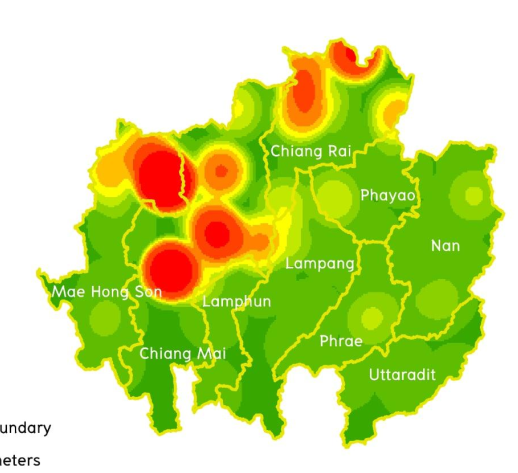
การศึกษานี้สร้างแนวทางใหม่ โดยการบูรณาการแบบจำลอง BERT-based Deep Learning เพื่อจำแนกความรู้สึกเชิงลบ ซึ่งเป็นเป้าหมายหลักของการวิเคราะห์ โดยแบบจำลองให้ค่าความแม่นยำ (Precision) สูงถึงร้อยละ 87 ในการระบุกลุ่มข้อมูลเชิงลบ จากนั้นประยุกต์ใช้การวิเคราะห์ N-Gram เพื่อจัดกลุ่มประเด็นปัญหา และเทคนิค Kernel Density Estimation (KDE) ด้วยแบนด์วิดท์ (h) 0.3 กม. เพื่อเปลี่ยนข้อมูลข้อความ (Textual data) ให้กลายเป็นพื้นผิวความหนาแน่นเชิงพื้นที่ (Density surface) ที่ระบุพิกัดวิกฤตได้อย่างแม่นยำ
ผลการศึกษาพบว่าปัจจัยหลักที่ขับเคลื่อนความไม่พึงพอใจคือ ความคุ้มค่าและราคา (Value & Pricing) โดยมีหลักฐานเชิงประจักษ์จากวลี 'not worth' (83 ครั้ง) และข้อร้องเรียนเรื่องราคาค่าเข้าชมสูง (‘300 บาท’) ซึ่งมีความสัมพันธ์เชิงพื้นที่สอดคล้องกับปัญหาด้านสิ่งแวดล้อมและการบำรุงรักษา (เช่น 'no water' และ 'dirty') โดยพื้นที่วิกฤต (Hotspots) กระจุกตัวอย่างเข้มข้นในบริเวณอุทยานแห่งชาติดอยอินทนนท์ และอำเภอปาย จังหวัดแม่ฮ่องสอน
ผลลัพธ์จากการระบุ Hotspot นี้ทำหน้าที่เป็น ข้อมูลเชิงลึกเชิงพื้นที่ (Actionable Spatial Insights) ที่ช่วยสนับสนุนหน่วยงานภาครัฐในการตัดสินใจเชิงนโยบายอย่างตรงจุด ทั้งการทบทวนโครงสร้างค่าธรรมเนียมให้สอดคล้องกับคุณค่า และการจัดการขีดความสามารถในการรองรับนักท่องเที่ยว (Carrying Capacity) ในระดับท้องถิ่นเพื่อยกระดับความยั่งยืนของการท่องเที่ยวในพื้นที่วิกฤตได้อย่างมีประสิทธิภาพ
เอกสารอ้างอิง
Alaei, A., Becken, S. & Stantic, B. (2017). Sentiment Analysis in Tourism: Capitalising on Big Data. Sage Journals. Journal of Travel Research, 8. DOI: 10.1177/0047287517747753.
Bird, S., Klein, E. and Loper, E. (2009). Natural Language Processing with Python. O'Reilly Media, Inc.
Chumwatana, T. & Chuaychoo, I. (2016). Automatic filtering non-English complaint emails in tourism industry using N-gram extraction and classification techniques. 4th International Symposium on Computational and Business Intelligence (ISCBI), September 5-7, 2016, Olten, Switzerland.
Cui, Y. & He, Q. (2019). Travel Behavior Analysis with Social Media Data and Smartphone GPS Data. Final Report. Transportation Informatics Tier I University Transportation Center, University of Buffalo, NY, USA.
Devlin, J., Chang, M. W., Lee, K. & Toutanova, K. (2018). BERT: Pre-training of Deep Bidirectional Transformers for Language Understanding. arXiv. DOI: 10.48550/arXiv.1810.04805.
Donthu, N., Kumar, S., Pandey, N., Pandey, N. & Mishra, A. (2021). Mapping the Electronic Word-of-Mouth (eWOM) research: A Systematic Review and Bibliometric Analysis. Journal of Business Research, 135, 758-773. DOI: 10.1016/j.jbusres.2021.07.015.
Esri. (2025, Dec 12). What is geocoding? 2021. Form https://desktop.arcgis.com/en/arcmap/latest/manage-data/geocoding/ what-is-geocoding.htm
Filieri, R., Alguezaui, S. & McLeay, F. (2015). Why do Travelers Trust TripAdvisor? Antecedents of Trust Towards Consumer-generated Media and its Influence on Recommendation Adoption and Word of Mouth. Tourism Management, 51. DOI: 10.1016/j.tourman.2015.05.007.
Fu, W. & Zhou, B. (2024). Theme Exploration and Sentiment Analysis of Online Reviews of Wuyishan National Park. Land, 13, 629. DOI: 10.3390/land13050629.
Hashim, R., Omar, B. & Al-Samarraie, H. (2020). The Application of Sentiment Analysis in Tourism Research: A Brief Review. Journal of Business Tourism and Applied Sciences (JBTS), 8(1), 51-60.
Henning, S., Beluch, W., Fraser, A. & Friedrich, A. (2023). A Survey of Methods for Addressing Class Imbalance in Deep-Learning Based Natural Language Processing. Proceedings of the 17th Conference of the European Chapter of the Association for Computational Linguistics, Dubrovnik, Croatia, 523-540.
Jeacle, I. & Carter, C. (2011). In TripAdvisor We Trust: Rankings, Calculative Regimes and Abstract Systems. Accounting Organizations and Society, 36(4-5), 293-309. DOI: 10.1016/j.aos.2011.04.002.
Kuhamanee, T., Talmongkol, N., Chaisuriyakul, K., San-Um, W., Pongpisuttinun, N. & Pongyupinpanich, S. (2017). Sentiment analysis of foreign tourists to Bangkok using data mining through online social network. IEEE 15th International Conference on Industrial Informatics (INDIN), Emden, Germany.
Lassen, N. B., Madsen, R. & Vatrapu, R. (2014). Predicting iPhone Sales from iPhone Tweets. IEEE 18th International Enterprise Distributed Object Computing Conference, Ulm, Germany.
Leelawat, N., Jariyapongpaiboon, S., Promjun, A., Boonyarak, S., Saengtabtim, K., Laosunthara, A., Yudha, A. K. & Tang, J. (2022). Twitter data sentiment analysis of tourism in Thailand during the COVID-19 pandemic using machine learning. Heliyon, 8(10), e10894. DOI: 10.1016/j.heliyon.2022.e10894.
Li, X., Pan, B., Law, R. & Huang, X. (2017). Forecasting Tourism Demand with Composite Search Index. Tourism Management, 59, 57-66. DOI: 10.1016/j.tourman.2016.07.005.
Lima, T. O., Colaço, M. Jr., Prado, K. H. J., Jesus, I. D. Jr. & Oliveira, F. R. (2021). A Big Data Experiment to Evaluate the Effectiveness of Traditional Machine Learning Techniques Against LSTM Neural Networks in the Hotels Clients Opinion Mining. IEEE International Conference on Big Data (Big Data), December 15-18, 2021, Orlando, FL, USA.
Lu, Z., Chen, S., Qiu, C., Lin, Y., Lu, Y. & Xu, Y. (2025). Exploring the impact of landscape environments on tourists’ emotional fluctuations in Fujian’s Coastal National Parks using machine learning. PLoS One, 20(8), e0329118. DOI: 10.1371/journal.pone.0329118.
McKinney, W., (2010). Data Structures for Statistical Computing in Python. Proceedings of the 9th Python in Science Conference (SCIPY 2010), June 28, 2010, Tacoma Convention Center | Tacoma, WA, USA.
Ministry of Tourism and Sports. (2025, Dec 12). National Tourism Development Plan No. 2 (2017-2021) 2016. Form https://secretary.mots.go.th/strategy/more_news.php?cid=9. (in Thai)
__________. (2025, Dec 12). Tourism Economic Review. Tourism Economic Report, Year 1, Issue 3/2020 2020. Form https://www.mots.go.th/more_news_new.php?cid=605. (in Thai)
__________. (2025, Dec 12). Development Strategy. National Tourism Development Plan No. 3 (2023-2027) 2023. Form https://anyflip.com/zzfck/kiel. (in Thai)
__________. (2025, Dec 12). Survey Project for Analysis of International Tourist Behavior 2024. Final Report. Form https://intelligencecenter.tat.or.th/articles/35286. (in Thai)
__________. (2025, Dec 12). Tourism Economic Review. Tourism Economic Report, Year 2, Issue 1/2021. Form https://www.mots.go.th/news/category/708. (in Thai)
Mission, R. S. (2024). Spatial Analysis Leveraging Geographic Information System and Kernel Density Estimation for Crime Prediction. Journal of Innovative Technology Convergence, 6(1), 95-104. DOI: 10.69478/JITC2024v6n2a10.
Muthukadan, B., (2025, Dec 12). Selenium Python Bindings 2024. Form https://selenium-python.readthedocs.io/
Pérez, J. M., Rajngewerc, M., Giudici, J. C., Furman, D. A., Luque, F., Alemany, L. A. & Martinez, M. V. (2024). pysentimiento: A Python Toolkit for Opinion Mining and Social NLP tasks. arXiv. DOI: 10.48550/arXiv.2106.09462.
Phithakkitnukoon, S. (2023). Analysis of Tourist Behavior Using Mobile Phone GPS Data. In: Urban Informatics Using Mobile Network Data. Springer Nature, 183-214.
Pleerux, N., Boonpook, W., Chaiyo, A. and Nardkulpat, A., (2023). Trip Advisor Restaurant Customer Reviews Analysis in Bangkok, Thailand. International Conference on Cyber Management and Engineering (CyMaEn), Jan 26-27, 2023, Bangkok, Thailand.
Prabha, M. I. & Srikanth, G. U. (2021). Survey of Sentiment Analysis Using Deep Learning Techniques. 1st International Conference on Innovations in Information and Communication Technology (ICIICT), April 25-26, 2019, Chennai, India.
Ramadhani, A., Sutoyo, E. & Widartha, V. P. (2021). LSTM-based Deep Learning Architecture of Tourist Review in Tripadvisor. Sixth International Conference on Informatics and Computing (ICIC), November 3-4, 2021, Jakarta, Indonesia.
Richardson, L. (2025, Dec 12). Beautiful Soup 2004. Form https://www.crummy.com/software/BeautifulSoup/.
Rogel-Salazar, J. (2025, Dec 12). Density-Based Clustering 2022. Form https://domino.ai/data-science-dictionary/density-based-clustering.
Rossum, G., van. (1995). Python tutorial. Department of Computer Science, College of Western Idaho, USA.
Sarker, I. H. (2021). Deep Learning: A Comprehensive Overview on Techniques, Taxonomy, Applications and Research Directions. Springer Nature Link, Computer Science, 2, 420. DOI: 10.1007/s42979-021-00815-1.
Secretariat of Cabinet, the. (2025, Dec 12). National Tourism Development Plan 2012-2016 2011. Form https://www.ratchakitcha.soc.go.th/DATA/PDF/2554/E/067/14.PDF. (in Thai)
Thongsawang, S. (2021). GUIDELINES FOR PROMOTING THAILAND TOURISM FOR CHINESE TOURISTS IN THE CHONBURI PROVINCE. Journal of Social Science and Buddhistic Anthropology, 6(8). 307-324. (in Thai)
Tokarchuk, O., Gabriele, R. & Maurer, O. (2021). Estimating tourism social carrying capacity. Annals of Tourism Research, 86, 102971. DOI: 10.1016/j.annals.2020.102971.
Valdivia, A., Luzón, M. V. & Herrera, F. (2017). Sentiment Analysis on TripAdvisor: Are There Inconsistencies in User Reviews? In: Martínez de Pisón, F., Urraca, R., Quintián, H., Corchado, E. (eds). Hybrid Artificial Intelligence Systems. HAIS, Lecture Notes in Computer Science, 10334, 15-25.
Wu et al. (2024). Stratified random sampling for neural network test input selection. Information and Software Technology, 165, 107331. DOI: 10.1016/j.infsof.2023.107331
Yuan, X. (2024). Evaluation of Rural Tourism Development Level using BERT-enhanced Deep Learning Model and BP Algorithm. Scientific Reports, 14, 25748. DOI: 10.1038/s41598-024-77444-0.