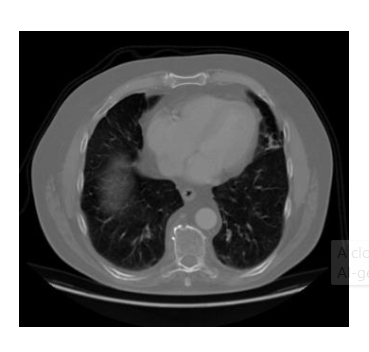
การทำนายมะเร็งปอดจากภาพ CT scan โดยใช้ Convolutional Neural Network
คำสำคัญ:
มะเร็งปอด, เอกซเรย์คอมพิวเตอร์, การเรียนรู้ของเครื่อง, โครงข่ายประสาทเทียมแบบคอนโวลูชัน, เทคนิคการรวมแบบจำลองบทคัดย่อ
มะเร็งปอดเป็นโรคที่มีความรุนแรงและเป็นสาเหตุสำคัญของการเสียชีวิตทั้งในประเทศไทยและต่างประเทศ การตรวจพบโรคตั้งแต่ระยะเริ่มต้นมีความสำคัญอย่างยิ่ง เนื่องจากสามารถเพิ่มโอกาสในการรักษาและลดอัตราการเสียชีวิตได้อย่างมีนัยสำคัญ งานวิจัยนี้มีวัตถุประสงค์เพื่อศึกษา จัดเตรียมข้อมูลที่เหมาะสม และพัฒนาแบบจำลองโครงข่ายประสาทเทียมแบบคอนโวลูชัน (CNN) สำหรับการทำนายมะเร็งปอดโดยใช้เทคนิคการเรียนรู้เชิงลึก โดยใช้ชุดข้อมูล Chest CT-Scan Images Dataset จากเว็บไซต์ Kaggle ซึ่งประกอบด้วยข้อมูลภาพ CT scan มะเร็งปอดที่ไม่ใช่ชนิดเซลล์เล็ก จำนวนทั้งหมด 1,000 ภาพ แบ่งออกเป็น 4 คลาส ได้แก่ มะเร็งอะดีโนคาร์ซิโนมา, มะเร็งสความัสเซลล์, มะเร็งชนิดเซลล์ใหญ่ และปอดปกติ
งานวิจัยนี้ได้เปรียบเทียบประสิทธิภาพของแบบจำลอง 4 แบบ ได้แก่ ResNet50, VGG16, InceptionV3 และ DenseNet121 จากนั้นนำผลลัพธ์ของแต่ละแบบจำลองมาผสานด้วยวิธี Stacking Ensemble โดยใช้เทคนิคการเรียนรู้ของเครื่องเป็นแบบจำลองเมตา 5 แบบ ได้แก่ Random Forest, Logistic Regression, Support Vector Machine, K-Nearest Neighbors และ Naive Bayes ผลการทดลองแสดงให้เห็นว่าแบบจำลองที่รวมผลลัพธ์โดยใช้ Random Forest มีความแม่นยำสูงสุดที่ร้อยละ 98.73 ซึ่งสูงกว่าแบบจำลองเดี่ยวทั้งหมด
เอกสารอ้างอิง
Alowais, S. A., Alghamdi, S. S., Alsuhebany, N., Alqahtani, T., Alshaya, A. I., Almohareb, S. N., ... & Albekairy, A. M. (2023). Revolutionizing healthcare: The role of artificial intelligence in clinical image analysis. BMC Medical Education. from https://doi.org/10.1186/s12909-023-04698-z.
American Cancer Society. (2024, 12 September). What is lung cancer?. From https://www.cancer.org/cancer/lung-cancer/about/what-is.html.
Aziz Taha, Abdel. (2015). Metrics for evaluating 3D medical image segmentation: Analysis, selection, and tool. BMC Medical Imaging, 15(29), 1–28. from https://doi.org/10.1186/s12880-015-0068-x.
BNH Hospital. (2024, 10 September). How are X-ray and CT scan for lung cancer screening different? Which is better & is it true that frequent scans pose a cancer risk?. From https://www.bnhhospital.com/th/. (in Thai)
Department of Medical Services. (2024, 10 September). Headline: National Cancer Institute recommends avoiding lung cancer risk factors. From https://www.dms.go.th/Content/Select_Landding_page?contentId=47994. (in Thai)
Friedman, J., Hastie, T., & Tibshirani, R. (2020). The elements of statistical learning: Data mining, inference, and prediction (2nd ed.). Springer.
Ferdous, M. J., & Shahriyar, R. (2024). An ensemble convolutional neural network model for brain stroke prediction using brain computed tomography images. Healthcare Analytics, 6, Article 100368. From https://doi.org/10.1016/j.health.2024.100368.
Google Developers. (2025, 5 May). Classification: Accuracy, recall, precision, and related metrics. from https://developers.google.com/machine-learning/crash-course/classification/accuracy-precision-recall?hl=th.
Hany, M. (2024, 10 September). Chest CT-scan images dataset [Dataset]. Kaggle. From https://www.kaggle.com/datasets/mohamedhanyyy/chest-ctscan-images.
He, K., Zhang, X., Ren, S., & Sun, J. (2016). Deep residual learning for image recognition. In Proceedings of the IEEE Conference on Computer Vision and Pattern Recognition (CVPR) (pp. 770–778). From https://doi.org/10.1109/CVPR.2016.90.
Huang, G., Liu, Z., Van Der Maaten, L., & Weinberger, K. Q. (2017). Densely connected convolutional networks. In Proceedings of the IEEE Conference on Computer Vision and Pattern Recognition (CVPR) (pp. 4700–4708). from https://doi.org/10.1109/CVPR.2017.243.
IBM. (2025, 5 May). Support vector machine, random forest, naive Bayes, and k-nearest neighbors. From https://www.ibm.com/think/topics/.
Islam, M. R., & Nahiduzzaman, M. (2022). Complex features extraction with deep learning model for the detection of COVID-19 from CT scan images using ensemble based machine learning approach. Expert Systems with Applications, 195, 116554. from https://doi.org/10.1016/j.eswa.2022.116554.
Khan, I. I., & Fattah, H. M. A. (2022). An ensemble technique of CNN for lung cancer identification. International Journal of Engineering Research and Management, 9(11), 7–11. From https://www.ijerm.com/download_data/IJERM0911003.pdf.
Li, X., Zhang, Y., Chen, Z., & Wang, H. (2025). FPA-based weighted average ensemble of deep learning models for classification of lung cancer using CT scan images (Scientific Reports). Advance online publication. from https://doi.org/10.1038/s41598-025-02015-w.
Lanjewar, M. G., Panchbhai, K. G., & Charanarur, P. (2023). Lung cancer detection from CT scans using modified DenseNet with feature selection methods and ML classifiers. Expert Systems with Applications, 224, 119961. from https://doi.org/10.1016/j.eswa.2023.119961.
Mamun, M., Mahmud, M. I., Meherin, M., & Abdelgawad, A. (2023). LCDctCNN: Lung cancer diagnosis of CT scan images using CNN based model. arXiv. from https://doi.org/10.48550/arXiv.2304.04814.
Mamun, S., Patil, A., & Gite, S. (2023). Lung cancer detection from CT scans using modified DenseNet with feature selection methods and machine learning classifiers. Expert Systems with Applications. From https://doi.org/10.1016/j.eswa.2023.119961.
National Cancer Institute. (2021, 24 May). Lung cancer screening (PDQ®) – Patient version. U.S. Department of Health and Human Services, National Institutes of Health. From https://www.cancer.gov/types/lung/patient/lung-screening-pdq.
Opitz, J., & Burst, S. (2019). Macro F1 and macro F1. arXiv preprint arXiv:1911.03347. From https://doi.org/10.48550/arXiv.1911.03347.
Perez, L., & Wang, J. (2017). The effectiveness of data augmentation in image classification using deep learning. arXiv preprint arXiv:1712.04621.
Powers, D. M. W. (2011). Evaluation: From precision, recall and F-measure to ROC, informedness, markedness & correlation. Journal of Machine Learning Technologies, 2(1), 37–63.
Rana, D. J., & Rana, K. (2025). SEMLCC: A stacked ensemble model with transfer learning for high-accuracy lung cancer classification from CT images. Procedia Computer Science, 258(C), 2584–2596. From https://doi.org/10.1016/j.procs.2025.04.520.
Raza, R., Zulfiqar, F., Khan, M. O., Arif, M., Alvi, A., Iftikhar, M. A., & Alam, T. (2024). Lung-EffNet: Lung cancer classification using EfficientNet from CT-scan images. Engineering Applications of Artificial Intelligence, 130, 105086. from https://doi.org/10.1016/j.engappai.2023.106902.
Reddy, S. R. B. R., Sen, S., Bhatt, R., Dhanetwal, M. L., Sharma, M., & Naaz, R. (2024). Stacked neural nets for increased accuracy on classification on lung cancer. Biomedical Signal Processing and Control, 90, 105491. from https://doi.org/10.1016/j.measen.2024.101052.
Shorten, C., & Khoshgoftaar, T. M. (2019). A survey on image data augmentation for deep learning. Journal of Big Data, 6(1), 60.
Simonyan, K., & Zisserman, A. (2015). Very deep convolutional networks for large-scale image recognition. International Conference on Learning Representations (ICLR). from https://arxiv.org/abs/1409.1556.
Swain, A. K., Swetapadma, A., Rout, J. K., & Balabantaray, B. K. (2024). Classification of non-small cell lung cancer types using sparse deep neural network features. Biomedical Signal Processing and Control, 87, Article 105485. from https://doi.org/10.1016/j.bspc.2023.105485.
Shaikh, A., Amin, S., Zeb, M. A., Sulaiman, A., & Al Reshan, M. S. (2025). Computers in Biology and Medicine. Advance online publication. From https://doi.org/10.1016/j.compbiomed.2025.109703.
Szegedy, C., Vanhoucke, V., Ioffe, S., Shlens, J., & Wojna, Z. (2016). Rethinking the inception architecture for computer vision. In Proceedings of the IEEE Conference on Computer Vision and Pattern Recognition (CVPR) (pp. 2818–2826). from https://doi.org/10.1109/CVPR.2016.308.
Tawfik, N., et al. (2024). Enhancing early detection of lung cancer through advanced image processing techniques and deep learning architectures for CT scans. Computational Materials and Continua, 81(1), 271–307.
Thai Health Promotion Foundation. (2024, 10 September). Lung cancer: A risk that is close to you. From https://www.thaihealth.or.th/. (in Thai)
World Health Organization. (2024, 10 September). Cancer. From https://www.who.int/news-room/fact-sheets/detail/cancer.
Wolpert, D. H. (1992). Stacked generalization. Neural Networks, 5(2), 241-259. From https://doi.org/10.1016/S0893-6080(05)80023-1.