Integration of GIS and "Home-Temple-School/Government" (BOWON) Wisdom for Sustainable Local Flora Conservation: A Case Study of Nam Bo Luang Subdistrict, San Pa Tong District, Chiang Mai Province
Keywords:
Geographic Information Systems (GIS), BOWON wisdom, Local flora species, Apatial innovation, Sustainable conservationAbstract
This research aimed to: (1) apply Geographic Information Systems (GIS) to survey and develop a local plant species database in Nam Bo Luang Subdistrict, San Pa Tong District, Chiang Mai Province; (2) document the BOWON (Home–Temple–School/Government) wisdom framework based on community participation for local plant conservation; and (3) synthesize a knowledge framework for the sustainable conservation of local plant species. A mixed-methods approach was employed, combining GIS-based spatial data collection, field surveys, interviews with local sages, monks, teachers, and government representatives, and focus group discussions to validate data and synthesize knowledge.
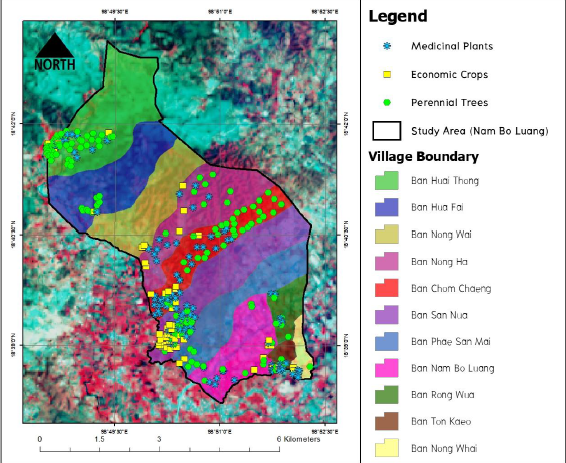
The findings revealed that GIS effectively supported the development of a comprehensive database and spatial distribution maps of local plant species, including perennial plants, medicinal plants, and economic crops. The study further found that sustainable conservation practices were driven by the integration of roles among homes, temples, schools, and government agencies through the transmission of indigenous knowledge, the building of environmental awareness, educational activities, and institutional support. Furthermore, the findings led to the development of the Model, consisting of four key components: (1) local plant resource conservation and management, (2) local wisdom transmission, (3) cultural and spiritual conservation awareness, and (4) collaborative networks and institutional support. GIS functions as an enabling tool for spatial data management and decision-making within the model.
References
Boripis, T., Pathak, S., Poungjinda, W., & Ling, J. C. Y. (2024). Community participation process for the sustainable business development of local wisdom learning centers. Journal of Human, Earth, and Future, 5(4), 660.
Burrough, P.A., & McDonnell, R.A. (1998). Principles of Geographical Information Systems. Oxford: Oxford University Press.
Chuanphetkaew, W. (2004). Folk wisdom and sustainable development. Bangkok: Odeon Store. (in Thai)
Cohen, J.M., & Uphoff, N.T. (1980). Participation’s Place in Rural Development: Seeking Clarity through Specificity. World Development, 8, 213.
Department of National Parks, Wildlife and Plant Conservation. (2021). Report on the situation of forest resources and plant species of Thailand for the year 2021. Bangkok: Ministry of Natural Resources and Environment. (in Thai)
Duangkrayom, J., Jintasakul, P., Songtham, W., Kruainok, P., Naksri, W., Thongdee, N., ... & Meepoka, R. (2022). Geodiversity in Khorat Geopark, Thailand: Approaches to geoconservation and sustainable development. International Journal of Geoheritage and Parks, 10(4), 569.
Duker, P., & Klanarongchaob, S. (2022). Community-based conservation of the Ngao River in Thailand: A networked story of success. Society & Natural Resources, 35(12), 1315.
Environmental Monitoring and Evaluation Group. (2022). Report on environmental situations and impacts from climate change for the year 2022. Bangkok: Office of Natural Resources and Environmental Policy and Planning. (in Thai)
Geo-Informatics and Space Technology Development Agency. (2009). Geographic information systems for environmental management. Bangkok: GISTDA. (in Thai)
Khemphet, S. (2021). The Reconciliation Promoting Model for Thai Youth By BOWAN: Home Monastery School. Journal of MCU Buddhapanya Review, 6(2), 1. (in Thai)
Nawin, S. (2020). The Existence of Local Wisdoms in the Globalization Era. Journal of SaengKhomKham Buddhist Studies, 5(2), 313.
Nonaka, I., & Takeuchi, H. (1995). The Knowledge-Creating Company. Oxford: Oxford University Press.
Norkum Ai, P., Inta, A., Sommano, S. R., Phinyo, K., Duangjan, K., & Tangpao, T. (2025). Exploring traditional knowledge and potential uses of local freshwater algae and aquatic plants in Thai wetland communities. Diversity, 17(1), 63.
Office of the Royal Development Projects Board. (2021). The master plan of the Plant Genetic Conservation Project under the Royal Initiative of Her Royal Highness Princess Maha Chakri Sirindhorn (RSPG), the seventh five-year period (October 2021–September 2026). Bangkok: Office of the Royal Development Projects Board. (in Thai)
Pancharoen, N., Chara, P., Nithisiriwaritkun, W., & Chaisam-Ang, S. (2025). Participatory knowledge management to enhance local wisdom based on cultural capital and resources on the Thai-Cambodian border, Surin. Asia Social Issues, 18(1), e268121.
Pongsermpol, C., & Chukaew, P. (2022). Traditional Thai community conservation focusing on sustainable participatory process: A case study of Talaad Lang Community, Chumphon Province, Thailand. Civil Engineering and Architecture, 10(3), 816.
Puengsom, S., Ratchavieng, A., Chooprai, N., & Tantisattayanon, N. (2025). The application of geographic information systems (GIS) for conservative local plant database development. ASEAN Journal of Scientific and Technological Reports, 28(5), e258063.
Wiyasingh, P., Nanhongbau, W., & Sa-ard-iam, T. (2022). The Bawon’s Sovereignty with the Building a Strong Community through the Kealmor’s Dimension of the Kui People in Si Suk District, Samrong Thap District, Surin Province. Journal of Spatial Innovation for Development, 4(1), 39. (in Thai)
Raymond, C. M., Fazey, I., Reed, M. S., Stringer, L. C., Robinson, G. M., & Evely, A. C. (2010). Integrating local and scientific knowledge for environmental management. Journal of Environmental Management, 91(8), 1766.
Simon, K., Diprose, G., & Thomas, A. C. (2020). Community-led initiatives for climate adaptation and mitigation. Kōtuitui: New Zealand Journal of Social Sciences Online, 15(1), 93.
Srinurak, N., Wonglangka, W., & Sukwai, J. (2024). Smart urban forest initiative: Nature-based solution and people-centered approach for tree management in Chiang Mai, Thailand. Sustainability, 16(24), 11078.
Strauss, A., & Corbin, J. M. (1990). Basics of qualitative research: Grounded theory procedures and techniques. Thousand Oaks: SAGE Publications, Inc.