Deep Learning and Kernel Density Estimation for Critical Area Identification: A Sustainable Tourism Management Case Study in Northern Thailand
Keywords:
Sentiment Analysis, BERT, Kernel Density Estimation (KDE), Northern Thailand, Sustainable Tourism PolicyAbstract
Tourism in Northern Thailand is a strategic pillar of the regional economy, yet managing its sustainability remains a critical challenge. This research aims to analyze the factors driving dissatisfaction among international tourists toward natural attractions in Northern Thailand. A dataset of 8,193 reviews was collected from TripAdvisor, spanning a ten-year period from 2014 to 2023.
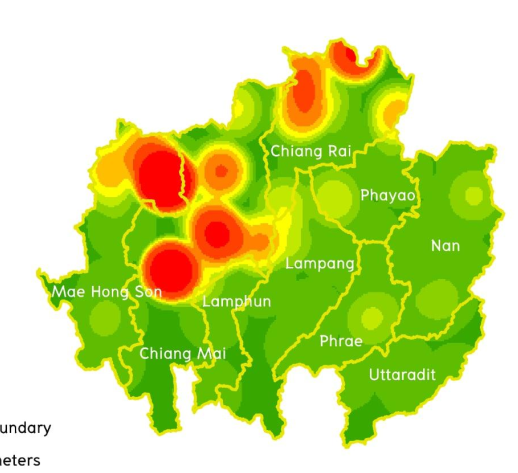
This study presents an academic contribution by integrating a BERT-based Deep Learning model to classify negative sentiments—the primary focus of this analysis. The model achieved a high precision of 87% in identifying negative class data. Subsequently, N-Gram Analysis was employed for issue clustering, and Kernel Density Estimation (KDE) with a bandwidth (h) of 0.3 km was applied to transform textual data into a continuous spatial density surface, enabling the precise identification of dissatisfaction hotspots.
The findings reveal that the primary driver of dissatisfaction is Value & Pricing, evidenced by the prevalence of the phrase 'not worth' (83 mentions) and specific complaints regarding high entry fees (e.g., '300 baht'). These issues are spatially correlated with environmental and maintenance concerns (e.g., 'no water' and 'dirty'). Negative hotspots are intensely concentrated in key locations, notably Doi Inthanon National Park and Pai District in Mae Hong Son Province.
The results provide actionable spatial insights to support government agencies in targeted policymaking. By identifying these crisis zones, the study facilitates informed decisions on revising entry fee structures and managing tourist carrying capacity within hotspots to enhance the long-term sustainability of Northern Thailand's natural tourism.
References
Alaei, A., Becken, S. & Stantic, B. (2017). Sentiment Analysis in Tourism: Capitalising on Big Data. Sage Journals. Journal of Travel Research, 8. DOI: 10.1177/0047287517747753.
Bird, S., Klein, E. and Loper, E. (2009). Natural Language Processing with Python. O'Reilly Media, Inc.
Chumwatana, T. & Chuaychoo, I. (2016). Automatic filtering non-English complaint emails in tourism industry using N-gram extraction and classification techniques. 4th International Symposium on Computational and Business Intelligence (ISCBI), September 5-7, 2016, Olten, Switzerland.
Cui, Y. & He, Q. (2019). Travel Behavior Analysis with Social Media Data and Smartphone GPS Data. Final Report. Transportation Informatics Tier I University Transportation Center, University of Buffalo, NY, USA.
Devlin, J., Chang, M. W., Lee, K. & Toutanova, K. (2018). BERT: Pre-training of Deep Bidirectional Transformers for Language Understanding. arXiv. DOI: 10.48550/arXiv.1810.04805.
Donthu, N., Kumar, S., Pandey, N., Pandey, N. & Mishra, A. (2021). Mapping the Electronic Word-of-Mouth (eWOM) research: A Systematic Review and Bibliometric Analysis. Journal of Business Research, 135, 758-773. DOI: 10.1016/j.jbusres.2021.07.015.
Esri. (2025, Dec 12). What is geocoding? 2021. Form https://desktop.arcgis.com/en/arcmap/latest/manage-data/geocoding/ what-is-geocoding.htm
Filieri, R., Alguezaui, S. & McLeay, F. (2015). Why do Travelers Trust TripAdvisor? Antecedents of Trust Towards Consumer-generated Media and its Influence on Recommendation Adoption and Word of Mouth. Tourism Management, 51. DOI: 10.1016/j.tourman.2015.05.007.
Fu, W. & Zhou, B. (2024). Theme Exploration and Sentiment Analysis of Online Reviews of Wuyishan National Park. Land, 13, 629. DOI: 10.3390/land13050629.
Hashim, R., Omar, B. & Al-Samarraie, H. (2020). The Application of Sentiment Analysis in Tourism Research: A Brief Review. Journal of Business Tourism and Applied Sciences (JBTS), 8(1), 51-60.
Henning, S., Beluch, W., Fraser, A. & Friedrich, A. (2023). A Survey of Methods for Addressing Class Imbalance in Deep-Learning Based Natural Language Processing. Proceedings of the 17th Conference of the European Chapter of the Association for Computational Linguistics, Dubrovnik, Croatia, 523-540.
Jeacle, I. & Carter, C. (2011). In TripAdvisor We Trust: Rankings, Calculative Regimes and Abstract Systems. Accounting Organizations and Society, 36(4-5), 293-309. DOI: 10.1016/j.aos.2011.04.002.
Kuhamanee, T., Talmongkol, N., Chaisuriyakul, K., San-Um, W., Pongpisuttinun, N. & Pongyupinpanich, S. (2017). Sentiment analysis of foreign tourists to Bangkok using data mining through online social network. IEEE 15th International Conference on Industrial Informatics (INDIN), Emden, Germany.
Lassen, N. B., Madsen, R. & Vatrapu, R. (2014). Predicting iPhone Sales from iPhone Tweets. IEEE 18th International Enterprise Distributed Object Computing Conference, Ulm, Germany.
Leelawat, N., Jariyapongpaiboon, S., Promjun, A., Boonyarak, S., Saengtabtim, K., Laosunthara, A., Yudha, A. K. & Tang, J. (2022). Twitter data sentiment analysis of tourism in Thailand during the COVID-19 pandemic using machine learning. Heliyon, 8(10), e10894. DOI: 10.1016/j.heliyon.2022.e10894.
Li, X., Pan, B., Law, R. & Huang, X. (2017). Forecasting Tourism Demand with Composite Search Index. Tourism Management, 59, 57-66. DOI: 10.1016/j.tourman.2016.07.005.
Lima, T. O., Colaço, M. Jr., Prado, K. H. J., Jesus, I. D. Jr. & Oliveira, F. R. (2021). A Big Data Experiment to Evaluate the Effectiveness of Traditional Machine Learning Techniques Against LSTM Neural Networks in the Hotels Clients Opinion Mining. IEEE International Conference on Big Data (Big Data), December 15-18, 2021, Orlando, FL, USA.
Lu, Z., Chen, S., Qiu, C., Lin, Y., Lu, Y. & Xu, Y. (2025). Exploring the impact of landscape environments on tourists’ emotional fluctuations in Fujian’s Coastal National Parks using machine learning. PLoS One, 20(8), e0329118. DOI: 10.1371/journal.pone.0329118.
McKinney, W., (2010). Data Structures for Statistical Computing in Python. Proceedings of the 9th Python in Science Conference (SCIPY 2010), June 28, 2010, Tacoma Convention Center | Tacoma, WA, USA.
Ministry of Tourism and Sports. (2025, Dec 12). National Tourism Development Plan No. 2 (2017-2021) 2016. Form https://secretary.mots.go.th/strategy/more_news.php?cid=9. (in Thai)
__________. (2025, Dec 12). Tourism Economic Review. Tourism Economic Report, Year 1, Issue 3/2020 2020. Form https://www.mots.go.th/more_news_new.php?cid=605. (in Thai)
__________. (2025, Dec 12). Development Strategy. National Tourism Development Plan No. 3 (2023-2027) 2023. Form https://anyflip.com/zzfck/kiel. (in Thai)
__________. (2025, Dec 12). Survey Project for Analysis of International Tourist Behavior 2024. Final Report. Form https://intelligencecenter.tat.or.th/articles/35286. (in Thai)
__________. (2025, Dec 12). Tourism Economic Review. Tourism Economic Report, Year 2, Issue 1/2021. Form https://www.mots.go.th/news/category/708. (in Thai)
Mission, R. S. (2024). Spatial Analysis Leveraging Geographic Information System and Kernel Density Estimation for Crime Prediction. Journal of Innovative Technology Convergence, 6(1), 95-104. DOI: 10.69478/JITC2024v6n2a10.
Muthukadan, B., (2025, Dec 12). Selenium Python Bindings 2024. Form https://selenium-python.readthedocs.io/
Pérez, J. M., Rajngewerc, M., Giudici, J. C., Furman, D. A., Luque, F., Alemany, L. A. & Martinez, M. V. (2024). pysentimiento: A Python Toolkit for Opinion Mining and Social NLP tasks. arXiv. DOI: 10.48550/arXiv.2106.09462.
Phithakkitnukoon, S. (2023). Analysis of Tourist Behavior Using Mobile Phone GPS Data. In: Urban Informatics Using Mobile Network Data. Springer Nature, 183-214.
Pleerux, N., Boonpook, W., Chaiyo, A. and Nardkulpat, A., (2023). Trip Advisor Restaurant Customer Reviews Analysis in Bangkok, Thailand. International Conference on Cyber Management and Engineering (CyMaEn), Jan 26-27, 2023, Bangkok, Thailand.
Prabha, M. I. & Srikanth, G. U. (2021). Survey of Sentiment Analysis Using Deep Learning Techniques. 1st International Conference on Innovations in Information and Communication Technology (ICIICT), April 25-26, 2019, Chennai, India.
Ramadhani, A., Sutoyo, E. & Widartha, V. P. (2021). LSTM-based Deep Learning Architecture of Tourist Review in Tripadvisor. Sixth International Conference on Informatics and Computing (ICIC), November 3-4, 2021, Jakarta, Indonesia.
Richardson, L. (2025, Dec 12). Beautiful Soup 2004. Form https://www.crummy.com/software/BeautifulSoup/.
Rogel-Salazar, J. (2025, Dec 12). Density-Based Clustering 2022. Form https://domino.ai/data-science-dictionary/density-based-clustering.
Rossum, G., van. (1995). Python tutorial. Department of Computer Science, College of Western Idaho, USA.
Sarker, I. H. (2021). Deep Learning: A Comprehensive Overview on Techniques, Taxonomy, Applications and Research Directions. Springer Nature Link, Computer Science, 2, 420. DOI: 10.1007/s42979-021-00815-1.
Secretariat of Cabinet, the. (2025, Dec 12). National Tourism Development Plan 2012-2016 2011. Form https://www.ratchakitcha.soc.go.th/DATA/PDF/2554/E/067/14.PDF. (in Thai)
Thongsawang, S. (2021). GUIDELINES FOR PROMOTING THAILAND TOURISM FOR CHINESE TOURISTS IN THE CHONBURI PROVINCE. Journal of Social Science and Buddhistic Anthropology, 6(8). 307-324. (in Thai)
Tokarchuk, O., Gabriele, R. & Maurer, O. (2021). Estimating tourism social carrying capacity. Annals of Tourism Research, 86, 102971. DOI: 10.1016/j.annals.2020.102971.
Valdivia, A., Luzón, M. V. & Herrera, F. (2017). Sentiment Analysis on TripAdvisor: Are There Inconsistencies in User Reviews? In: Martínez de Pisón, F., Urraca, R., Quintián, H., Corchado, E. (eds). Hybrid Artificial Intelligence Systems. HAIS, Lecture Notes in Computer Science, 10334, 15-25.
Wu et al. (2024). Stratified random sampling for neural network test input selection. Information and Software Technology, 165, 107331. DOI: 10.1016/j.infsof.2023.107331
Yuan, X. (2024). Evaluation of Rural Tourism Development Level using BERT-enhanced Deep Learning Model and BP Algorithm. Scientific Reports, 14, 25748. DOI: 10.1038/s41598-024-77444-0.