Assessment to Determine Urgent Plan Priorities Project to Reduce Greenhouse Gases in Phayao Province
Keywords:
City carbon footprint, Greenhouse gas emissions, Phayao provinceAbstract
This study aimed to assess provincial-level greenhouse gas (GHG) emissions in Phayao Province. The 2019 GHG inventory was conducted at two reporting levels: Basic and Basic+. At the Basic level, total emissions were approximately 667,981 tons of carbon dioxide equivalent (tCO2e) or about 1.41 tCO2e per capita. At the more comprehensive Basic+ level, which involves more detailed and extensive data collection, total emissions reached 5,093,153 tCO2e, equivalent to approximately 10.78 tCO2e per capita, calculated based on the registered population of 472,356 in 2019 (Department of Provincial Administration, 2019). The main source of emissions in Phayao Province was the Agriculture, Forestry, and Other Land Use (AFOLU) sector, accounting for 86.82% of total emissions, followed by the waste management, energy, and transportation sectors, while no emissions from the industrial processes sector were reported in that year.
As most provincial GHG emissions were generated from land use and agricultural activities, Phayao Province developed a GHG reduction plan comprising 26 measures covering the energy, transportation, agriculture, and forestry sectors, with a target to reduce emissions by 422,380 tCO2e by 2030. The implementation framework is divided into three phases: short-term measures focusing on low-cost and immediately actionable actions, such as replacing public lighting with LED bulbs and promoting energy conservation campaigns; medium-term measures emphasizing infrastructure investment and development, including solar rooftop installations, improved waste and wastewater management systems, and expansion of green areas; and long-term measures aiming at structural transformation, such as the development of clean energy public transportation systems and full-scale renewable energy utilization. The plan places particular emphasis on the agricultural sector by promoting safe and low-carbon agriculture under the Bio-Circular-Green (BCG) Economy model through reducing chemical use, strengthening farmers’ capacity, applying innovation and appropriate technologies, and establishing local cooperation networks, together with continuous monitoring and evaluation to ensure effective and tangible outcomes.
References
Department of Provincial Administration. (2019). Population statistics from the civil registration system, Phayao Province. Ministry of Interior, Thailand. (in Thai)
Phayao Provincial Office of Natural Resources and Environment. (2024). Project on Capacity Development of the Provincial Office of Natural Resources and Environment for the Enhancement of Provincial-Level Climate Change Action Planning: Phayao Province. (in Thai)
Phayao Provincial Livestock Office.(2022). Livestock by District: 2020. Form
https://phayao.nso.go.th/images/ebook/PhayaoProvincialStatisticalReport_2022.pdf. (in Thai)
Phayao District Agricultural Office. (2019). Rice cultivation statistics in Phayao Province. Office of Agricultural Economics, Thailand. (in Thai)
Thailand Greenhouse Gas Management Organization. (2016). Guidelines for Assessing the Carbon Footprint of City (2nd Ed). January 2, 2020. Form http://conference.tgo.or.th/download/tgo_or_th/ccf/TGO_CCF_Ebook_V.Sep2559.pdf. (in Thai)
Thailand Greenhouse Gas Management Organization (Public Organization). (2019). Final report: Provincial greenhouse gas mitigation roadmap development project, Phrae Province. Bangkok: TGO. (in Thai)
Thailand Greenhouse Gas Management Organization (Public Organization). (2025). Final report: Provincial greenhouse gas mitigation roadmap development project – Phrae Province. Bangkok: Thailand Greenhouse Gas Management Organization (Public Organization). (in Thai)
World Resources Institute (WRI), C40 Cities Climate Leadership Group and ICLEI – Local Governments for Sustainability. (2014). Global Protocol for Community-Scale Greenhouse Gas Emission Inventories (GPC). Washington, DC: World Resources Institute.
Office of the National Economic and Social Development Council. (2018). The 20-Year National Strategy (2018 2037). Bangkok, Thailand: Office of the Prime Minister.
Office of the National Economic and Social Development Council. (2022). The Thirteenth National Economic and Social Development Plan (2023–2027). Bangkok, Thailand: Office of the Prime Minister.
Ministry of Energy. (2019). Energy Efficiency Plan (EEP 2018–2037). Bangkok, Thailand: Ministry of Energy.
Ministry of Energy. (2019). Alternative Energy Development Plan: AEDP 2018–2037. Bangkok, Thailand: Ministry of Energy.
Thailand Greenhouse Gas Management Organization (Public Organization). (2021). Thailand’s Greenhouse Gas Emissions Reduction Roadmap (2021–2030). Bangkok, Thailand: Thailand Greenhouse Gas Management Organization (Public Organization).
Thailand Greenhouse Gas Management Organization (Public Organization). (2020). Thailand’s Post-2020 Greenhouse Gas Emission Reduction Framework. Bangkok, Thailand: Thailand Greenhouse Gas Management Organization (Public Organization).
Office of Natural Resources and Environmental Policy and Planning. (2015). Thailand Climate Change Master Plan (2015–2050). Bangkok, Thailand: Ministry of Natural Resources and Environment.
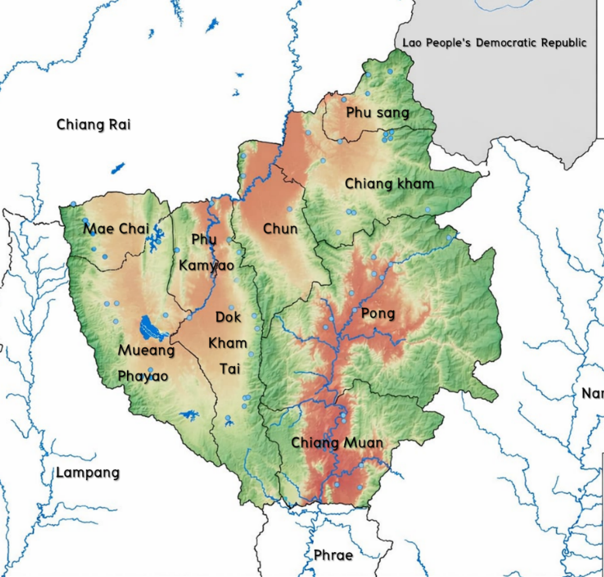
Regional Hydrological Cycle (RHC ThaiWater). (n.d.). Water resource database: Phayao province [Map]. Retrieved From https://rhc.thaiwater.net/uppernorth/database/phayao.html.
Greenhouse Gas Management Organization (Public Organization). (2022). Provincial Greenhouse Gas Emission Calculation Manual (2nd ed., revised edition 1, September 2016). (in Thai)
National Statistical Office’s .(2022).Quantity of Gasoline Sold by Type of Gasoline: 2019 – 2021. From https://phayao.nso.go.th/images/ebook/PhayaoProvincialStatisticalReport_2022.pdf. (in Thai)
Phayao Provincial Statistical Report. (2020). Consumer and Electricity Sales by Type of Consumers and District: Fiscal Year 2019. From https://phayao.nso.go.th/images/ebook/PhayaoProvincialStatisticalReport_2020.pdf. (in Thai)
Pollution Control Department. (2019). Municipal solid waste management report: Phayao province—Landfill/open dumping data 2019 [Report]. Bangkok, Thailand: Pollution Control Department.
Department of Energy Business. (2025). Liquefied Petroleum Gas (LPG) sales volume by province, including Phayao Province (Statistical data 2562). Open Government Data Platform (Data.go.th). https://data.go.th/dataset/lpg
Thailand Tourism Directory. (n.d.). Tourism Authority of Thailand. From https://thailandtourismdirectory.go.th.
Department of Intellectual Property. (2024). Phayao Lychee Mae Chai. From https://www.ipthailand.go.th.
Office of the Permanent Secretary for Agriculture and Cooperatives. (2019). Basic information of Phayao Province. Office of the Permanent Secretary for Agriculture and Cooperatives.