Development of a Rule-Based Chatbot for Standardizing Undergraduate Research Project Report Preparation
Keywords:
Chatbot, Report Formatting, Research Project, Virtual Assistant, Rule-Based ApproachAbstract
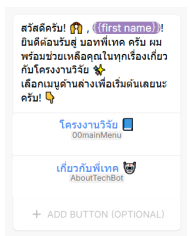
This research aims to develop and evaluate the performance of a chatbot utilizing a Rule-Based Approach to control the formatting standards of undergraduate research project reports. The research methodology comprised five stages: analysis, design, development, experimentation, and evaluation. The prototype was developed on the Chatfuel platform, with its operational mechanism described using the 3-Tier Architecture concept. The research instruments were validated for content validity (IOC) by two experts, yielding indices ranging from 0.50 to 1.00. The evaluation, involving 20 users, revealed that the chatbot received a good efficiency rating from experts (Mean = 4.00 on a 5-point scale), while user satisfaction was at a high level (Mean = 3.81, S.D. = 0.93). The content dimension received the lowest average score (3.80). Qualitative analysis indicated that the issues stemmed primarily from navigational obstacles rather than content quality. The results confirm that the Rule-Based Approach is sufficiently effective in controlling research report formatting quality. The study suggests enhancing the user experience to facilitate future development into a Hybrid Model.
References
Adamopoulou, E., & Moussiades, L. (2020). Chatbots: History, technology, and applications. Machine Learning with Applications, 2, 100006. Form https://doi.org/10.1016/j.mlwa.2020.100006
Butsabok, S., Phetphong, N., & Singtokaew, J. (2020). Development of a chatbot application for student services: A case study of the student development division, Rajamangala University of Technology Suvarnabhumi. RMUTT Research Journal, 19(2), 85-94. (in Thai)
Chaatpreecha, P., & Uttamasirisoni, C. (2024). Development of an intelligent chatbot prototype for undergraduate student counseling. Thonburi University Journal of Science and Technology, 8(1), 28–43. (in Thai)
Davis, F. D. (1989). Perceived usefulness, perceived ease of use, and user acceptance of information technology. MIS Quarterly, 13(3), 319-340.
Nielsen, J. (1994). Enhancing the explanatory power of usability heuristics. Proceedings of the SIGCHI Conference on Human Factors in Computing Systems (pp. 152-158). https://doi.org/10.1145/191666.191729
Punpiboon, W. (2019). Doing research beyond academics. From https://dcc.wu.ac.th/2019/10/21/รศ-ดร-วรวรรณ-พันพิบูลย์-ก/. (in Thai)
Sudsanguan, N., & Tangwanwit, S. (2023). The development of a chatbot for university news and information communication. Journal of Information Technology Application, 9(2), 97-110. (in Thai)