Guidelines for Promoting Natural Tourism in Raman District Yala Province by using Environmental Assessment Techniques (SWOT and TOWS Matrix Analysis)
Keywords:
Nature-based tourism, SWOT & TOWS analysis, Raman district, Tourism promotionAbstract
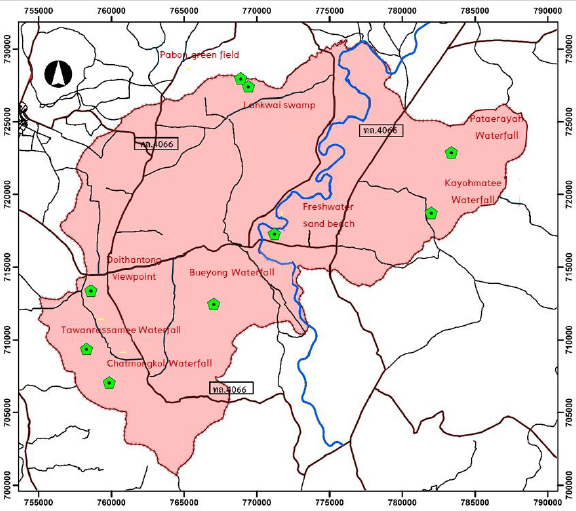
This study is a qualitative and survey research methodology. The objectives are to study and analyze the environment of 9 natural tourist attractions and propose guidelines for promoting natural tourism in Raman District, Yala Province. The data collection process is from key-informants such as government agencies, private entrepreneurs, tourists, and local people, along with strategic analysis using SWOT Analysis and TOWS Matrix techniques. The survey and data analysis found that natural tourist attractions in Raman District have strengths in terms of the number of tourist attractions, the diversity of topography and tourism activities, as well as beautiful elements within the tourist attractions, including tourism promotion via online media. However, there are still several weaknesses, such as lack of good waste management, lack of facilities in some tourist attractions, and insufficient personnel providing services in tourist attractions. For opportunities the tourism development, it was found that tourist attractions are still highly natural conditions, so more government tourism promotion has begun, especially in terms of facilities. However, the tourism sector faces obstacles such as tourists feeling unsafe due to the long-standing unrest in the area, and the limited development budget, which makes it difficult to develop basic facilities. From the results of the study, the main recommendations are to publicize tourist attractions more widely in many channels, improve necessary basic facilities in each tourist attraction to be in a complete and ready-to-use condition, and develop local personnel. and variety tourism activities, including creating new tourism activity content that can attract tourists throughout the year, with the government sector supporting the budget in line with the potential of the tourist attractions.
References
Khrongphumin, S. (2014). SWOT analysis of Underwater World Pattaya to accommodate Russian tourists. (Bachelor’s thesis). Russian Studies Program, Thammasat University, Bangkok. (in Thai)
Kim, S. S., Timothy, D. J., & Han, H. C. (2016). Tourism and political ideologies: A case of tourism in North Korea. Tourism Management, 55, 134–145. from https://doi.org/10.1016/j.tourman.2016.02.002.
Kontogeorgopoulos, N., Churyen, A., & Duangsaeng, V. (2014). Success factors in community-based tourism in Thailand: The role of luck, external support, and local leadership. Tourism Planning & Development, 11(1), 106–124. from https://doi.org/10.1080/21568316.2013.852991.
Kotler, P., Bowen, J. T., & Makens, J. C. (2017). Marketing for hospitality and tourism (7th ed.). Harlow: Pearson.
Krajangchom, S., Sangkakorn, K., & Poonsukcharoen, N. (2021). The Adaptation Strategy of Tourism in Upper North of Thailand under the COVID-19 Pandemic. University of the Thai Chamber of Commerce Journal Humanities and Social Sciences, 41(1), 1–20. from https://so06.tci-thaijo.org/index.php/utccjournalhs/article/view/243464.
Helms, M. M., & Nixon, J. (2010). Exploring SWOT analysis – where are we now?. Journal of Strategy and Management, 3(3), 215–251. from https://doi.org/10.1108/17554251011064837.
Laoharunothai, T., Chailert, B., & Ngowprasertwong, S. (2022). A SWOT analysis of community-based tourist attractions in Bang Len District, Nakhon Pathom Province for the design of a new model of community-based tourism development. (Master’s thesis). Tourism and Service Management Program, Suan Sunandha Rajabhat University, Bangkok. (in Thai)
Mansour, M., Al-Mansour, J., & Sadiq, A. (2020). Rebuilding tourism in conflict-affected regions: Lessons from fragile destinations. Tourism Management Perspectives, 33, 100605. from https://doi.org/10.1016/j.tmp.2019.100605.
Ministry of Tourism and Sports. (2023). Thailand's sustainable tourism policy report. Bangkok: Tourism Promotion Office. (in Thai)
Patton, M. Q. (2015). Qualitative research & evaluation methods (4th ed.). Thousand Oaks: SAGE Publications.
Peerapun, W. (2012). Analytical techniques for regional and urban planning. Bangkok: Department of Urban and Regional Planning, Faculty of Architecture, Chulalongkorn University. (in Thai)
Scheyvens, R. (1999). Ecotourism and the empowerment of local communities. Tourism Management, 20(2), 245–249. from https://doi.org/10.1016/S0261-5177(98)00069-7.
Scheyvens, R., & Russell, M. (2012). Tourism and poverty alleviation in Fiji: Comparing the impacts of small- and large-scale tourism enterprises. Journal of Sustainable Tourism, 20(3), 417–436. From https://doi.org/10.1080/09669582.2011.629049.
Tourism Authority of Thailand. (2022). Tourism statistics of Yala Province. Bangkok: Tourism Authority of Thailand. (in Thai)
UNWTO. (2022). Tourism and sustainable development goals – Journey to 2030. United Nations World Tourism Organization. from https://www.unwto.org/tourism-and-sdgs.
Weaver, D. (2001). Ecotourism. Brisbane: John Wiley & Sons.
Weihrich, H. (1982). The TOWS Matrix—A tool for situational analysis. Long Range Planning, 15(2), 54–66. From https://doi.org/10.1016/0024-6301(82)90120-0.