
การลดความสูญเปล่าทางพลังงานของเครื่องทำความเย็นตามแนวทางของลีน กรณีศึกษา กระบวนการผลิตสารเคลือบกระป๋องชนิดโลหะ
คำสำคัญ:
ลีน, เครื่องทำความเย็น, ความสูญเปล่าทางพลังงาน, อินเตอร์เน็ตของสรรพสิ่งบทคัดย่อ
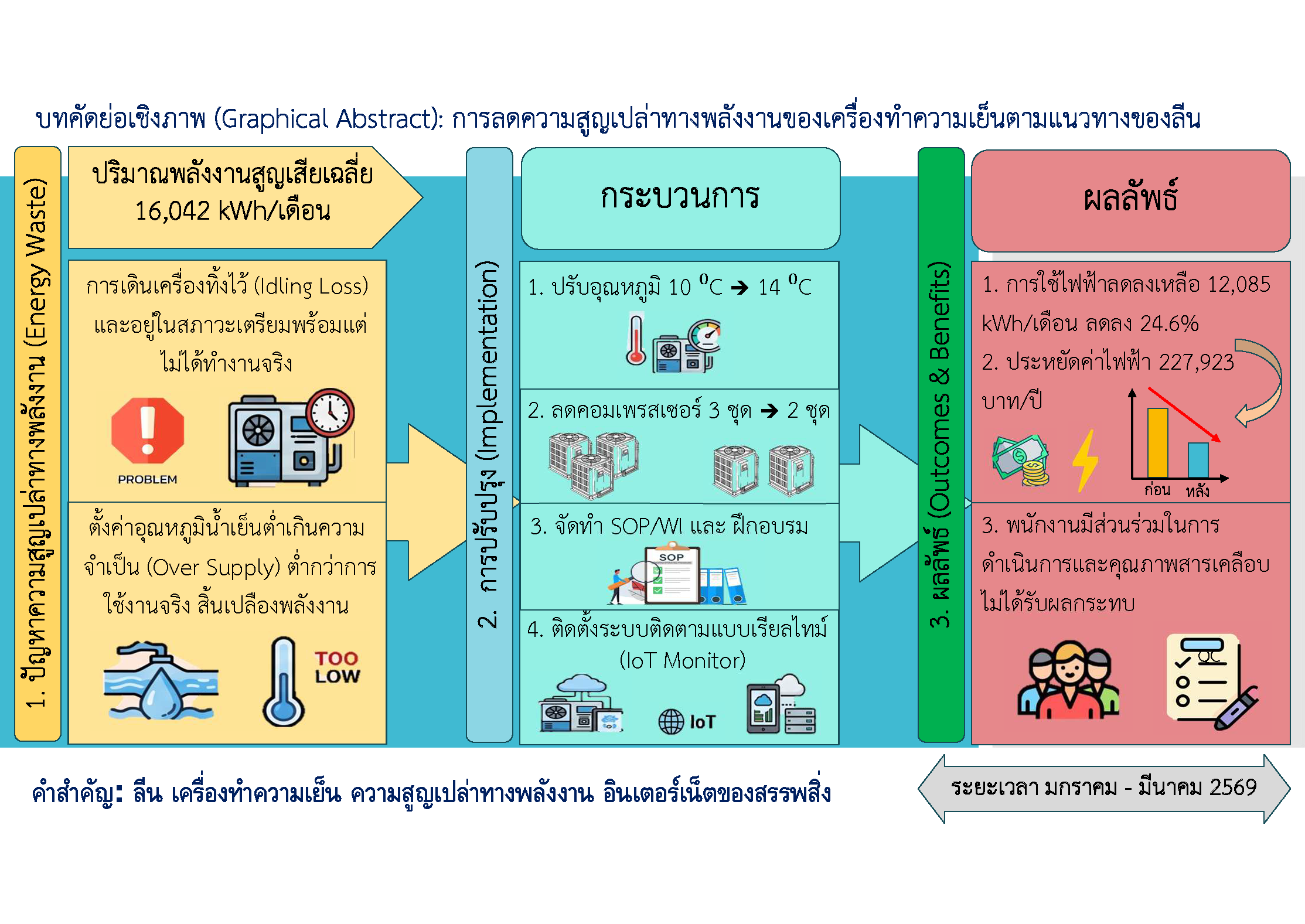
งานวิจัยนี้มีวัตถุประสงค์เพื่อวิเคราะห์สาเหตุของความสูญเปล่าทางพลังงานในระบบทำความเย็น (Chiller) ของกระบวนการผลิตสารเคลือบกระป๋องชนิดโลหะในบริษัทแห่งหนึ่ง ซึ่งเป็นระบบที่ใช้พลังงานสูงสุด เฉลี่ย 16,042 kWh/เดือน จากการศึกษาพบสาเหตุหลักของความสูญเปล่ามี 2 ประการ คือ การเดินเครื่องทิ้งไว้ในสภาวะเตรียมพร้อมแต่ไม่มีการทำงาน (Idling) และการปรับตั้งอุณหภูมิน้ำเย็นต่ำกว่าการใช้งานจริงทำให้ใช้พลังงานมากเกินความจำเป็น (Over Supply) ผู้วิจัยได้กำหนดแนวทางปรับปรุง 4 ด้าน ประกอบด้วย (1) ปรับเพิ่มอุณหภูมิน้ำเย็นจาก 10 °C เป็น 14 °C ให้สอดคล้องกับภาระงาน (2) ลดจำนวนการทำงานของคอมเพรสเซอร์จาก 3 ชุด เหลือ 2 ชุด (3) จัดทำมาตรฐานการปฏิบัติงาน (SOP) คู่มือการใช้งาน (WI) และการฝึกอบรมผู้ใช้งาน (4) ติดตั้งระบบ IoT เพื่อตรวจวัดและติดตามการใช้พลังงานแบบเรียลไทม์ ผลการดำเนินงาน ในช่วงเดือนมกราคม – มีนาคม 2569 พบว่าปริมาณการใช้ไฟฟ้าโดยเฉลี่ยลดลงเหลือ 12,085 kWh/เดือน หรือลดลงร้อยละ 24.6 โดยไม่ส่งผลกระทบต่อคุณภาพของสารเคลือบ คิดเป็นค่าใช้จ่ายทางพลังงานที่ลดลงได้โดยประมาณ 227,923 บาท/ปี นอกจากนี้พนักงานยังได้มีส่วนร่วมในการใช้พลังงานอย่างมีประสิทธิภาพอีกด้วย
เอกสารอ้างอิง
Intellify Industry Report, “Thailand's Energy Industry Outlook 2025–2030,” Sep. 13, 2025. [Online]. Available: https://www.intellifyglobal.com/thailand–energy–industry–outlook–2025/. [Accessed Sep. 13, 2025]. (in Thai).
A. Rodphai and L. Sriratana, “Reducing Energy Use in Aluminum Furnaces by Applying Lean Energy Concepts: A Case Study of Seng Chun Asia Co., Ltd.,” in Proceedings of the 21st Kasetsart University Kamphaeng Saen National Conference 2024, Nakhon Pathom, Thailand, 2024, pp. 650–661 (in Thai).
S. Pimsakul, Supply Chain Management, Bangkok, Thailand, 2017 (in Thai).
S. Inthongkham, “Reducing the Specific Energy Consumption (SEC) By Increase in Overall Equipment Effectiveness (OEE) Case Study of Electrolytic De flash and Water Jet Machine” M. S. Independent Study, University of Chulalongkorn, Bangkok, 2022 (in Thai).
C. Wongwian, K. Sagulpongmalee, and C. Inyasri, “Propeller Mass Reduction of the Electric Motor in Ring–Spinning Machine in Textile Industry for Energy Saving,” Thai Industrial Engineering Network Journal, vol. 7, no. 2, pp. 111–117, 2021 (in Thai).
W. Klinbun, R. Yadseang, N. Suchisong, and J. Klinbun, “Design of Sandblasting Machine to Reduce Waste in the Production of Motorcycle Exhaust Muffler,” Manufacturing and Management Technology Journal, vol. 3, no. 2, pp. 1–8, 2024 (in Thai).
M. Abdul Aziz and R. Eddy Nugroho, “Reducing Electrical Power Consumption SEEC by 2 kWh/ton Cement and Increaseing Production Rate by 10–15 TPH through Diaphragm Slot Cleaning and Grinding Ball Addition in Chambers 1 and 2,” in The Mercu Buana Ecobiz International Conference: Innovation and Operational Efficiency in Energy Business, Jakarta, Indonesia, 2025, pp. 76–90.
S. Jia, S. Wang, W. Cai, J. Lv, S. Li, Z. S. Li, G. Zhou, and L. Hu, “Energy–Saving Strategy and Method of Spindle Deceleration During No–Load Operation of Machine Tools for Energy Lean Management,” Energy Conversion and Management, vol. 300, pp. 1–13, 2024.
J. Cosgrove, M. J. R. Duarte, J. Littlewood, and P. Wilgeroth, “An Energy Mapping Methodology to Reduce Energy Consumption in Manufacturing Operations,” in Proceedings of the Institution of Mechanical Engineers, Part B: Journal of Engineering Manufacture, vol. 230, pp. 1–9, 2016.
L. Incipini, M. E. Mehtedi, T. Mancia, and P. Pierleoni, “IoT Network for Industrial Machine Energy Monitoring,” in Proceedings of the International Conference on Advances in Education and Information Technology, 2019, pp. 1–6.
Thai National LCI Database, “TIIS–MTEC–NSTDA (with TGO Electricity 2016–2018),” [Online]. Available: https://thaicarbonlabel.tgo.or.th/index.php?lang=TH&mod=YhKdlpIVmpkSE5m
WlcxcGMzTnBiMjQ9. [Accessed Feb. 8, 2026]. (in Thai).
ดาวน์โหลด
เผยแพร่แล้ว
รูปแบบการอ้างอิง
ฉบับ
ประเภทบทความ
สัญญาอนุญาต
บทความ ข้อมูล เนื้อหา รูปภาพ ฯลฯ ที่ได้รับการเผยแพร่ในวารสารเทคโนโลยีการผลิตและการจัดการนี้ ถือเป็นลิขสิทธิ์ของวารสารเทคโนโลยีการ ผลิตและการจัดการหากบุคคลหรือหน่วยงานใดต้องการนำทั้งหมดหรือส่วนหนึ่งส่วนใดไปเผยแพร่ต่อหรือกระทำการใด ๆ จะต้องได้รับอนุญาตเป็น ลายลักษณ์อักษรจากวารสารเทคโนโลยีการผลิตและการจัดการก่อนเท่านั้น


