
การพัฒนาผลสัมฤทธิ์ทางการเรียนโดยวิธีการเพื่อนช่วยเพื่อน ในรายวิชาการเขียนโปรแกรมวิชวลและเชิงวัตถุ
DOI:
https://doi.org/10.14456/jmmt.2025.13คำสำคัญ:
ผลสัมฤทธิ์ทางการเรียน, เพื่อนช่วยเพื่อน, การเขียนโปรแกรมวิชวลและเชิงวัตถุบทคัดย่อ
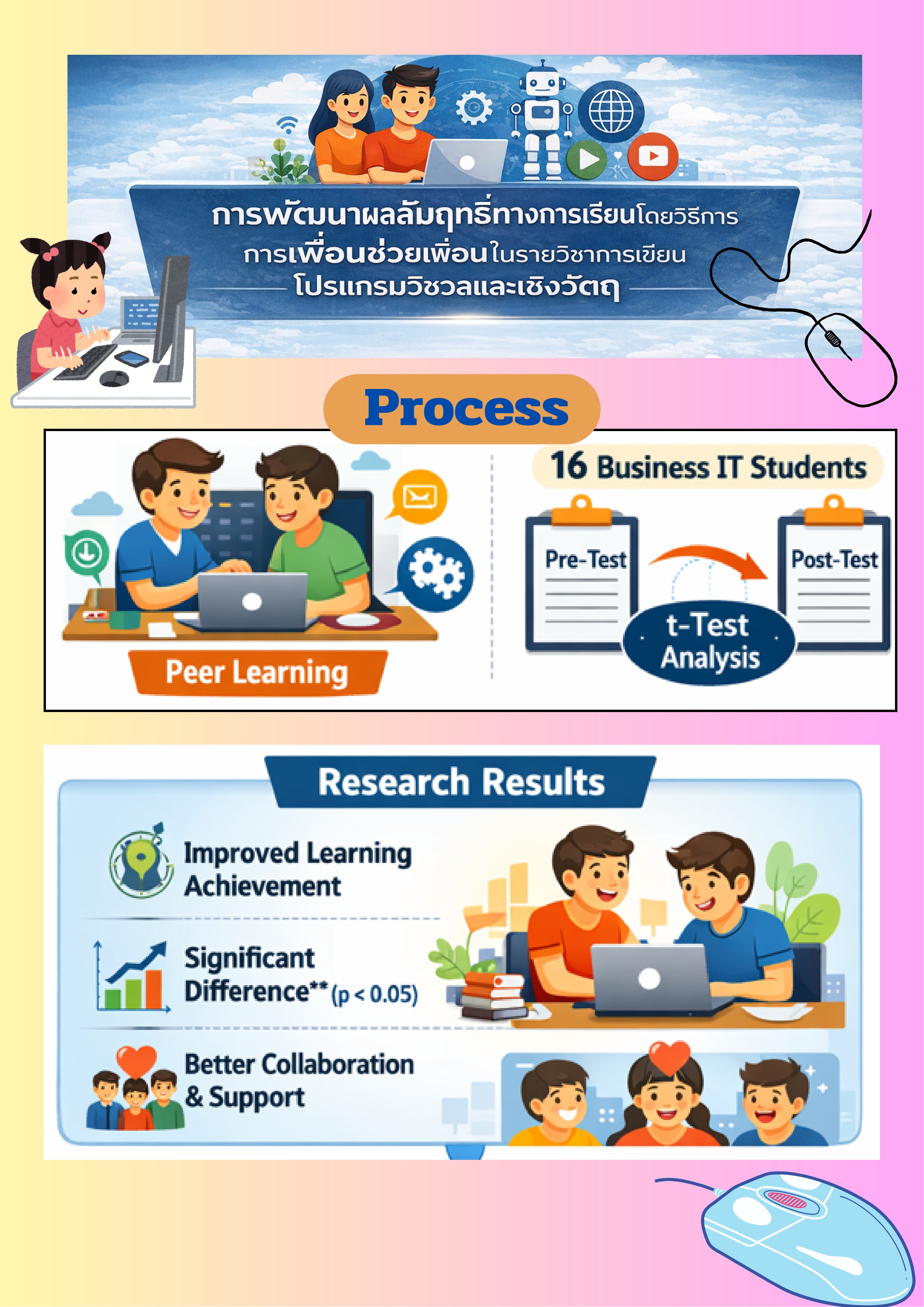
การพัฒนาคนไทยในยุคใหม่จำเป็นต้องเตรียมเยาวชนของชาติเข้าสู่โลกยุคศตวรรษที่ 21 หรือที่เรียกว่าเป็นการจัดการศึกษายุคฐานแห่งเทคโนโลยี ดังนั้นผู้วิจัยจึงได้ศึกษาการพัฒนาผลสัมฤทธิ์ทางการเรียนโดยวิธีการเพื่อนช่วยเพื่อนในรายวิชาการเขียนโปรแกรมวิชวลและเชิงวัตถุ โดยมีวัตถุประสงค์ 1) เพื่อพัฒนารูปแบบการจัดการเรียนการสอนที่เอื้อต่อการเรียนการสอนในรายวิชาการเขียนโปรแกรม 2) เพื่อวัดผลสัมฤทธิ์ทางการเรียนโดยวิธีการเรียนแบบเพื่อนช่วยเพื่อน กลุ่มตัวอย่าง คือ นักศึกษาระดับประกาศนียบัตรชั้นสูง โปรแกรมคอมพิวเตอร์ธุรกิจ สาขาวิชาบริหารธุรกิจ จำนวน 16 คน โดยเครื่องมือที่ใช้ในการวิจัย ได้แก่ แบบทดสอบก่อนและหลังเรียน และแบบฝึกหัดที่มอบหมายโดยอาจารย์ผู้สอน สถิติที่ใช้ คือ t–test ค่าเฉลี่ย และส่วนเบี่ยงเบนมาตรฐาน ผลการวิจัยพบว่า ผลสัมฤทธิ์ทางการเรียนของนักศึกษาสูงขึ้นในระดับความสามารถที่ใกล้เคียงกัน และผลการทดสอบความแตกต่างคะแนนระหว่างหลังเรียนและก่อนเรียนด้วยสถิติ t–test พบว่า มีความแตกต่างกันอย่างมีนัยสำคัญทางสถิติที่ระดับ 0.05 และพบว่าวิธีการเรียนแบบเพื่อนช่วยเพื่อน จะสามารถแก้ปัญหาด้านการเรียนสำหรับนักศึกษาที่มีความเข้าใจช้าและเป็นการสร้างความสัมพันธ์ที่ดีระหว่างผู้เรียน การรู้จักช่วยเหลือซึ่งกันและกัน และเป็นการพัฒนาความสัมพันธ์กับผู้อื่นในทางที่ดีในการเรียนการสอนของนักศึกษา
เอกสารอ้างอิง
N. Songkram, S. Chootongchai, J. Khlaisang and P. Koraneekij, “Education 3.0 system to enhance twenty–first century skills for higher education learners in Thailand”, Interactive Learning Environments, vol. 29, no. 4, pp. 566–582, 2021.
A. Caleesuntorn, “Thai Education and the 21st century skills: A proposal for a new world of work”, Life Sciences and Environment Journal, vol. 16, no. 2, pp. 131–142, 2015.
A. Poonputta and P. Nuangchalerm, “A model framework for enhancing twenty–first century competencies in primary school teachers within northeastern Thailand’s sub–area”, International Journal of Learning, Teaching and Educational Research, vol. 23, no. 1, pp. 98–113, 2024.
O. Walida and D.A. Keith, “Collaborative Learning Based on Differentiated Instruction for Students”, Journal of Humanities and Social Sciences Uttaradit Rajabhat University. vol. 8, no. 2, pp. 125–136, 2024. (in Thai)
B. Waluyo, “Technology–Fused English Teaching and Learning in Higher Education: From Individual Differences to Being Different Individuals”, LEARN Journal: Language Education and Acquisition Research Network, vol. 17, no. 2, pp. 42–47, 2024.
J. Meyer, T. Jansen, M. Daumiller, and J. Fleckenstein, “Understanding individual differences in students’ responses to technology–based feedback on a writing task: the role of achievement motives and initial task performance”, Journal of Research on Technology in Education, 2025, pp. 1–31.
R. Kern, “Twenty‐first century technologies and language education: Charting a path forward”, Modern Language Journal (John Wiley & Sons, Inc.), vol. 108, no. 2, pp. 515–533, 2024.
T. Piyawat, “The Effects of Peer Tutoring on Data Structure and Algorithm Learning Achievement and Team Learning Behaviors of Software Engineering and Information System Students”, Journal of Education Naresuan University, vol. 23, no. 1, pp. 223–236, 2021. (in Thai)
M. Avcı, “Peer–assisted learning augmented by peer counseling to foster academic and personal development in flipped classroom”, Education and Information Technologies, vol. 30, no. 3, pp. 2837–2858, 2025.
L. Chilvers, “The Peer–to–Peer Model: A UK Institution’s Approach to Broadening and Embedding the Provision of Peer Learning and Support”, Journal of Peer Learning, vol. 16, no. 1, pp. 1–15, 2025.
C. Phattaraporn, “The Development of Learning Model Using Structuralism Theory and Peer – Assisted Learning to Enhance Interpretative Reading of Undergraduate Students”, Lawarath Social E–Journal, Vol. 4, no. 3, pp. 161–182, 2022. (in Thai)
S. Suksikarn, “A study on Visual Arts for Industrial Design Learning Achievement
of Drawing by Buddy Learning”, Journal of Education, vol. 28, no. 1, pp. 195–207, 2017. (in Thai)
M. Ganya, “Study of teaching and learning results With Peer assist techniques in accounting
management for environmental of students in accounting programs”, Phikun Journal, vol. 18, no. 2, pp. 221–233, 2020. (in Thai)
R. Warawut and B. Anuwatwat, “Peer–assisted Learning to Development of Learning Achievement on Saw–U String Instrument for Students of the Faculty of Education Loei Rajabhat University”, The 7th National Conference National College, 2020, pp. 11–19. (in Thai)
ดาวน์โหลด
เผยแพร่แล้ว
รูปแบบการอ้างอิง
ฉบับ
ประเภทบทความ
สัญญาอนุญาต
บทความ ข้อมูล เนื้อหา รูปภาพ ฯลฯ ที่ได้รับการเผยแพร่ในวารสารเทคโนโลยีการผลิตและการจัดการนี้ ถือเป็นลิขสิทธิ์ของวารสารเทคโนโลยีการ ผลิตและการจัดการหากบุคคลหรือหน่วยงานใดต้องการนำทั้งหมดหรือส่วนหนึ่งส่วนใดไปเผยแพร่ต่อหรือกระทำการใด ๆ จะต้องได้รับอนุญาตเป็น ลายลักษณ์อักษรจากวารสารเทคโนโลยีการผลิตและการจัดการก่อนเท่านั้น


