
The Development of Learning Achievement by Peer–assisted Learning Associated in the Course of Visual and Object Oriented Programming
DOI:
https://doi.org/10.14456/jmmt.2025.13Keywords:
Learning Achievement, Peer-assisted Learning, Visual and Object Oriented ProgrammingAbstract
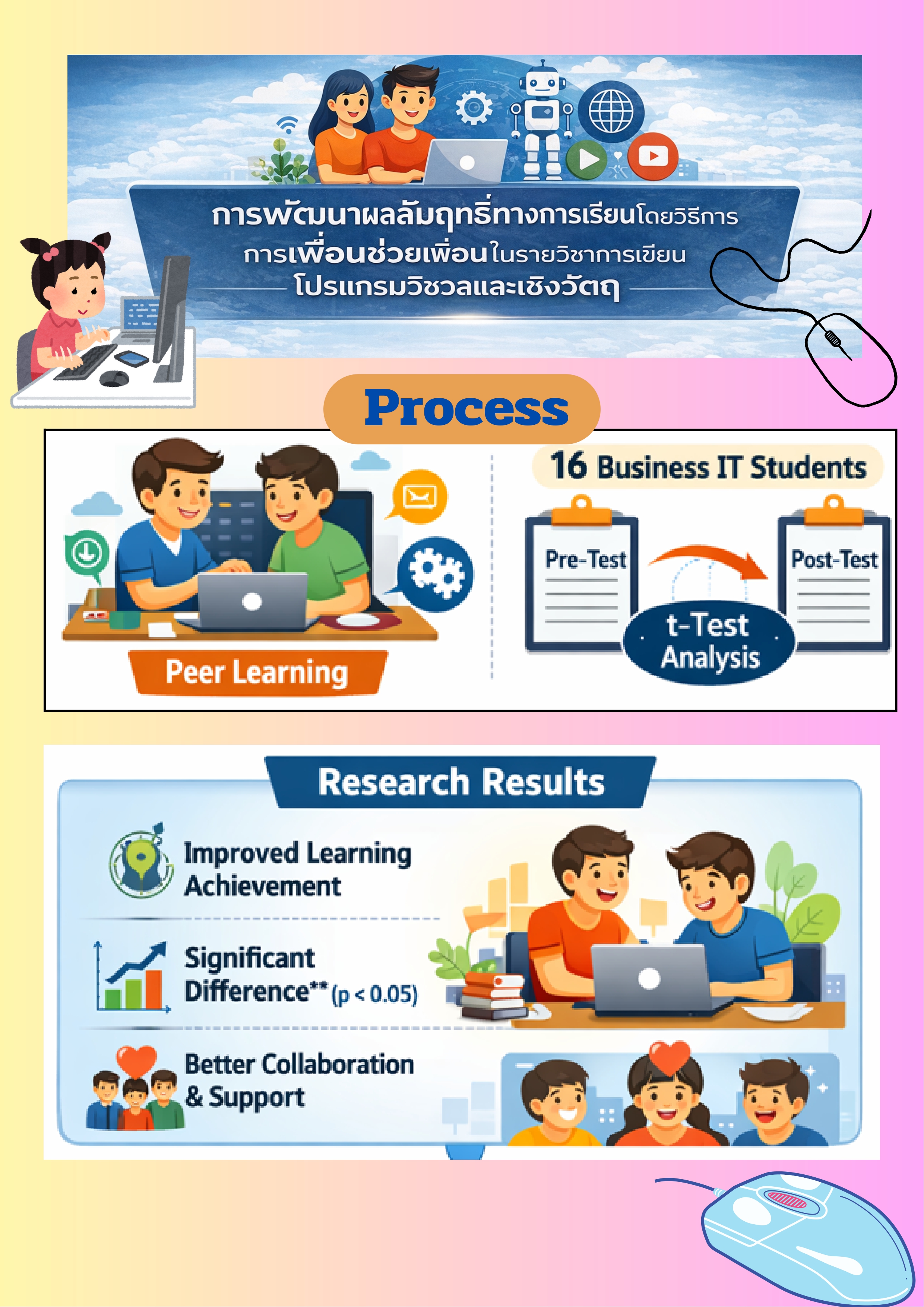
The development of Thai people in the new era needs to prepare the nation's youth for the 21st century world, also known as the management of education in the era of technology. Therefore, the development of learning achievement by peer–assisted learning is associated the course of Visual and Object Oriented Programming. The objectives are 1) To develop a teaching and learning management model that is conducive to teaching and learning in programming courses, 2) To measure academic achievement by peer–assisted learning. The sample group was 16 students with a higher diploma in business computer program majoring in Business Administration. The research tools include teaching and learning activities, pre–tests and post–tests, and instructor–assigned exercises. The statistics used are t–test, mean and standard deviation. The results showed that students' academic achievement was higher at a similar level of ability, and the difference in scores between after school and before school with t–test statistics showed a statistically significant difference of 0.05. It was found that the peer–assisted learning method can solve learning problems for students who are slow to understand and build good relationships between learners. It is to know how to help each other and to develop relationships with others in a positive way in the teaching and learning of students.
References
N. Songkram, S. Chootongchai, J. Khlaisang and P. Koraneekij, “Education 3.0 system to enhance twenty–first century skills for higher education learners in Thailand”, Interactive Learning Environments, vol. 29, no. 4, pp. 566–582, 2021.
A. Caleesuntorn, “Thai Education and the 21st century skills: A proposal for a new world of work”, Life Sciences and Environment Journal, vol. 16, no. 2, pp. 131–142, 2015.
A. Poonputta and P. Nuangchalerm, “A model framework for enhancing twenty–first century competencies in primary school teachers within northeastern Thailand’s sub–area”, International Journal of Learning, Teaching and Educational Research, vol. 23, no. 1, pp. 98–113, 2024.
O. Walida and D.A. Keith, “Collaborative Learning Based on Differentiated Instruction for Students”, Journal of Humanities and Social Sciences Uttaradit Rajabhat University. vol. 8, no. 2, pp. 125–136, 2024. (in Thai)
B. Waluyo, “Technology–Fused English Teaching and Learning in Higher Education: From Individual Differences to Being Different Individuals”, LEARN Journal: Language Education and Acquisition Research Network, vol. 17, no. 2, pp. 42–47, 2024.
J. Meyer, T. Jansen, M. Daumiller, and J. Fleckenstein, “Understanding individual differences in students’ responses to technology–based feedback on a writing task: the role of achievement motives and initial task performance”, Journal of Research on Technology in Education, 2025, pp. 1–31.
R. Kern, “Twenty‐first century technologies and language education: Charting a path forward”, Modern Language Journal (John Wiley & Sons, Inc.), vol. 108, no. 2, pp. 515–533, 2024.
T. Piyawat, “The Effects of Peer Tutoring on Data Structure and Algorithm Learning Achievement and Team Learning Behaviors of Software Engineering and Information System Students”, Journal of Education Naresuan University, vol. 23, no. 1, pp. 223–236, 2021. (in Thai)
M. Avcı, “Peer–assisted learning augmented by peer counseling to foster academic and personal development in flipped classroom”, Education and Information Technologies, vol. 30, no. 3, pp. 2837–2858, 2025.
L. Chilvers, “The Peer–to–Peer Model: A UK Institution’s Approach to Broadening and Embedding the Provision of Peer Learning and Support”, Journal of Peer Learning, vol. 16, no. 1, pp. 1–15, 2025.
C. Phattaraporn, “The Development of Learning Model Using Structuralism Theory and Peer – Assisted Learning to Enhance Interpretative Reading of Undergraduate Students”, Lawarath Social E–Journal, Vol. 4, no. 3, pp. 161–182, 2022. (in Thai)
S. Suksikarn, “A study on Visual Arts for Industrial Design Learning Achievement
of Drawing by Buddy Learning”, Journal of Education, vol. 28, no. 1, pp. 195–207, 2017. (in Thai)
M. Ganya, “Study of teaching and learning results With Peer assist techniques in accounting
management for environmental of students in accounting programs”, Phikun Journal, vol. 18, no. 2, pp. 221–233, 2020. (in Thai)
R. Warawut and B. Anuwatwat, “Peer–assisted Learning to Development of Learning Achievement on Saw–U String Instrument for Students of the Faculty of Education Loei Rajabhat University”, The 7th National Conference National College, 2020, pp. 11–19. (in Thai)
Downloads
Published
How to Cite
Issue
Section
License
Copyright Notice articles, information, images, etc. was published in this Journal of Manufacturing and Management Technology is a copyright of the Journal of Manufacturing and Management Technology. If any person or deparment wants to bring all or part of it for publish or take any action. Authorization is required in written form from the Journal of Manufacturing and Management Technology only.


