
Classification of Thailand’s industrial firms under global supply chain disruptions: Integrating resilience and sustainability in industrial performance
Article Sidebar
Main Article Content
Abstract
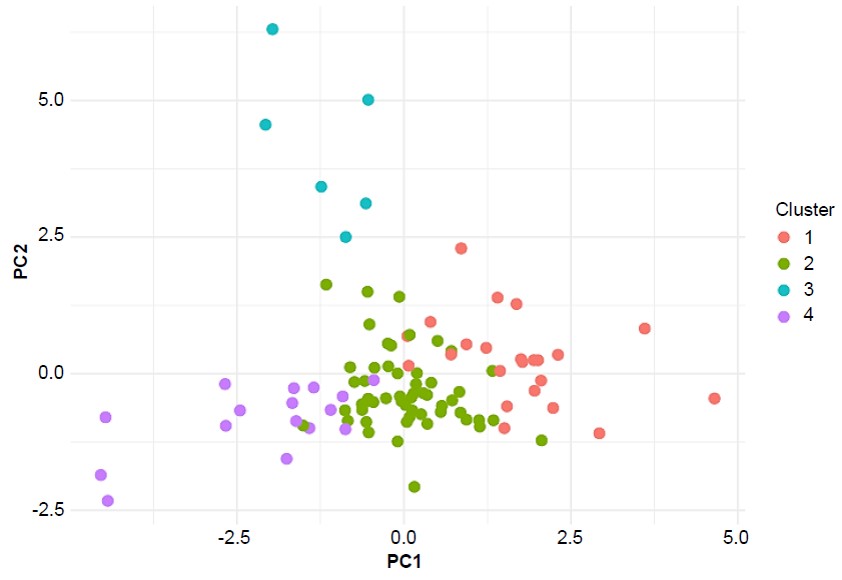
There has been significant disruption of global supply chains as a result of pandemics, geopolitical tensions, and climate-related events. Firms around the world, including those in Thailand, have been compelled to adapt, with increasing emphasis on resilience and sustainability. While many studies have addressed supply chain performance through these lenses, few have focused specifically on the industrial context in Thailand. Moreover, the direction of industrial transformation in response to global challenges remains insufficiently examined. This study addresses these gaps by proposing a comprehensive framework that integrates conventional supply chain performance indicators with resilience and sustainability dimensions. Data were collected from 98 publicly listed industrial firms in Thailand using their 2023 annual reports. Principal component analysis (PCA) was used to identify key performance patterns, and this was followed by K-means clustering to classify firms based on strategic orientation. The analysis revealed four distinct clusters. The largest group, referred to as resilient enterprises (54 firms), demonstrated a balanced performance across efficiency and resilience. Performance-oriented firms (23 firms) exhibited high customer satisfaction, product quality, and flexibility. Agile and lean operators (6 firms) prioritized operational speed and rapid delivery. Flexibility-centric firms (16 firms) focused on adaptability but faced constraints in financial and inventory performance. Overall, the findings indicate that economic factors such as revenue, profitability, and productivity, together with resilience attributes like agility and flexibility, are the primary variables that differentiate firms. This suggests that Thailand’s industrial firms currently place the most emphasis on operational efficiency and adaptability, while broader environmental and social sustainability concerns remain less prominent in strategic differentiation.
Article Details

This work is licensed under a Creative Commons Attribution-NonCommercial-NoDerivatives 4.0 International License.

This work is licensed under a Creative Commons Attribution-NonCommercial-NoDerivatives 4.0 International License.
References
Ministry of Industry. The achievement in implementation of the government policy and industrial strategy fiscal year 2017: Thailand 4.0 – the next revolution. Bangkok: Ministry of Industry; 2017.
Katsaliaki K, Galetsi P, Kumar S. Supply chain disruptions and resilience: a major review and future research agenda. Ann Oper Res. 2022;319(1):965-1002.
Ivanov D, Dolgui A. OR-methods for coping with the ripple effect in supply chains during COVID-19 pandemic: managerial insights and research implications. Int J Prod Econ. 2021;232:107921.
Everitt BS, Landau S, Leese M, Stahl D. Cluster analysis. 5th ed. Chichester: Wiley; 2011.
Patti AL. Economic clusters and the supply chain: a case study. Supply Chain Manag: Int J. 2006;11(3):266-70.
Hugos M. Essentials of supply chain management. 4th ed. Hoboken: John Wiley & Sons; 2018.
Dobrovnik M, Herold DM, Kummer S. Exploring supply chain managers’ complex perceptions of dynamic capabilities for digital transformation. Digit. Bus. 2025;5(1):100098.
Yang X, Wang J. The relationship between sustainable supply chain management and enterprise economic performance: does firm size matter?. J Bus Ind Mark. 2023;38(3):553-67.
Watanabe WC, Patitad P, Ransikarbum K, Janmontree J. Evaluation of interrelationship between supply chain transparency and relative efficiency for logistics service providers in Thailand. J Ind Prod Eng. 2025:1-14.
Keskin B, Ungan MC. Determinants and impacts of supply chain responsiveness: an empirical research. Bus Process Manag J. 2024:1-24.
Mohammadi M, Nikzad A. Sustainable and reliable closed-loop supply chain network design during pandemic outbreaks and disruptions. Oper Manag Res. 2023;16(2):969-91.
Ebrahimi SB, Bagheri E. Optimizing profit and reliability using a bi-objective mathematical model for oil and gas supply chain under disruption risks. Comput Ind Eng. 2022;163:107849.
Pu G, Gao X, Qiao J. Impact of supply chain quality management practices on supply chain resilience: a dynamic capability perspective. Bus Process Manag J. 2025:1-22.
Shishodia A, Sharma R, Rajesh R, Munim ZH. Supply chain resilience: a review, conceptual framework and future research. Int J Logist Manag. 2023;34(4):879-908.
Singh RK, Modgil S. Adapting to disruption: the impact of agility, absorptive capacity and ambidexterity on supply chain resilience. Int J Product Perform Manag. 2025;74(2):637-58.
Agrawal R, Majumdar A, Majumdar K, Raut RD, Narkhede BE. Attaining sustainable development goals (SDGs) through supply chain practices and business strategies: a systematic review with bibliometric and network analyses. Bus Strategy Environ. 2022;31(7):3669-87.
González-Sánchez R, Alonso-Muñoz S, Kocollari U. Exploring the supply chain’s transformation to achieve the sustainable development goals in the post-pandemic scenario: a review and a research agenda. Int J Logist Manag. 2025;36(7):137-77.
Ransikarbum K, Pitakaso R. Multi-objective optimization design of sustainable biofuel network with integrated fuzzy analytic hierarchy process. Expert Syst Appl. 2024;240:122586.
Ransikarbum K, Wattanasaeng N, Madathil SC. Analysis of multi-objective vehicle routing problem with flexible time windows: The implication for open innovation dynamics. J Open Innov: Technol Mark Complex. 2023;9(1):100024.
Bazhan M, Shafiei Sabet F, Borumandnia N. Development and validation of a questionnaire to examine determinants of consumer intentions to purchase organic food. BMC Nutr. 2023;9(1):74.
Mahdinia M, Mohammadfam I, Seyedtabib M, Omidi Oskouei A, Aghaei H, Soltanzadeh A. Development and validation of a safety behavior scale for industrial workplaces. Int J Occup Saf Ergon. 2025;31(2):545-53.
Zenouz RY, Rad FH, Centobelli P, Cerchione R. Knowledge management systems evaluation in food industry: a multicriteria decision-making approach. IEEE Trans Eng Manag. 2024;71:506-16.
Goharshenasan A, Aboumasoudi AS, Shahin A, Ansari A. Identifying and classifying sustainable supply chain performance indicators: a GRI based multivariate analysis. Int J Ind Syst Eng. 2022;41(1):41-70.
Wang J, Swartz CLE, Corbett B, Huang K. Supply chain monitoring using principal component analysis. Ind Eng Chem Res. 2020;59(27):12487-503.
Paul S, Ali SM, Hasan MA, Paul SK, Kabir G. Critical success factors for supply chain sustainability in the wood industry: an integrated PCA-ISM model. Sustainability. 2022;14(3):1863.
Kumar S, Suhaib M, Asjad M. Narrowing the barriers to industry 4.0 practices through PCA-Fuzzy AHP-K means. J Adv Manag Res. 2020;18(2):200-26.
Kang PS, Bhawna B. Enhancing supply chain resilience through supervised machine learning: supplier performance analysis and risk profiling for a multi-class classification problem. Bus Process Manag J. 2025:1-24.
Shi J. Optimization of frozen goods distribution logistics network based on k-means algorithm and priority classification. Sci Rep. 2024;14(1):22477.
Unterberger P, Müller JM. Clustering and classification of manufacturing enterprises regarding their industry 4.0 reshoring incentives. Procedia Comput Sci. 2021;180:696-705.
Zeng A, Rossetti C. Developing a framework for evaluating the logistics costs in global sourcing processes: an implementation and insights. Int J Phys Distrib Logist Manag. 2003;33(9):785-803.
Christopher M. Logistics and supply chain management. 5th ed. London: Pearson; 2016.
Gunasekaran A, Patel C, Tirtiroglu E. Performance measures and metrics in a supply chain environment. Int J Oper Prod Manag. 2001;21(1-2):71-87.
Fawcett SE, Osterhaus P, Magnan GM, Brau JC, McCarter MW. Information sharing and supply chain performance: the role of connectivity and willingness. Supply Chain Manag: Int J. 2007;12(5):358-68.
Flynn BB, Huo B, Zhao X. The impact of supply chain integration on performance: a contingency and configuration approach. J Oper Manag. 2010;28(1):58-71.
Simão LE, Somensi K, Dávalos RV, Rodriguez CMT. Measuring supply chain performance: the triple E model. Int J Product Perform Manag. 2021;71(7):2951-69.
Christopher M. The agile supply chain: competing in volatile markets. Ind Mark Manag. 2000;29(1):37-44.
Zhang Q, Vonderembse MA, Lim JS. Logistics flexibility and its impact on customer satisfaction. Int J Logist Manag. 2005; 16(1):71-95.
Goldsby TJ, Griffis SE, Roath AS. Modeling lean, agile, and leagile supply chain strategies. J Bus Logist. 2006;27(1):57-80.
Shah R, Ward PT. Lean manufacturing: context, practice bundles, and performance. J Oper Manag. 2003;21(2):129-49.
Iqbal MW, Kang Y, Jeon HW. Zero waste strategy for green supply chain management with minimization of energy consumption. J Clean Prod. 2020;245:118827.
Iqbal MW, Kang Y. Waste-to-energy supply chain management with energy feasibility condition. J Clean Prod. 2021;291: 125231.
Watanabe WC, Wichaisri S, Patitad P. Outbound logistics resilience considering customer participation level: a case study of Thailand’s sugar factory. Eng Appl Sci Res. 2023;50(4):382-90.
Patitad P, Watanabe WC. DEA model for considering relationship between supply chain members. Naresuan University Journal: Science and Technology. 2022;30(4):38-52.
Sopadang A, Wichaisri S, Banomyong R. Sustainable supply chain performance measurement. A case study of the sugar industry. Proceedings of the International Conference on Industrial Engineering and Operations Management; 2017 Apr 11-13; Rabat, Morocco. p 1-12.
Bellingan M, Tilley C, Kumar M, Batista L, Evans S. Uncovering the link between well-being and factory performance among workers in China: a longitudinal study. Int J Oper Prod Manag. 2024;44(5):987-1006.
Weziak-Bialowolska D, Białowolski P, McNeely E. Worker's well-being. Evidence from the apparel industry in Mexico. Intell Build Int. 2019;11(3-4):158-77.
Lay AM, Saunders R, Lifshen M, Breslin FC, LaMontagne AD, Tompa E, et al. The relationship between occupational health and safety vulnerability and workplace injury. Saf Sci. 2017;94:85-93.
Zimolong BM, Elke G. Occupational health and safety management. In: Salvendy G, editor. Handbook of Human Factors and Ergonomics. 3rd ed. Hoboken: John Wiley & Sons; 2006. p. 671-707.
Khan MN, Akhtar P, Zhang LL, Khan Z. Operating in environments affected by uncertainty: supply chain finance, timely information sharing using advanced technology, and financial performance in supply chain management 4.0. J Gen Manag. 2024;50(1):37-52.
Duong LNK, Wood LC, Wang WYC. Inventory management of perishable health products: a decision framework with non-financial measures. Ind Manag Data Syst. 2020;120(5):987-1002.
Galankashi MR, Rafiei FM. Financial performance measurement of supply chains: a review. Int J Product Perform Manag. 2022;71(5):1674-707.
Forslund H, Jonsson P. Integrating the performance management process of on-time delivery with suppliers. Int J Logist Res Appl. 2010;13(3):225-41.
Bhagwat R, Sharma MK. Performance measurement of supply chain management: a balanced scorecard approach. Comput Ind Eng. 2007;53(1):43-62.
Hoe LC, Mansori S. The effects of product quality on customer satisfaction and loyalty: evidence from Malaysian engineering industry. Int J Ind Mark. 2018;3(1):20-35.
Frei FX. Breaking the trade-off between efficiency and service. Harv Bus Rev. 2006;84(11):93-101.
Hallavo V. Superior performance through supply chain fit: a synthesis. Supply Chain Manag: Int J. 2015;20(1):71-82.
Christopher M, Peck H. Building the resilient supply chain. Int J Logist Manag. 2004;15(2):1-14.
Hohenstein NO, Feisel E, Hartmann E, Giunipero L. Research on the phenomenon of supply chain resilience. Int J Phys Distrib Logist Manag. 2015;45(1-2):90-117.
Um J. Improving supply chain flexibility and agility through variety management. Int J Logist Manag. 2017;28(2):464-87.
Tengfei L, Ullah A. Impact of fiscal policies and green financing on firm innovation and firm value for green economic recovery. Heliyon. 2024;10(9):e30145.
Hagen B, Ghauri PN, Macovei V. The balancing act: organizational agility in fast-growing international ventures. Ind Mark Manag. 2024;123:119-32.
