
Assessment of surface water and groundwater potential under climate change in the Lam Phaniang River Basin
Article Sidebar
Main Article Content
Abstract
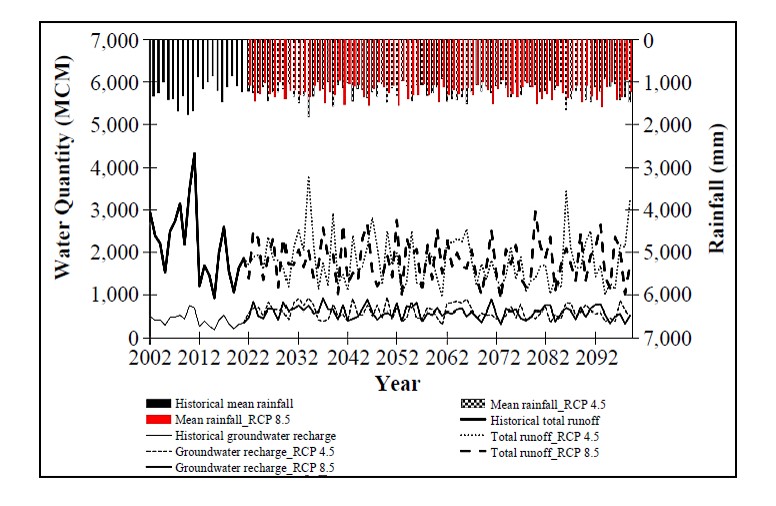
The assessment of surface water and groundwater potential under climate change in the Lam Phaniang River Basin was based on SWAT model for evaluating streamflow, and MODFLOW model for evaluating groundwater flow. The SWAT model was well calibrated and validated with daily discharge measured at E.68A during 2010-2015 and 2016-2021, respectively, with R2 and Nash-Sutcliffe Efficiency values more than 0.60. The MODFLOW model was also well calibrated and validated with observation data from 16 groundwater wells during May 2021, and 2 groundwater observation wells of Department of Groundwater Resources during 2013-2021, respectively, with r greater than 0.95 and Normalized Root Mean Square Error less than 10%. Future climate analysis (2022-2099) was based on Regional Climate Models (CNRM-CM5, CanESM2, and GFDL-ESM2M), under RCPs 4.5 and 8.5 scenarios. The maximum and minimum temperatures under RCP 4.5 were 34.54 °C and 21.07 °C, respectively, while under RCP 8.5, both temperatures were 35.30 °C and 20.36, respectively. The future mean temperature tended to be higher than present temperature (32.35 °C and 19.28, respectively). The future mean annual rainfall, which were 1,246.37 mm/year and 1,250.01 mm/year under RCPs 4.5 and 8.5, respectively, were lower than the mean annual rainfall recorded between 2002-2021 (1,257.00 mm/year). The surface water under RCPs 4.5 and 8.5 were lower than the present condition (2,175,988,582 m3/year), while the future groundwater supply was increased from the present (424,418,714 m3/year). When annual surface water supply was compared with water demand, no water shortage was expected under present condition, while low to moderate levels of water shortage were identified under RCPs 4.5 and 8.5. When compared annual surface and groundwater supply with the demand, no water shortage was detected under present and future conditions. Finally, the obtained results will be useful for surface and groundwater management, in which water-related problems can sustainably be solved.
Article Details

This work is licensed under a Creative Commons Attribution-NonCommercial-NoDerivatives 4.0 International License.

This work is licensed under a Creative Commons Attribution-NonCommercial-NoDerivatives 4.0 International License.
References
Chow VT. Applied Hydrology. New York: McGraw-Hill; 1960.
Chidtaisong A. Thailand climate change information (volume 2: climate model and future climate). Bangkok: Thailand Research Fund; 2010. (In Thai)
Emori S, Taylor K, Hewitson B, Zermoglio F, Juckes M, Lautenschlager M, et al. CMIP5 data provided at the IPCC data distribution centre. Fact sheet of the task group on data and scenario support for impact and climate analysis (TGICA). Geneva: IPCC; 2016.
Office of the National Water Resources. Special area documents and integrated solutions (Area-based) [Internet]. Bangkok: Office of the National Water Resources; 2018 [cited 2022 Feb 1]. Available from: http://www.onwr.go.th/?page_id=5109. (In Thai)
Molina-Navarro E, Bailey RT, Andersen HE, Thodsen H, Nielsen A, Park S, et al. Comparison of abstraction scenarios simulated by SWAT and SWAT-MODFLOW. Hydrol Sci J. 2019;64(4):434-54.
Kim NW, Chung IM, Won YS, Arnold JG. Development and application of the integrated SWAT–MODFLOW model. J Hydrol. 2008;356(1-2):1-16.
Ntona MM, Busico G, Mastrocicco M, Kazakis N. Modeling groundwater and surface water interaction: an overview of current status and future challenges. Sci Total Environ. 2022;846:157355.
Rath S. Agricultural water security through sustainable use of the Floridan aquifer: an integrated study of water quantity and water quality impacts [dissertation]. Gainesville: University of Florida; 2021.
Chunn D. Application of SWAT-MODFLOW software to evaluate groundwater-surface water interaction in west-central Alberta [thesis]. Edmonton: University of Alberta; 2018.
Said A, Stevens DK, Sehlke G. Estimating water budget in a regional aquifer using HSPF-MODFLOW integrated model. J Am Water Resour Assoc. 2005;41(1):55-66.
Putthividhya A, Laonamsai J. SWAT and MODFLOW modeling of spatio-temporal runoff and groundwater recharge distribution. Proceedings of the World Environmental and Water Resources Congress 2017; 2017 May 21-25; Sacramento, USA. Reston: American Society of Civil Engineers; 2017. p. 51-65.
Aslam RA, Shrestha S, Usman MN, Khan SN, Ali S, Sharif MS, et al. Integrated SWAT-MODFLOW modeling-based groundwater adaptation policy guidelines for Lahore, Pakistan under projected climate change, and human development scenarios. Atmosphere. 2022;13(12):2001.
Saurav KC. Improving groundwater governance in rapidly urbanizing areas under multiple stresses: a case of Khon Kaen, Thailand [dissertation]. Pathum Thani: Asian Institute of Technology; 2023.
Raja O, Parsinejad M, Tajrishy M. Evaluation of coupled SWAT-MODFLOW-NWT model for conjunctive use of surface water and groundwater resources in the Mahabad plain of Iran. Sci Rep. 2024;14:32111.
Zhang L, Dai Y, Lin J, Han J, Sun X, Li X, et al. Evaluating spatiotemporal variations of groundwater–surface water interaction using an integrated hydrological model in Huashan Basin, China. Sustainability. 2022;14(21):14325.
Guzman JA, Moriasi DN, Gowda PH, Steiner JL, Starks PJ, Arnold JG, et al. A model integration framework for linking SWAT and MODFLOW. Environ Model Softw. 2015;73:103-16.
Surin W. The study on the assessment of flood risk areas in the Chi-Mun River Basins. Bangkok: Office of Water Management and Hydrology; 2023. (In Thai)
Office of the National Water Resources. River basin information “Chi River Basin”. Bangkok: Office of the Prime Minister; 2021. (In Thai)
Kuntiyawichai K, Wongsasri S. Assessment of drought severity and vulnerability in the Lam Phaniang River Basin, Thailand. Water. 2021;13(19):2743.
Hydro-Informatics Institute (Public Organization). Chi River Basin [Internet]. Bangkok: Hydro-Informatics Institute; 2012 [cited 2022 Jan 21]. Available from: https://tiwrm.hii.or.th/web/attachments/25basins/04-chi.pdf. (In Thai)
Department of Water Resources. Strategic environmental assessment for the Mekong-Chi-Mun River Basin under the feasibility study of the water network system in 19 crisis areas. Bangkok: Department of Water Resources; 2013. (In Thai)
Groundwater Resources Department. Groundwater availability and quality map of Thailand (GWAV) [Internet]. Bangkok: Groundwater Resources Department; 2014 [cited 2022 Jan 13]. Available from: https://datum.dgr.go.th/mapgroundwater/. (In Thai)
Department of Mineral Resources. Zoning for geological and mineral resources management in Nong Bua Lam Phu Province. Bangkok: Department of Mineral Resources; 2009. (In Thai)
Guzmán P, Batelaan O, Huysmans M, Wyseure G. Comparative analysis of baseflow characteristics of two Andean catchments, Ecuador. Hydrol Process. 2015;29(14):3051-64.
Neitsch SL, Arnold JG, Kiniry JR, Williams JR. Soil and water assessment tool theoretical documentation version 2009. College Station: Texas Water Resources Institute; 2011. Report No.: 406.
Kuntiyawichai K, Sri-Amporn W, Wongsasri S, Chindaprasirt P. Anticipating of potential climate and land use change impacts on floods: a case study of the lower Nam Phong River Basin. Water. 2020;12(4):1158.
Moriasi DN, Gitau MW, Pai N, Daggupati P. Hydrologic and water quality models: performance measures and evaluation criteria. Trans ASABE. 2015;58(6):1763-85.
Moriasi DN, Arnold JG, Van Liew MW, Bingner RL, Harmel RD, Veith TL. Model evaluation guidelines for systematic quantification of accuracy in watershed simulations. Trans ASABE. 2007;50(3):885-900.
Freeze AR, John AC. Groundwater. Englewood Cliffs (NJ): Prentice Hall; 1979.
von Gunten D. Modeling hydrological impacts of climate and irrigation changes in a Mediterranean Catchment [dissertation]. Tubingen: University of Tubingen; 2015.
Pandey HK, Srivastava SK, Pandey P. Petro-geochemical analysis and their correlation for genesis of fluoride contamination in groundwater of District Sonbhadra, U.P., India. In: Saha D, Marwaha S, Mukherjee A, editors. Clean and Sustainable Groundwater in India. Singapore: Springer; 2018. p. 61-79.
Jiang R, He W, He L, Yang JY, Qian B, Zhou W, et al. Modelling adaptation strategies to reduce adverse impacts of climate change on maize cropping system in Northeast China. Sci Rep. 2021;11:810.
Prommacot K, Kuntiyawichai K, Pawattana C, Jothityangkoon C. Assessment of drought severity in the upper phong river basin. UBU Eng J. 2021;14(3):47-62. (In Thai)
Smakhtin V, Revenga C, Döll P. Taking into account environmental water requirements in global-scale water resources assessments. Colombo: Comprehensive Assessment Secretariat; 2004. Report No.: 2.
Xiong Y, Ta Z, Gan M, Yang M, Chen X, Yu R, et al. Evaluation of CMIP5 climate models using historical surface air temperatures in Central Asia. Atmosphere. 2021;12(3):308.
Ruan Y, Yao Z, Wang R, Liu Z. Ranking of CMIP5 GCM skills in simulating observed precipitation over the Lower Mekong Basin, using an improved score-based method. Water. 2018;10(12):1868.
Ta Z, Yu Y, Sun L, Chen X, Mu G, Yu R. Assessment of precipitation simulations in Central Asia by CMIP5 climate models. Water. 2018;10(11):1516.
Jena P, Azad S, Rajeevan MN. Statistical selection of the optimum models in the CMIP5 dataset for climate change projections of Indian monsoon rainfall. Climate. 2015;3(4):858-75.
Su F, Duan X, Chen D, Hao Z, Cuo L. Evaluation of the global climate models in the CMIP5 over the Tibetan Plateau. J Climate. 2013;26(10):3187-208.
Governor's Office of Nong Bua Lam Phu Province. Supporting document for the monitoring of the subcommittee on the study of the management guidelines for the Mekong, Loei, Chi, Mun, Songkhram River Basins, in the Ad-hoc Committee for the guidelines for the integrated river basin management, The House of Representatives. Nong Bua Lam Phu: Governor's Office of Nong Bua Lam Phu Province; 2020. (In Thai)
