
Predictive maintenance of industrial milling machine using machine learning techniques
Article Sidebar
Main Article Content
Abstract
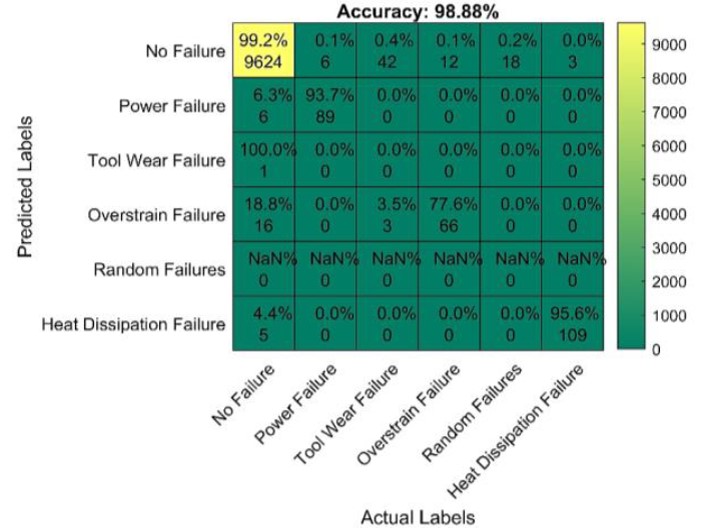
Condition-based predictive maintenance of industrial machinery is a key area of research in the present world looking towards Industry 4.0. Machine learning (ML) techniques can have tremendous impact in this aspect because of their robust predictive modeling capabilities. The present paper aims to determine the optimized machine learning technique for the predictive maintenance of an industrial milling machine. The data pertaining to the operating parameters and the failure types of the machine is obtained from a public dataset with 10,000 data points. Five of the most popular classification ML algorithms namely, Artificial Neural Network (ANN), Discriminant Analysis (DA), Naïve Bayes (NB), Support Vector Machine (SVM) and Decision Tree (DT) techniques are implemented for the dataset to determine their optimized hyperparameters for an effective prediction of the machine failure type. DT and ANN were found to be the two best techniques with overall accuracy of 99.15% and 98.8%, respectively, and superior performance metrics of Precision, Recall and F-Measure compared to the other models. The results obtained from the present study may be enriched in the future by incorporating deep learning-based models and hybrid ML and intelligent optimization techniques for effective predictive maintenance of various industrial systems. The present approach can thus be employed in real-time factory settings to realize the targets of Smart Manufacturing and Industry 4.0.
Article Details

This work is licensed under a Creative Commons Attribution-NonCommercial-NoDerivatives 4.0 International License.

This work is licensed under a Creative Commons Attribution-NonCommercial-NoDerivatives 4.0 International License.
References
Sharma A, Yadava GS, Deshmukh SG. A literature review and future perspectives on maintenance optimization. J Qual Maint Eng. 2011;17(1):5-25.
Faccio M, Persona A, Sgarbossa F, Zanin G. Industrial maintenance policy development: a quantitative framework. Int J Prod Econ. 2014;147:85-93.
Mota B, Gomes L, Faria P, Ramos C, Vale Z, Correia R. Production line optimization to minimize energy cost and participate in demand response events. Energies. 2021;14(2):462.
Ramos C, Barreto R, Mota B, Gomes L, Faria P, Vale Z. Scheduling of a textile production line integrating PV generation using a genetic algorithm. Energy Rep. 2020;6(S8):148-54.
Garg A, Deshmukh SG. Maintenance management: literature review and directions. J Qual Maint Eng. 2006;12(3):205-38.
Shin JH, Jun HB. On condition based maintenance policy. J Comput Des Eng. 2015;2(2):119-27.
Carvalho TP, Soares FAAMN, Vita R, Francisco RP, Basto JP, Alcalá SGS. A systematic literature review of machine learning methods applied to predictive maintenance. Comput Ind Eng. 2019;137:106024.
Udo W, Muhammad Y. Data-driven predictive maintenance of wind turbine based on SCADA data. IEEE Access. 2021;9:162370-88.
Calabrese M, Cimmino M, Fiume F, Manfrin M, Romeo L, Ceccacci S, et al. SOPHIA: an event-based iot and machine learning architecture for predictive maintenance in industry 4.0. Information. 2020;11(4):202.
Zonta T, da Costa CA, Righi RDR, de Lima MJ, da Trindade ES, Li GP. Predictive maintenance in the Industry 4.0: a systematic literature review. Comput Ind Eng. 2020;150:106889.
Chaudhuri A. Predictive maintenance for industrial IoT of vehicle fleets using hierarchical modified fuzzy support vector machine [Internet]. arXiv [Preprint]. 2023 [cited 2025 Mar 3]. Available from: https://arxiv.org/abs/1806.09612.
Wang L, Zhang C, Zhu J, Xu F. Fault diagnosis of motor vibration signals by fusion of spatiotemporal features. Machines. 2022; 10(4):246.
Abidi MH, Mohammed MK, Alkhalefah H. Predictive maintenance planning for industry 4.0 using machine learning for sustainable manufacturing. Sustainability. 2022;14(6):3387.
Çınar ZM, Nuhu AA, Zeeshan Q, Korhan O, Asmael M, Safaei B. Machine learning in predictive maintenance towards sustainable smart manufacturing in industry 4.0. Sustainability. 2020;12(19):8211.
Schiller E, Aidoo A, Fuhrer J, Stahl J, Ziörjen M, Stiller B. Landscape of IoT security. Comput Sci Rev. 2022;44:100467.
Heymann H, Schmitt RH. Machine learning pipeline for predictive maintenance in polymer 3D printing. Procedia CIRP. 2023;117:341-6.
De Luca R, Ferraro A, Galli A, Gallo M, Moscato V, Sperli G. A deep attention based approach for predictive maintenance applications in IoT scenarios. J Manuf Technol Manag. 2023;34(4):535-56.
Karabacak YE. Intelligent milling tool wear estimation based on machine learning algorithms. J Mech Sci Technol. 2024;38:835-50.
Gong L, Chen Y. Machine learning-enhanced loT and wireless sensor networks for predictive analysis and maintenance in wind turbine systems. Int J Intell Netw. 2024;5:133-44.
Dong E, Zhan X, Yan H, Tan S, Bai Y, Wang R, et al. A data-driven intelligent predictive maintenance decision framework for mechanical systems integrating transformer and kernel density estimation. Comput Ind Eng. 2025;201:110868.
Chen C, Shi J, Shen M, Feng L, Tao G. A predictive maintenance strategy using deep learning quantile regression and kernel density estimation for failure prediction. IEEE Trans Instrum Meas. 2023;72:1-12.
Wang L, Cao H, Ye Z, Xu H. Bayesian large-kernel attention network for bearing remaining useful life prediction and uncertainty quantification. Reliab Eng Syst Saf. 2023;238:109421.
Efeoğlu E, Tuna G. Machine learning for predictive maintenance: support vector machines and different kernel functions. J Mach Manuf Reliab. 2022;51:447-56.
Sengupta P, Mehta A, Rana PS. Predictive maintenance of armoured vehicles using machine learning approaches [Interne]. arXiv [Preprint]. 2023 [cited 2025 Mar 3]. Available from: https://arxiv.org/abs/2307.14453.
Ghasemkhani B, Aktas O, Birant D. Balanced K-Star: an explainable machine learning method for internet-of-things-enabled predictive maintenance in manufacturing. Machines. 2023;11(3):322.
Bhat SK, Deepak GD. Predictive modelling and optimization of double ring electrode based cold plasma using artificial neural network. Int J Eng. 2024;37(1):83-93.
Bhat SK, Ranjan A, Upadhyaya YS, Managuli V. Fatigue strength prediction of Cobalt alloys using material composition and monotonic properties: ML-based approach. Mater Res Express. 2025;12(4):046505.
Deepak GD, Bhat SK. Predictive modeling and optimization of pin electrode based cold plasma using machine learning approach. Multiscale Multidiscip Model Exp Des. 2024;7(3):2045-64.
Doreswamy D, Bhat SK, Raghunandana K, Hiremath P, Shreyas DS, Bongale A. ANN-based predictive modelling of the effect of abrasive water-jet parameters on the surface roughness of AZ31 Mg alloy. Manufacturing Rev. 2024;11:21.
Deepak GD, Bhat SK. Optimization of deep neural networks for multiclassification of dental X-rays using transfer learning. Comput Methods Biomech Biomed Eng: Imaging Vis. 2024;12(1):2272976.
Mathew SK, Zhang Y. Acoustic-based engine fault diagnosis using WPT, PCA and Bayesian optimization. Appl Sci. 2020;10(19):6890.
Soofi AA, Awan A. Classification techniques in machine learning: applications and issues. J Basic Appl Sci. 2017;13:459-65.
Owusu KB, Skinner W, Asamoah RK. Acoustic sensing and supervised machine learning for in situ classification of semi-autogenous (SAG) mill feed size fractions using different feature extraction techniques. Powders. 2023;2(2):299-322.
Patil VK, Pawar VP, Kulkarni SP, Mehta TA, Khare NP. Real time emotion recognition with AD8232 ECG sensor for classwise performance evaluation of machine learning methods. Int J Eng. 2023;36(6):1040-7.
Zhu G, Blumberg DG. Classification using ASTER data and SVM algorithms: the case study of Beer Sheva, Israel. Remote Sens Environ. 2002;80(2):233-40.
Kotsiantis SB. Supervised machine learning: a review of classification techniques. Informatica. 2007;31:249-68.
Breiman L, Friedman J, Stone CJ, Olshen RA. Classification and regression trees. Boca Raton: CRC Press; 1984.
Gupta SC, Goel N. Performance enhancement of diabetes prediction by finding optimum K for KNN classifier with feature selection method. 2020 Third International Conference on Smart Systems and Inventive Technology (ICSSIT); 2020 Aug 20-22; Tirunelveli, India. USA: IEEE; 2020. p. 980-6.
Moorthy U, Gandhi UD. A novel optimal feature selection technique for medical data classification using ANOVA based whale optimization. J Ambient Intell Human Comput. 2021;12:3527-38.
Luo FJ, Song DL. Study on the influence of ambient temperature on spindle box of the wheel groove milling machine based on ANSYS. Appl Mech Mater. 2013;475-476:1513-6.
Mota B, Faria P, Ramos C. Predictive maintenance for maintenance-effective manufacturing using machine learning approaches. The 17th International Conference on Soft Computing Models in Industrial and Environmental Applications (SOCO 2022); 2022 Sep 5-7; Salamanca, Spain. Cham: Springer; 2023. p. 13-22.
Cruz YJ, Rivas M, Quiza R, Beruvides G, Haber RE. Computer vision system for welding inspection of liquefied petroleum gas pressure vessels based on combined digital image processing and deep learning techniques. Sensors. 2020;20(16):4505.
Cruz YJ, Rivas M, Quiza R, Haber RE, Castaño F, Villalonga A. A two-step machine learning approach for dynamic model selection: a case study on a micro milling process. Comput Ind. 2022;143:103764.
Beruvides G, Castaño F, Haber RE, Quiza R, Villalonga A. Coping with complexity when predicting surface roughness in milling processes: hybrid incremental model with optimal parametrization. Complexity. 2017;2017:7317254.
Chawla NV, Bowyer KW, Hall LO, Kegelmeyer WP. SMOTE: synthetic minority over-sampling technique. J Artif Intell Res. 2002;16(1):321-57.
Ling CX, Sheng VS. Cost-sensitive learning and the class imbalance problem. In: Sammut C, editor. Encyclopedia of Machine Learning. Boston: Springer; 2008. p. 1-8.
Wang R, Dong E, Cheng Z, Liu Z, Jia X. Transformer-based intelligent fault diagnosis methods of mechanical equipment: a survey. Open Phys. 2024;22(1):20240015.
Saeed A, Akram MU, Khattak M, Khan MB. An interpretable hybrid framework combining convolution latent vectors with transformer based attention mechanism for rolling element fault detection and classification. Heliyon. 2024;10(21):e38993.
Fan Z, Li W, Chang KC. A bidirectional long short-term memory autoencoder transformer for remaining useful life estimation. Mathematics. 2023;11(24):4972.
Kobbacy KAH, Jeon J. The development of a hybrid intelligent maintenance optimisation system (HIMOS). J Oper Res Soc. 2001;52(7):762-78.
