
Effect of curing methods on compressive strength of pervious concrete containing silica fume and calcium carbonate
Article Sidebar
Main Article Content
Abstract
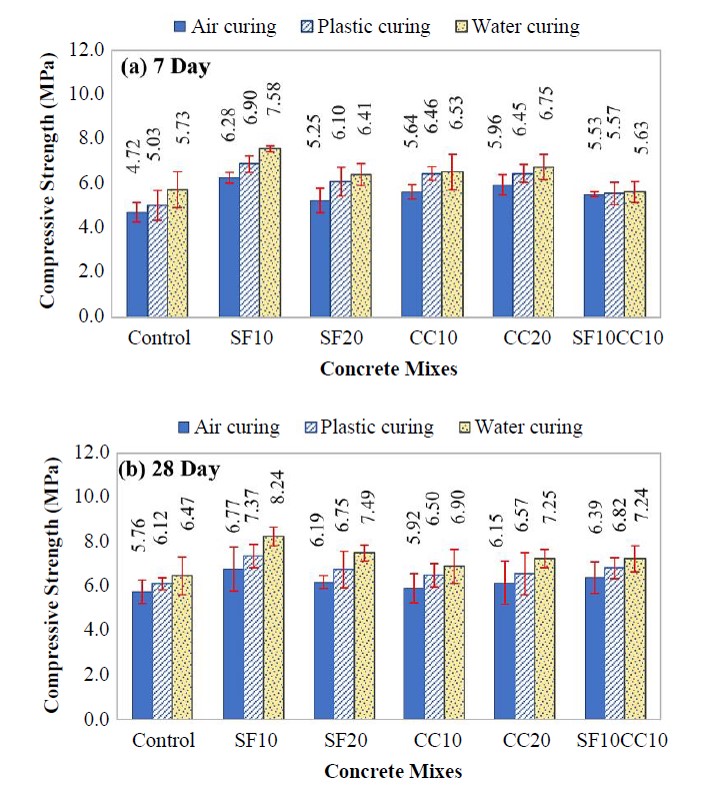
Concrete curing plays a critical role in the development of compressive strength, particularly in pervious concrete, which is highly susceptible to moisture loss due to its porous structure. This study investigates the effects of different curing methods on the compressive strength of pervious concrete and examines how the incorporation of silica fume (SF) and calcium carbonate powder (CC) influences the curing sensitivity index (CSI). Experimental results indicate that water curing consistently yields the highest compressive strength across all pervious concrete mixes at 7 and 28 days, followed by plastic and air curing. The presence of silica fume increases CSI, making pervious concrete more dependent on curing conditions, particularly under air curing. In contrast, calcium carbonate powder reduces CSI, enhancing curing efficiency and mitigating sensitivity to curing variations. Notably, a ternary blend of silica fume and calcium carbonate significantly lowers CSI at early ages, indicating improved curing resilience. However, at 28 days, the effect of CC in mitigating curing sensitivity diminishes slightly, while SF continues to increase curing dependency. These findings suggest that optimal curing strategies should be tailored to the binder composition, with calcium carbonate powder proving effective in stabilizing curing sensitivity. The results contribute to developing more durable and sustainable pervious concrete mixes with enhanced performance under variable curing conditions.
Article Details

This work is licensed under a Creative Commons Attribution-NonCommercial-NoDerivatives 4.0 International License.

This work is licensed under a Creative Commons Attribution-NonCommercial-NoDerivatives 4.0 International License.
References
Al-Gahtani AS. Effect of curing methods on the properties of plain and blended cement concretes. Constr Build Mater. 2010;24(3):308-14.
Wongsanga S, Sermram S, Dongklang C, Chitip N, Puaynongkhae P. Effect and curing sensitivity index of different curing methods on compressive strength of normal concrete. Phranakhon Rajabhat Res J Sci Technol. 2020;15(1):27-40. (In Thai)
Srichan T, Chatveera B, Choktaweekarn P, Tangtermsirikul S. A study on curing sensitivity of concrete with different cement types and mineral admixtures. KMUTT Res Dev J. 2011;34(4):383-94. (In Thai)
Hussain K, Choktaweekarn P, Tangtermsirikul S. Effect of mineral admixtures on curing sensitivity of concrete. Thammasat Int J Sci Technol. 2011;16(3):1-8.
Hussain K, Choktaweekarn P, Saengsoy W, Srichan T, Tangtermsirikul S. Effect of cement types, mineral admixtures, and bottom ash on the curing sensitivity of concrete. Int J Miner Metall Mater. 2013;20:94-105.
ACI. ACI 522 R-10: Report on pervious concrete. Farmington Hills: American Concrete Institute; 2011.
Narmluk M. Effect of cement to aggregate ratio and compaction effort on properties of pervious concrete made of ternary-sized gravel. Eng J Chiang Mai Univ. 2016;23(2):60-6.
Zhao J, Lu J, Ge J, Fan Y, Wang H, Gu M, et al. Influences of permeable pavements with different hydraulic properties on evaporative cooling and outdoor thermal environment: field experiments. Build Environ. 2025;270:112525.
Li T, Tang X, Xia J, Gong G, Xu Y, Li M. Investigation of mechanical strength, permeability, durability and environmental effects of pervious concrete from travertine waste material. Constr Build Mater. 2024;426:136175.
Kevern JT, Schaefer VR, Wang K. The effect of curing regime on pervious concrete abrasion resistance. J Test Eval. 2009;37(4):337-42.
Yusak MIM, Jaya RP, Hainin MR, Ismail CR, Ibrahim MHW. Strength of porous concrete pavement at different curing methods. J Teknologi. 2015;76(14):99-103.
Rangelov M, Nassiri S, Chen Z, Russell M, Uhlmeyer J. Quality evaluation tests for pervious concrete pavements’ placement. Int J Pavement Res Technol. 2017;10(3):245-53.
Yeih W, Chang JJ. The influences of cement type and curing condition on properties of pervious concrete made with electric arc furnace slag as aggregates. Constr Build Mater. 2019;197:813-20.
Ibrahim HA, Razak HA, Abutaha F. Strength and abrasion resistance of palm oil clinker pervious concrete under different curing methods. Constr Build Mater. 2017;147:576-87.
Abdulwahid MY. Influences of different stone powders on pervious concrete strength. Struct Concr. 2021;22(S1):E528-34.
Zaetang Y, Wongsa A, Sata V, Chindaprasirt P. Influence of mineral additives on the properties of pervious concrete. Indian J Eng Mater Sci. 2017;24(6):507-15.
Afzal G, Rasool T. Exploring the impact of nano-limestone cementitious material on mechanical, infiltration, and microstructure properties of pervious concrete. Innov Infrastruct Solut. 2024;9:63.
Hajiabadi M, Shirgir B, Delnavaz M. Evaluation of urban runoff quality passing from pervious concrete pavements containing limestone powder. Int J Pavement Res Technol. 2023;16:1101-12.
Pradhan SK, Behera N. Performance assessment of pervious concrete road on strength and permeability by using silica fume. Mater Today: Proc. 2022;60:559-68.
Seeni BS, Madasamy M, Chellapandian M, Arunachelam N. Effect of silica fume on the physical, hydrological, and mechanical properties of pervious concrete. Mater Today: Proc. In press 2023.
Huang J, Luo Z, Khan MBE. Impact of aggregate type and size and mineral admixtures on the properties of pervious concrete: an experimental investigation. Constr Build Mater. 2020;265:120759.
Kumar BS, Srikanth K. A study on properties of pervious concrete with high-volume usage of supplementary cementitious materials as substitutes for cement. Asian J Civ Eng. 2023;24:1997-2009.
Yuan W, Ji L, Meng L, Fang M, Zhang X. Influence of mineral admixtures on the performance of pervious concrete and microscopic research. Buildings. 2024;14(2):533.
TIS. TIS 15-2012: Portland cement: part 1 specification. Bangkok: Thai Industrial Standards Institute; 2012. (In Thai)
ASTM. ASTM C1754/C1754M-12: Standard test method for density and void content of hardened pervious concrete. West Conshohocken: ASTM International; 2012.
ASTM. ASTM C39: Standard test method for compressive strength of cylindrical concrete specimens. West Conshohocken: ASTM International; 2014.
Mehta PK, Monteiro PJM. Concrete: microstructure, properties, and materials. 4th ed. New York: McGraw-Hill; 2014.
Scrivener K, Snellings R, Lothenbach B. A practical guide to microstructural analysis of cementitious materials. Boca Raton: CRC Press; 2018.
Singh R, Goel S. Experimental investigation on mechanical properties of binary and ternary blended pervious concrete. Front Struct Civ Eng. 2020;14:229-40.
Cao M, Ming X, He K, Li L, Shen S. Effect of macro-, micro- and nano-calcium carbonate on properties of cementitious composites-a review. Materials. 2019;12(5):781.
Cosentino I, Liendo F, Arduino M, Restuccia L, Bensaid S, Deorsola F, et al. Nano CaCO3 particles in cement mortars towards developing a circular economy in the cement industry. Procedia Struct Integr. 2020;26:155-65.
Narmluk M, Nawa T. Effect of fly ash on the kinetics of Portland cement hydration at different curing temperatures. Cem Concr Res. 2011;41(6):579-89.
Atiş CD, Özcan F, Kılıç A, Karahan O, Bilim C, Severcan MH. Influence of dry and wet curing conditions on compressive strength of silica fume concrete. Build Environ. 2005;40(12):1678-83.
Bonavetti V, Donza H, Rahhal V, Irassar E. Influence of initial curing on the properties of concrete containing limestone blended cement. Cem Concr Res. 2000;30(5):703-8.
