
Optimizing the pork supply chain: A model integrating feed production and pig farming with outsourcing and subcontracting costs
Article Sidebar
Main Article Content
Abstract
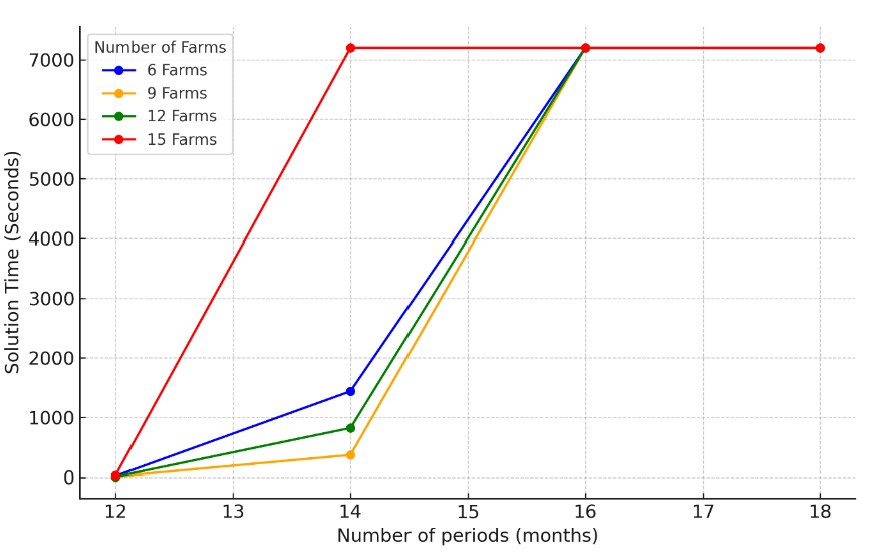
This study introduces a mathematical model designed to optimize the vertically integrated pork supply chain by addressing key cost factors, including pig farming, feed production, and outsourcing. The model integrates pig fattening and feed production stages, incorporating essential cost components to synchronize farming schedules with feed production plans while minimizing total costs. Computational experiments, using data from an empirical study of Thailand's vertically integrated pork supply chain, were conducted to evaluate the model's efficiency and sensitivity under varying farm sizes and planning horizons. The results demonstrate that the model effectively identifies optimal solutions for shorter planning periods (up to 14 months). However, extended planning horizons and larger farm sizes significantly affect solution times and the quality of feasible solutions. These findings provide valuable insights and practical strategies for pork production companies seeking to enhance cost efficiency and improve supply chain sustainability. Future research should focus on developing advanced heuristics and exploring additional supply chain dynamics within integrated environments.
Article Details

This work is licensed under a Creative Commons Attribution-NonCommercial-NoDerivatives 4.0 International License.

This work is licensed under a Creative Commons Attribution-NonCommercial-NoDerivatives 4.0 International License.
References
Kim SW, Gormley A, Jang KB, Duarte ME. Current status of global pig production: an overview and research trends. Anim Biosci. 2023;37(4):719-29.
Ufkes FM. Lean and mean: US meat-packing in an era of agro-industrial restructuring. Environ Plan D Soc Space. 1995;13(6):683-705.
Wang G, Wang J, Chen S, Zhao C. Vertical integration selection of Chinese pig industry chain under African swine fever - from the perspective of stable pig supply. PLoS One. 2023;18(2):e0280626.
Niemi JK, Sevón-Aimonen ML, Stygar AH, Partanen K. The economic and environmental value of genetic improvements in fattening pigs: an integrated dynamic model approach. J Anim Sci. 2015;93(8):4161-71.
Roy A, Choudhary RK, Shee A, Saren AK, Rana T. Recent advancements in scientific management practices for enhancing the productivity of pigs: a review. Curr J Appl Sci Technol. 2023;45(32):42-53.
Wiedemann SG, McGahan EJ, Murphy CM. Environmental impacts and resource use from Australian pork production determined using life cycle assessment. Anim Prod Sci. 2017;58(6):1153-63.
Nakrachata-Amon T, Vorasayan J, Pitiruek K, Arunyanart S, Niyamosoth T, Pathumnakul S. Optimizing vertically integrated pork production supply chain: a Lagrangian heuristic approach. Heliyon. 2024;10(6):e26407.
Piewthongngam K, Pathumnakul S, Homkhampad S. An interactive approach to optimize production-distribution planning for an integrated feed swine company. Int J Prod Econ. 2013;142(2):290-301.
Zhou BH, Yin M, Lu ZQ. An improved Lagrangian relaxation heuristic for the scheduling problem of operating theatres. Comput Ind Eng. 2016;101:490-503.
Solano-Blanco AL, González JE, Medaglia AL. Production planning decisions in the broiler chicken supply chain with growth uncertainty. Oper Res Perspect. 2023;10:100273.
Nadal-Roig E, Plà-Aragonès LM, Pagès-Bernaus A, Albornoz VM. A two-stage stochastic model for pig production planning in vertically integrated production systems. Comput Electron Agric. 2020;176:105615.
Villalba D, Díez-Unquera B, Carrascal A, Bernués A, Ruiz R. Multi-objective simulation and optimisation of dairy sheep farms: exploring trade-offs between economic and environmental outcomes. Agric Syst. 2019;173:107-18.
Han JH, Kim YD. Design and operation of a two-level supply chain for production-time-dependent products using Lagrangian relaxation. Comput Ind Eng. 2016;96:118-25.
Khamjan S, Piewthongngam K, Pathumnakul S. Pig procurement plan considering pig growth and size distribution. Comput Ind Eng. 2013;64(4):886-94.
Praseeratasang N, Pitakaso R, Sethanan K, Kaewman S, Golinska-Dawson P. Adaptive large neighborhood search for a production planning problem arising in pig farming. J Open Innov Technol Mark Complex. 2019;5(2):26.
Moryadee S. A mixed-integer linear program for supply chain management problem: case study of dairy department, the Thai Vet Army School. KKU Eng J. 2016;43(S2):346-9.
Taghikhah F, Voinov A, Shukla N, Filatova T, Anufriev M. Integrated modeling of extended agro-food supply chains: a systems approach. Eur J Oper Res. 2021;288(3):852-68.
Gholamian MR, Taghanzadeh AH. Integrated network design of wheat supply chain: a real case of Iran. Comput Electron Agric. 2017;140:139-47.
Kogler C, Schimpfhuber S, Eichberger C, Rauch P. Benchmarking procurement cost saving strategies for wood supply chains. Forests. 2021;12(8):1086.
Chakraborty D, Jana DK, Roy TK. Multi-item integrated supply chain model for deteriorating items with stock-dependent demand under fuzzy random and bifuzzy environments. Comput Ind Eng. 2015;88:166-80.
LINGO System Inc. LINGO User’s Manual (version 13). Chicago: LINDO Systems Inc.; 2011.
Ivanov B, Nikolova D, Kirilova E, Vladova R. A MILP approach of optimal design of a sustainable combined dairy and biodiesel supply chain using dairy waste scum generated from dairy production. Comput Chem Eng. 2022;166:107976.
Mostaghim N, Gholamian MR, Arabi M. Designing a resilient-sustainable integrated broiler supply chain network using multiple sourcing and backup facility strategies dealing with uncertainties in a disruptive network: a real case of a chicken meat network. Comput Chem Eng. 2024;188:108772.
Sebatjane M, Cárdenas-Barrón LE, Nobil AH. Sustainable inventory models for a three-echelon food supply chain with growing items and price- and carbon emissions-dependent demand under different emissions regulations. Clean Logist Supply Chain. 2024;13:100192.
Urra-Calfuñir BA, Monardes-Concha CA, Miranda-González PA. Agri-food supply chain optimization through a decentralized production process in the olive oil industry. Comput Ind Eng. 2024;192:110185.
Fikry I, Gheith M, Eltawil A. An integrated production-logistics-crop rotation planning model for sugar beet supply chains. Comput Ind Eng. 2021;157:107300.
Jabbarzadeh A, Shamsi M. Designing a resilient and sustainable multi-feedstock bioethanol supply chain: integration of mathematical modeling and machine learning. Appl Energy. 2025;377:123794.
