
Modeling standard lines for soil compaction testing using artificial neural networks and geometric algorithms
Article Sidebar
Main Article Content
Abstract
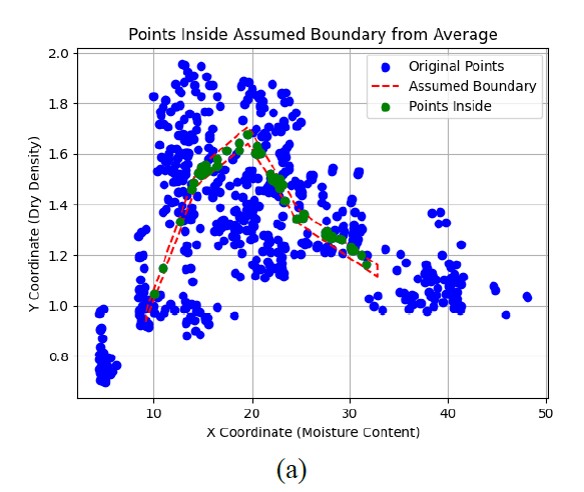
Soil compaction testing is crucial for ensuring the stability and durability of infrastructure projects. Traditional methods for generating standard lines, such as averaging and polynomial fitting, often fail to capture the nonlinear relationships and variability in compaction data, leading to inaccuracies in soil property assessments. This study introduces a novel framework that leverages Artificial Neural Networks (ANNs) to dynamically model standard lines for compaction curves, addressing limitations of traditional approaches. Four activation functions—ReLU, Sigmoid, Tanh, and Swish—were evaluated, with Swish emerging as most effective for capturing complex relationships between Dry Density (DD) and Moisture Content (MC). A tolerance-based evaluation framework, incorporating tolerance levels of 2%, 5%, and 10%, was applied to analyze coverage areas. The 5% tolerance level was identified as most balanced, minimizing errors while providing reliable representations of compaction data. The study also introduced the Ray-Casting Algorithm for precise calculation of coverage areas, enabling a new performance indicator based on density of data points within the region. Results demonstrate that the ANN framework, particularly with Swish activation, outperforms traditional statistical methods in accuracy and adaptability. ReLU delivered the best performance, with the lowest prediction and percentage errors (0.1910–0.2005 and 10.66%–11.74%), while effectively explaining over 55% of the data’s variability. Sigmoid showed the weakest results, with high errors and near-zero variance explanation. Tanh performed moderately, balancing accuracy and generalization with reasonable error levels and 44%–54% variance capture. Swish was consistently reliable, with stable errors and over 50% of the variance explained. This research advances compaction testing by addressing variability, operator-induced errors, and nonlinear data patterns, establishing a reliable methodology for generating standard lines. Future work could explore diverse soil types, integrate environmental factors, develop hybrid machine learning models, and improve performance indicators.
Article Details

This work is licensed under a Creative Commons Attribution-NonCommercial-NoDerivatives 4.0 International License.

This work is licensed under a Creative Commons Attribution-NonCommercial-NoDerivatives 4.0 International License.
References
Almuaythir S, Zaini MSI, Lodhi RH. Predicting soil compaction parameters in expansive soils using advanced machine learning models: a comparative study. Sci Rep. 2025;15(1):24018.
ASTM. ASTM D698-12e2: standard test methods for laboratory compaction characteristics of soil using standard effort. West Conshohocken: ASTM International; 2012.
Othman K, Abdelwahab H. Prediction of the soil compaction parameters using deep neural networks. Transp Infrastruct Geotech. 2023;10:147-64.
Jalal FE, Xu Y, Iqbal M, Jamhiri B, Javed MF. Predicting the compaction characteristics of expansive soils using two genetic programming-based algorithms. Transp Geotech. 2021;30:100608.
Okonkwo UN, Ekeoma EC, Eleke LO. Polynomial models for predicting time limits for compaction after mixing operation of lateritic soil reinforced using cement or lime. J Civ Eng Sci Technol. 2023;14(1):26-34.
Zainal AKE. Mathematical modeling of compaction curve using normal distribution functions. J Eng. 2018;24(2):118-30.
Gurtug Y, Sridharan A, İkizler SB. Simplified method to predict compaction curves and characteristics of soils. Iran J Sci Technol Trans Civ Eng. 2018;42(6):207-16.
Wang X, Li J, Li J, Zhang J, Ma G. Advanced intelligent compaction strategy for subgrade soil considering heterogeneous database. J Rock Mech Geotech Eng. 2025;17(5):3265-79.
Yao Y, Song E. Intelligent compaction methods and quality control. Smart Constr Sustain Cities. 2023;1:2.
Sinha SK, Wang MC. Artificial neural network prediction models for soil compaction and permeability. Geotech Geol Eng. 2008;26(1):47-64.
Aydın Y, Işıkdağ Ü, Bekdaş G, Nigdeli SM, Geem ZW. Use of machine learning techniques in soil classification. Sustainability. 2023;15(3):2374.
Wang HL, Yin ZY. High performance prediction of soil compaction parameters using multi-expression programming. Eng Geol. 2020;276:105758.
Yaghoubi E, Yaghoubi E, Khamees A, Vakili AH. A systematic review and meta-analysis of artificial neural network, machine learning, deep learning, and ensemble learning approaches in field of geotechnical engineering. Neural Comput Appl. 2024;36:12655-99.
Lee KL, Singh A. Relative density and relative compaction. J Soil Mech Found Div. 1971;97(7):1049-52.
Li B, You Z, Ni K, Wang Y. Prediction of soil compaction parameters using machine learning models. Appl Sci. 2024;14(7):2716.
Khatti J, Grover KS. Determination of the optimum performance AI model and methodology to predict the compaction parameters of soils. ICTACT J Soft Comput. 2022;12(3):2640-50.
Khatti J, Grover KS. Prediction of compaction parameters of compacted soil using LSSVM, LSTM, LSBoostRF, and ANN. Innov Infrastruct Solut. 2023;8(1):76.
Khatti J, Grover KS. Assessment of fine-grained soil compaction parameters using advanced soft computing techniques. Arab J Geosci. 2023;16(3):208.
Khatti J, Grover KS. Evaluation of compactive parameters of soil using machine learning. In: Muthukkumaran K, Ayothiraman R, Kolathayar S, editors. Soil Dynamics, Earthquake and Computational Geotechnical Engineering. Lecture Notes in Civil Engineering, vol 300. Singapore: Springer; 2023. p. 1-14.
Khatti J, Grover KS. Prediction of compaction parameters for fine-grained soil: critical comparison of the deep learning and standalone models. J Rock Mech Geotech Eng. 2023;15(11):3010-38.
Khan MHA, Jafri TH, Ud-Din S, Ullah HS, Nawaz MN. Prediction of soil compaction parameters through the development and experimental validation of Gaussian process regression models. Environ Earth Sci. 2024;83:129.
Mohammed AMA, Husain O, Abdulkareem M, Yunus NZM, Jamaludin N, Mutaz E, et al. Explainable artificial intelligence for predicting the compressive strength of soil and ground granulated blast furnace slag mixtures. Results Eng. 2025;25:103637.
Adamolekun LB, Saliu MA, Lawal AI, Okewale IA. Development of machine learning-based standalone GUI application for predicting hydraulic conductivity and compaction parameters of lateritic soils. Sci Afr. 2024;26:e02393.
Szandała T. Review and comparison of commonly used activation functions for deep neural networks [Internet]. arXiv [Preprint]. 2020 [cited 2025 Apr 2]. Available from: https://arxiv.org/abs/2010.09458.
Goodfellow I, Bengio Y, Courville A. Deep Learning. London: MIT Press; 2016.
Agarap AF. Deep learning using rectified linear units (ReLU) [Internet]. arXiv [Preprint]. 2018 [cited 2025 Jan 15]. Available from: https://arxiv.org/abs/1803.08375.
Ramachandran P, Zoph B, Le QV. Searching for activation functions [Internet]. arXiv [Preprint]. 2017 [cited 2025 Jan 15]. Available from: https://arxiv.org/abs/1710.05941.
Nwankpa C, Ijomah W, Gachagan A, Marshall S. Activation functions: comparison of trends in practice and research for deep learning [Internet]. arXiv [Preprint]. 2018 [cited 2025 Jan 15]. Available from: https://arxiv.org/abs/1811.03378.
Willmott CJ, Matsuura K. Advantages of the mean absolute error (MAE) over the root mean square error (RMSE) in assessing average model performance. Clim Res. 2005;30(1):79-82.
Chai T, Draxler RR. Root mean square error (RMSE) or mean absolute error (MAE)? arguments against avoiding RMSE in the literature. Geosci Model Dev. 2014;7(3):1247-50.
Flores BE. A pragmatic view of accuracy measurement in forecasting. Omega. 1986;14(2):93-8.
de Myttenaere A, Golden B, Le Grand B, Rossi F. Mean absolute percentage error for regression models. Neurocomputing. 2016;192:38-48.
Japkowicz N, Shah M. Performance evaluation in machine learning. In: El Naqa I, Li R, Murphy M, editors. Machine Learning in Radiation Oncology. Cham: Springer; 2015. p. 41-56.
Moriasi DN, Arnold JG, Van Liew MW, Bingner RL, Harmel RD, Veith TL. Model evaluation guidelines for systematic quantification of accuracy in watershed simulations. Trans ASABE. 2007;50(3):885-900.
Nash JE, Sutcliffe JV. River flow forecasting through conceptual models: part I—a discussion of principles. J Hydrol. 1970;10(3):282-90.
Gauch HG, Hwang JTG, Fick GW. Model evaluation by comparison of model predictions and observed values. Agron J. 2003;95(6):1442-6.
