
Flexural performance of reinforced concrete beams used shredded scrap tire rubber and steel fibers
Article Sidebar
Main Article Content
Abstract
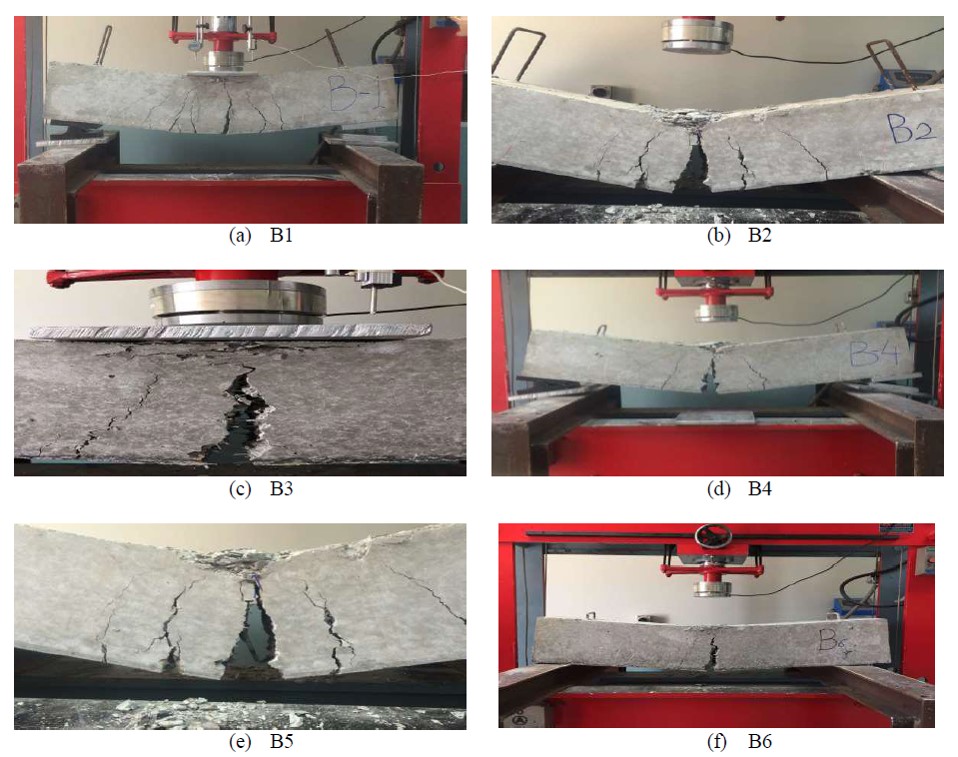
This research experimentally investigates the flexural performance of fibrous reinforced concrete beams containing shredded scrap tire rubber (SSTR) as a substitute for gravel. Six reinforced concrete (RC) beams (1500 × 300 × 200 mm) were prepared with varying steel fibers (SF) (0%, 0.5%, 1%, and 1.5%) and SSTR (0%, 5%, 7.5%, and 10%) by volume of concrete. All samples were tested as simply supported beams under 3-point static loads. The RC beam with natural materials (0% SSTR and 0% SF) exhibited a typical crack propagation pattern, while the addition of 1% SF and 5% SSTR caused cracks to cease, resulting in ductile behavior. The optimal percentages were found to be 1% SF and 5% SSTR. The presence of SSTR reduced the compressive strength due to the impermeability of rubber, which helps absorb load energy, though SF additions improved this. Compressive strength reductions for 5%, 7.5%, and 10% SSTR were 15.37%, 11.64%, and 18.08%, respectively, compared to the control mix. However, the compressive strength of concrete containing 1% SF and 5% SSTR increased slightly by about 2.52%. Flexural strength of concrete prisms also decreased with higher SSTR content and varied SF dosages. Compared to the control mix, reductions in flexural strength for 0.5% SF with 5%, 7.5%, and 10% SSTR were 14.29%, 19.05%, and 19.05%, respectively. These reductions are due to the poor bond between SSTR and the cement matrix. The flexural performance of the reinforced concrete beam improved slightly by 1.71% for the B5 beam, which was made with 5% SSTR and 1% SF, accompanied by a slight increase in deflection (2.24%) and beam weight. The design ultimate loads from BS8110 were lower than the experimental values, with ratios of tested failure load to design ultimate load ranging from 1.99 to 2.78, the maximum ratio achieved by the B5 beam.
Article Details

This work is licensed under a Creative Commons Attribution-NonCommercial-NoDerivatives 4.0 International License.

This work is licensed under a Creative Commons Attribution-NonCommercial-NoDerivatives 4.0 International License.
References
Oman Daily Observer. Be’ah seeks ways to recycle waste tyres [Internet]. 2017 [cited 2025 Jan 3]. Available from: https://www.omanobserver.om/article/90397/Main/beah-seeks-ways-to-recycle-waste-tyres.
Hernandez-Olivares F, Barluenga G, Bollati M, Witoszek B. Static and dynamic behaviour of recycled tyre rubber-filled concrete. Cem Concr Res. 2002;32(10):1587-96.
Ahmad J, Zhou Z, Majdi A, Alqurashi M, Deifalla AF. Overview of concrete performance made with waste rubber tires: a step toward sustainable concrete. Materials. 2022;15(16):5518.
Venkatesan G, Saravanakumar M, Kapgate BP, Rajkumar K. Laboratory studies on strength behavior of concrete added with tire derived products. Mater Today: Proc. 2020;33:2665-70.
Martínez-Barrera G, del Coz-Díaz JJ, Álvarez-Rabanal FP, Gayarre FL, Martínez-López M, Cruz-Olivares J. Waste tire rubber particles modified by gamma radiation and their use as modifiers of concrete. Case Stud Constr Mater. 2020;12:e00321.
Záleská M, Pavlík Z, Čítek D, Jankovský O, Pavlíková M. Eco-friendly concrete with scrap-tyre-rubber-based aggregate–properties and thermal stability. Constr Build Mater. 2019;225:709-22.
Eldin NN, Senouci AB. Measurement and prediction of the strength of rubberized concrete. Cem Concr Compos. 1994;16(4):287-98.
Reda Taha MM, El-Dieb AS, Abd El-Wahab MA, Abdel-Hameed ME. Mechanical, fracture, and microstructural investigations of rubber concrete. J Mater Civ Eng. 2008;20(10):640-9.
Sukontasukkul P, Tiamlom K. Expansion under water and drying shrinkage of rubberized concrete mixed with crumb rubber with different size. Constr Build Mater. 2012;29:520-6.
Chaikaew C, Sukontasukkul P, Chaisakulkiet U, Sata V, Chindaprasirt P. Properties of concrete pedestrian blocks containing crumb rubber from recycle waste tyres reinforced with steel fibres. Case Stud Constr Mater. 2019;11:e00304.
Vikhyath, Kumar MSR. Experimental investigation of waste rubber and steel fiber reinforced cement concrete. Int J Eng Res Adv Technol. 2018;4(9):25-36.
Sreeshma PK, Varghese S. Effect of combination of steel fiber and crumb rubber on the properties of concrete. Int J Innov Res Adv Eng. 2016;3(8):58-63.
Ganjian E, Khorami M, Maghsoudi AA. Scrap-tyre-rubber replacement for aggregate and filler in concrete. Constr Build Mater. 2009;23(5):1828-36.
Panda KC, Parhi PS, Jena T. Scrap-tyre-rubber replacement for aggregate in cement concrete: experimental study. Int J Earth Sci Eng. 2012;5(6):1692-701.
Dumne SM. An experimental study on performance of recycled tyre rubber-filled concrete. Int J Eng Res Technol. 2013;2(12): 766-72.
Eldhose C, Soosan TG. Studies on scrap tyre added concrete for rigid pavements. Int J Eng Res. 2014;3(12):777-9.
Kotresh KM, Belachew MG. Study on waste tyre rubber as concrete aggregates. Int J Sci Eng Technol. 2014;3(4):433-6.
Asutkar P, Shinde SB, Patel R. Study on the behavior of rubber aggregates concrete beams using analytical approach. Eng Sci Technol Int J. 2017;20(1):151-9.
Gerges NN, Issa CA, Fawaz SA. Rubber concrete: mechanical and dynamical properties. Case Stud Constr Mater. 2018;9: e00184.
Thomas BS, Gupta RC. Long term behavior of cement concrete containing discarded tire rubber. J Clean Prod. 2015;102:78-87.
Senin MS, Shahidan S, Abdullah SR, Guntor NA, Leman AS. A review on the suitability of rubberized concrete for concrete bridge decks. IOP Conf Ser: Mater Sci Eng. 2017;271:012074.
Moustafa A, ElGawady MA. Strain rate effect on properties of rubberized concrete confined with glass fiber-reinforced polymers. J Compos Constr. 2016;20(5):04016014.
Onuaguluchi O. Effects of surface pre-coating and silica fume on crumb rubber-cement matrix interface and cement mortar properties. J Clean Prod. 2015;104:339-45.
Adamu M, Mohammed BS, Liew MS. Effect of crumb rubber and nano silica on the creep and drying shrinkage of roller compacted concrete pavement. Int J Geomate. 2018;15(47):58-65.
Xie JH, Guo YC, Liu LS, Xie ZH. Compressive and flexural behaviours of a new steel-fibre-reinforced recycled aggregate concrete with crumb rubber. Constr Build Mater. 2015;79:263-72.
Noaman AT, Abu Bakar BH, Akil HM. Experimental investigation on compression toughness of rubberized steel fiber concrete. Constr Build Mater. 2016;115:163-70.
Tawfeeq WM, Ali TKM, Al-Kumzari Y, Al-Hosni M, Al-Fazari K, Al-Bedwawi M, et al. Flexural performance of reinforced concrete beams made by using recycled block aggregates and fibers. Innov Infrastruct Solut. 2021;6:38.
Sharaky IA, Seleem MH, Elamary AS. Minimizing the crumb rubber effects on the flexural behaviour of the layered RC beams cast using rubberized concrete with or without recycled tire steel fibers. Constr Build Mater. 2023;400:132503.
Ismail MK, Hassan AAA. An experimental study on flexural behaviour of large-scale concrete beams incorporating crumb rubber and steel fibres. Eng Struct. 2017;145:97-108.
Shahjalal M, Islam K, Rahman J, Ahmed KS, Karim MR, Billah AHMM. Flexural response of fiber reinforced concrete beams with waste tires rubber and recycled aggregate. J Clean Prod. 2021;278:123842.
Xu J, Chang F, Bai J, Liu C. Statistical analysis on the fracture behavior of rubberized steel fiber reinforced recycled aggregate concrete based on acoustic emission. J Mater Res Technol. 2023;24:8997-9014.
Islam MMU, Li J, Roychand R, Saberian M, Chen F. A comprehensive review on the application of renewable waste tire rubbers and fibers in sustainable concrete. J Clean Prod. 2022;374:133998.
Jirawattanasomkul T, Minakawa H, Likitlersuang S, Ueda T, Dai JG, Wuttiwannasak N, et al. Use of water hyacinth waste to produce fibre-reinforced polymer composites for concrete confinement: mechanical performance and environmental assessment. J Clean Prod. 2021;292:126041.
Shufrin I, Pasternak E, Dyskin A. Environmentally friendly smart construction—review of recent developments and opportunities. Appl Sci. 2023;13(23):12891.
Oman Daily Observer. Be’ah to supply scrap tyres to Oman cement in waste to energy deal [Internet]. 2020 [cited 2025 Jan 3]. Available from: https://www.omanobserver.om/article/16838/Business/beah-to-supply-scrap-tyres-to-oman-cement-in-waste-to-energy-deal.
British Standards Institution. BS 882:1992. Specification for aggregates from natural sources for concrete. London: British Standards Institution; 1992.
British Standards Institution. BS EN993-1:1997. Tests for geometrical properties of aggregates. Part 1: Determination of particle size distribution — sieving method. London: British Standards Institution; 1997.
British Standards Institution. BS 812–2:1995. Testing aggregates. Part 2. Methods of determination of density. London: British Standards Institution; 1995.
British Standards Institution. BS EN1097-3:1998. Tests for mechanical and physical properties of aggregates. Part 3: Determination of loose bulk density and voids. London: British Standards Institution; 1998.
British Standards Institution. BS EN197-1:2000. Cement–Part 1: Composition, specifications and conformity criteria for common cements. London: British Standards Institution; 2000.
Neville AM, Brooks JJ. Concrete technology. 2nd ed. Harlow: Prentice Hall; 2010.
Kashani A, Ngo TD, Hemachandra P, Hajimohammadi A. Effects of surface treatments of recycled tyre crumb on cement-rubber bonding in concrete composite foam. Constr Build Mater. 2018;171:467-73.
Khaloo AR, Dehestani M, Rahmatabadi P. Mechanical properties of concrete containing a high volume of tire–rubber particles. Waste Manag. 2008;28(12):2472-82.
Min K, Pei X, Li H, Cao Z, Yang Z, Hao D, et al. Optimization of cohesive parameters in the interfacial transition zone of rubberized concrete based on the response surface method. Polymers. 2024;16(11):1579.
British Standards Institution. BS EN12350-2:2009. Testing fresh concrete. Part 2: Slump-test. London: British Standards Institution; 2009.
British Standards Institution. BS EN12390-3:2002. Testing hardened concrete-Part 3: Compressive strength of test specimens. London: British Standards Institution; 2002.
British Standards Institution. BS EN12390-5:2019. Testing hardened concrete-Part 5: Flexural strength of test specimens. London: British Standards Institution; 2019.
Mosley WH, Bungey JH. Reinforced concrete design. 4th ed. London: Macmillan; 1999.
Shahjalal M, Islam MA, Prantik RA, Ahmed KS. Mechanical characterization of concrete containing crumb rubber and recycled brick aggregate. AIP Conf Proc. 2021;2441:030012.
Islam MMU, Li J, Wu YF, Roychand R, Saberian M. Design and strength optimization method for the production of structural lightweight concrete: an experimental investigation for the complete replacement of conventional coarse aggregates by waste rubber particles. Resour Conserv Recycl. 2022;184:106390.
Song PS, Hwang S. Mechanical properties of high-strength steel fiber-reinforced concrete. Constr Build Mater. 2004;18(9):669-73.
British Standards Institution. BS8110-1:1997. Structural use of concrete-Part 1: Code of practice for design and construction. London: British Standards Institution; 1997.
