
Green-Synthesis and characterization of TiO2 anatase nanoparticles as photocatalyst materials of methylene blue degradation
Article Sidebar
Main Article Content
Abstract
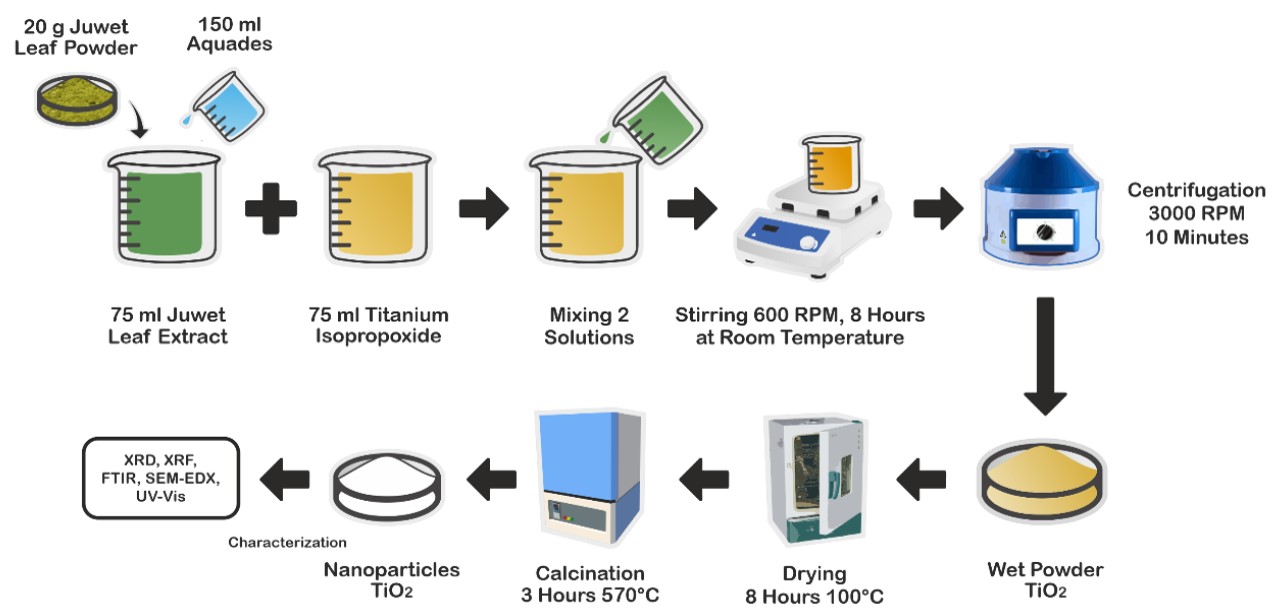
Water pollution is a critical global issue, hindering the achievement of SDG-6 on clean water and sanitation. Titanium dioxide (TiO₂) nanoparticles (NPs) have emerged as effective photocatalysts for degrading organic pollutants. Green synthesis, utilizing plant-derived phytochemicals as natural reducing and capping agents, offers an eco-friendly alternative to conventional methods. This study reports the green synthesis of TiO₂ NPs using just (Syzygium cumini) leaf extract as a reductant. The synthesized nanoparticles were characterized using XRD, XRF, FTIR, UV-Vis, bandgap analysis, SEM, and TEM. The results confirmed the formation of anatase-phase TiO₂ with 98.21% purity (XRF), a spherical morphology (»10-50 nm), and a bandgap of 2.94 eV. Photocatalytic tests demonstrated 94.92% and 95.89% methylene blue degradation efficiencies after 180 and 240 minutes under UV light. These findings highlight the potential of green-synthesized TiO₂ NPs for environmental remediation. Future studies should explore modifications to enhance photocatalytic performance for wastewater treatment applications.
Article Details

This work is licensed under a Creative Commons Attribution-NonCommercial-NoDerivatives 4.0 International License.

This work is licensed under a Creative Commons Attribution-NonCommercial-NoDerivatives 4.0 International License.
References
Kedzior SB. Clean water and universal sanitation in an Era of sustainable development: understanding the challenges and prospects for SDG 6 in the Ganga River Basin. In: Dutta V, Ghosh P, editors. Sustainability: Science, Policy, and Practice in India. Sustainable Development Goals Series. Cham: Springer; 2023. p. 85-103.
Milan BF. Clean water and sanitation for all: interactions with other sustainable development goals. Sustain Water Resour Manag. 2017;3(4):479-89.
Chowdhary P, Bharagava RN, Mishra S, Khan N. Role of industries in water scarcity and its adverse effects on environment and human health. In: Shukla V, Kumar N, editors. Environmental Concerns and Sustainable Development. Singapore: Springer; 2020. p. 235-56.
Adyasari D, Pratama MA, Teguh NA, Sabdaningsih A, Kusumaningtyas MA, Dimova N. Anthropogenic impact on Indonesian coastal water and ecosystems: current status and future opportunities. Mar Pollut Bull. 2021;171:112689.
Murgolo S, De Ceglie C, Di Iaconi C, Mascolo G. Novel TiO2-based catalysts employed in photocatalysis and photoelectrocatalysis for effective degradation of pharmaceuticals (PhACs) in water: a short review. Curr Opin Green Sustain Chem. 2021;30:100473.
Ahmadpour N, Nowrouzi M, Avargani VM, Sayadi MH, Zendehboudi S. Design and optimization of TiO2-based photocatalysts for efficient removal of pharmaceutical pollutants in water: recent developments and challenges. J Water Process Eng. 2024;57:104597.
Maqbool Q, Czerwinska N, Giosue C, Sabbatini S, Ruello ML, Tittarelli F. New waste-derived TiO2 nanoparticles as a potential photocatalytic additive for lime based indoor finishings. J Clean Prod. 2022;373:133853.
Kalse SB, Swami SB. Recent application of jackfruit waste in food and material engineering: a review. Food Biosci. 2022;48:101740.
Narath S, Koroth SK, Shankar SS, George B, Mutta V, Wacławek S, et al. Cinnamomum tamala leaf extract stabilized zinc oxide nanoparticles: a promising photocatalyst for methylene blue degradation. Nanomaterials. 2021;11(6):1558.
Khoirotin, Faaizatunnisa N, Munasir. Green synthesis of Fe3O4 nanoparticles using green betel leaf extract for methylene blue adsorption. Nat Life Sci Commun. 2023;22(3):e2023042.
Bassim S, Mageed AK, AbdulRazak AA, Al-Sheikh F. Photodegradation of methylene blue with aid of green synthesis of CuO/TiO2 nanoparticles from extract of citrus aurantium juice. Bull Chem React Eng Catal. 2023;18(1):1-16.
Sarkar Phyllis AK, Tortora G, Johnson I. Photodegradation. In: Sarkar Phyllis AK, Tortora G, Johnson I, editors. The Fairchild Books Dictionary of Textiles. New York: Bloomsbury Publishing; 2022.
Hanafi MF, Sapawe N. A review on the water problem associate with organic pollutants derived from phenol, methyl orange, and remazol brilliant blue dyes. Mater Today: Proc. 2020;31:A141-50.
Faaizatunnisa N, Ediati R, Fansuri H, Juwono H, Suprapto S, Hidayat ARP, et al. Facile green synthesis of core–shell magnetic MOF composites (Fe3O4@SiO2@HKUST-1) for enhanced adsorption capacity of methylene blue. Nano-Struct Nano-Objects. 2023;34:100968.
Bassim S, Mageed AK, AbdulRazak AA, Majdi HS. Green synthesis of Fe3O4 Nanoparticles and its applications in wastewater treatment. Inorganics. 2022;10(12):260.
Verma V, Al-Dossari M, Singh J, Rawat M, Kordy MGM, Shaban M. A review on green synthesis of TiO2 NPs: synthesis and applications in photocatalysis and antimicrobial. Polymers (Basel). 2022;14(7):1444.
Faaizatunnisa N, Ediati R, Yusof ENM, Fadlan A, Karelius K, Kulsum U, et al. The mixed-ligand strategy for structural modification of MOF materials to enhance the photocatalytic degradation and adsorption of organic pollutants: a review. Nano-Struct Nano-Objects. 2024;40:101366.
Dastan D, Chaure NB. Influence of surfactants on TiO2 nanoparticles grown by sol-gel technique. Int J Mater Mech Manuf. 2014;2(1):21-4.
Okto SHS, As’adah A, Putri AR, Basmalah M, Munasir M. Green synthesis of TiO₂ nanoparticles from Juwet leaf extract (Syzygium cumini) as a photocatalytic material: removing ion-Pb in industrial wastewater. Prosiding Seminar Nasional Unimus. 2022;5:647-56. (In Indonesian)
Ali K, Dwivedi S, Azam A, Saquib Q, Al-Said MS, Alkhedhairy AA, et al. Aloe vera extract functionalized zinc oxide nanoparticles as nanoantibiotics against multi-drug resistant clinical bacterial isolates. J Colloid Interface Sci. 2016;472:145-56.
Vinayagam R, Batra S, Murugesan G, Goveas LC, Varadavenkatesan T, Menezes A, et al. Emerging contaminant removal using eco-friendly zinc ferrite nanoparticles: sunlight-driven degradation of tetracycline. Emerg Contam. 2025;11(2):100469.
Li Y, Fu Y, Zhu M. Green synthesis of 3D tripyramid TiO2 architectures with assistance of aloe extracts for highly efficient photocatalytic degradation of antibiotic ciprofloxacin. Appl Catal B Environ. 2020;260:118149.
Anbumani D, Dhandapani KV, Manoharan J, Babujanarthanam R, Bashir AKH, Muthusamy K, et al. Green synthesis and antimicrobial efficacy of titanium dioxide nanoparticles using Luffa acutangula leaf extract. J King Saud Univ Sci. 2022;34(3):101896.
Huamán A, Salazar K, Quintana M. Molecular interaction of natural dye based on Zea mays and Bixa orellana with nanocrystalline TiO2 in dye sensitized solar cells. J Electrochem Sci Eng. 2021;11(3):179-95.
Nabi G, Majid A, Riaz A, Alharbi T, Kamran MA, Al-Habardi M. Green synthesis of spherical TiO2 nanoparticles using Citrus Limetta extract: excellent photocatalytic water decontamination agent for RhB dye. Inorg Chem Commun. 2021;129:108618.
Pushpamalini T, Keerthana M, Sangavi R, Nagaraj A, Kamaraj P. Comparative analysis of green synthesis of TiO2 nanoparticles using four different leaf extract. Mater Today: Proc. 2021;40:S180-4.
Krisdiyanto D, Khuzaifah S, Khamidinal K, Sedyadi E, et al. Influence of dye adsorbtion time on TiO2 dye-sensitized solar cell with krokot extract (Portulaca Oleracea. L) as a natural sensitizer. J Pure Appl Chem Res. 2015;4(1):17-24.
Vembu S, Vijayakumar S, Nilavukkarasi M, Vidhya E, Punitha VN. Phytosynthesis of TiO2 nanoparticles in diverse applications: what is the exact mechanism of action?. Sens Int. 2022;3:100161.
Selvaraj R, Nagendran V, Varadavenkatesan T, Goveas LC, Vinayagam R. Stable silver nanoparticles synthesis using Tabebuia aurea leaf extract for efficient water treatment: a sustainable approach to environmental remediation. Chem Eng Res Des. 2024;208:456-63.
Ghosh S, Das AP. Modified titanium oxide (TiO2) nanocomposites and its array of applications: a review. Toxicol Environ Chem. 2015;97(5):491-514.
Maurya IC, Singh S, Senapati S, Srivastava P, Bahadur L. Green synthesis of TiO2 nanoparticles using Bixa orellana seed extract and its application for solar cells. Sol Energy. 2019;194:952-8.
Varadavenkatesan T, Nagendran V, Vinayagam R, Goveas LC, Selvaraj R. Effective degradation of dyes using silver nanoparticles synthesized from Thunbergia grandiflora leaf extract. Bioresour Technol Rep. 2024;27:101914.
Eddy DR, Permana MD, Sakti LK, Sheha GAN, Solihudin, Hidayat S, et al. Heterophase Polymorph of TiO2 (Anatase, Rutile, Brookite, TiO2 (B)) for efficient photocatalyst: fabrication and activity. Nanomaterials. 2023;13(4):704.
Koelsch M, Cassaignon S, Guillemoles JF, Jolivet JP. Comparison of optical and electrochemical properties of anatase and brookite TiO2 synthesized by the sol-gel method. Thin Solid Films. 2002;403-404:312-9.
Allen NS, Mahdjoub N, Vishnyakov V, Kelly PJ, Kriek RJ. The effect of crystalline phase (anatase, brookite and rutile) and size on the photocatalytic activity of calcined polymorphic titanium dioxide (TiO2). Polym Degrad Stab. 2018;150:31-6.
Sethy NK, Arif Z, Mishra PK, Kumar P. Green synthesis of TiO2 nanoparticles from Syzygium cumini extract for photocatalytic removal of lead (Pb) in explosive industrial wastewater. Green Process Synth. 2020;9(1):171-81.
Kharat SN, Mendhulkar VD. Synthesis, characterization and studies on antioxidant activity of silver nanoparticles using Elephantopus scaber leaf extract. Mater Sci Eng C Mater Biol Appl. 2016;62:719-24.
Sunny NE, Mathew SS, Chandel N, Saravanan P, Rajeshkannan R, Rajasimman M, et al. Green synthesis of titanium dioxide nanoparticles using plant biomass and their applications- a review. Chemosphere. 2022;300:134612.
Tien TWH, Rasmiyanti NKE, Tandi J, Magfirah. Total secondary metabolites and test of antioxidant activity of juwet leaves (Syzygium cumini L.) with Uv-Vis spectrophotometer. KOVALEN: Jurnal Riset Kimia. 2023;9(3):295-304. (In Indonesia)
Jagetia GC. Bioactive phytoconstituents and medicinal properties of Jamun (Syzygium cumini). J Explor Res Pharmacol. 2024;9(3):180-212.
Zhang H, Banfield JF. Understanding polymorphic phase transformation behavior during growth of nanocrystalline aggregates: insights from TiO2. J Phys Chem B. 2000;104(15):3481-7.
Sharma M, Behl K, Nigam S, Joshi M. TiO2-GO nanocomposite for photocatalysis and environmental applications: a green synthesis approach. Vacuum. 2018;156:434-9.
Munasir N, Kusumawati RP, Kusumawati DH, Supardi ZAI, Taufiq A, Darminto. Characterization of Fe3O4/rGO composites from natural sources: application for dyes color degradation in aqueous solution. Int J Eng Trans A: Basics. 2020;33(1):18-27.
Bai J, Zhou B. Titanium dioxide nanomaterials for sensor applications. Chem Rev. 2014;114(19):10131-76.
Eshwarappa RSB, Iyer RS, Subbaramaiah SR, Richard SA, Dhananjaya BL. Antioxidant activity of Syzygium cumini leaf gall extracts. Bioimpacts. 2014;4(2):101-7.
Banerjee A, Dasgupta N, De B. In vitro study of antioxidant activity of Syzygium cumini fruit. Food Chem. 2005;90(4):727-33.
da Rosa ACS, Hoscheid J, Garcia VAdS, de Oliveira Santos Junior O, da Silva C. Phytochemical extract from Syzygium cumini leaf: maximization of compound extraction, chemical characterization, antidiabetic and antibacterial activity, and cell viability. Processes 2024;12(10):2270.
Djerdj I, Tonejc AM. Structural investigations of nanocrystalline TiO2 samples. J Alloys Compd. 2006;413(1-2):159-74.
You YF, Xu CH, Xu SS, Cao S, Wang JP, Huang YB, et al. Structural characterization and optical property of TiO2 powders prepared by the sol–gel method. Ceram Int. 2014;40(6):8659-66.
Jalaukhan AHA. Optical investigation of TiO2/graphene oxide thinfilm prepared by spin coating technique. IOP Conf Ser: Mater Sci Eng. 2020;871:012087.
Dodoo-Arhin D, Buabeng FP, Mwabora JM, Amaniampong PN, Agbe H, Nyankson E, et al. The effect of titanium dioxide synthesis technique and its photocatalytic degradation of organic dye pollutants. Heliyon. 2018; 4(7):e00681.
Habibi Jetani G, Rahmani MB. TiO2/GO nanocomposites: synthesis, characterization, and DSSC application. Eur Phys J Plus. 2020;135(9):720.
Ola O, Maroto-Valer MM. Review of material design and reactor engineering on TiO2 photocatalysis for CO2 reduction. J Photochem Photobiol C: Photochem Rev. 2015;24:16-42.
Perumalsamy H, Balusamy SR, Sukweenadhi J, Nag S, MubarakAli D, El-Agamy Farh M, et al. A comprehensive review on Moringa oleifera nanoparticles: importance of polyphenols in nanoparticle synthesis, nanoparticle efficacy and their applications. J Nanobiotechnol. 2024;22:71.
Žerjav G, Žižek K, Zavašnik J, Pintar A. Brookite vs. rutile vs. anatase: what`s behind their various photocatalytic activities?. J Environ Chem Eng. 2022;10(3):107722.
Nasikhudin, Diantoro M, Kusumaatmaja A, Triyana K. Study on photocatalytic properties of TiO2 nanoparticle in various pH condition. J Phys Conf: Ser. 2018;1011:012069.
Schneider J, Matsuoka M, Takeuchi M, Zhang J, Horiuchi Y, Anpo M, et al. Understanding TiO2 photocatalysis: mechanisms and materials. Chem Rev. 2014;114(19):9919-86.
Islam Molla MA, Tateishi I, Furukawa M, Katsumata H, Suzuki T, Kaneco S. Evaluation of reaction mechanism for photocatalytic degradation of dye with self-sensitized TiO under visible light irradiation. Open J Inorg Non-Met Mater. 2017;7(1):1-7.
Nosaka Y, Nosaka A. Understanding hydroxyl radical (•OH) generation processes in photocatalysis. ACS Energy Lett. 2016;1(2):356-9.
Wang R, Shi K, Huang D, Zhang J, An S. Synthesis and degradation kinetics of TiO2/GO composites with highly efficient activity for adsorption and photocatalytic degradation of MB. Sci Rep. 2019;9:18744.
Saranya KS, Padil VVT, Senan C, Pilankatta R, Saranya SK, George B, et al. Green synthesis of high temperature stable anatase titanium dioxide nanoparticles using gum kondagogu: characterization and solar driven photocatalytic degradation of organic dye. Nanomaterials. 2018;8(12):1002.
Mittal P, Bansal R. Role of cross-disciplinary collaborations for holistic approach to sustainability bt- community engagement for sustainable practices in higher education: from awareness to action. In: Mittal P, Bansal R, editors. Community Engagement for Sustainable Practices in Higher Education. Cham: Palgrave Macmillan; 2024; p. 143-60.
Cai Y, Feng YP. Review on charge transfer and chemical activity of TiO2: Mechanism and applications. Prog Surf Sci. 2016;91(4):183-202.
Gautam A, Kshirsagar A, Biswas R, Banerjee S, Khanna PK. Photodegradation of organic dyes based on anatase and rutile TiO2 nanoparticles. RSC Adv. 2016;6(4):2746-59.
Almashhori K, Ali TT, Saeed A, Alwafi R, Aly M, Al-Hazmi FE. Antibacterial and photocatalytic activities of controllable (anatase/rutile) mixed phase TiO2 nanophotocatalysts synthesized: via a microwave-assisted sol-gel method. New J Chem. 2020;44(2):562-70.
Mustapha FH, Jalil AA, Mohamed M, Triwahyono S, Hassan NS, Khusnun NF, et al. New insight into self-modified surfaces with defect-rich rutile TiO2 as a visible-light-driven photocatalyst. J Clean Prod. 2017;168:1150-62.
Latif S, Tahir K, Khan AU, Abdulaziz F, Arooj A, Alanazi TYA, et al. Green synthesis of Mn-doped TiO2 nanoparticles and investigating the influence of dopant concentration on the photocatalytic activity. Inorg Chem Commun. 2022;146:110091.
Srujana S, Anjamma M, Alimuddin, Singh B, Dhakar RC, Natarajan S, et al. A comprehensive study on the synthesis and characterization of TiO2 nanoparticles using aloe vera plant extract and their photocatalytic activity against MB dye. Adsorpt Sci Technol. 2022;2022:7244006.
