
Ecological concrete blocks with sawdust additions: Overview of mechanical and microstructural analysis
Article Sidebar
Main Article Content
Abstract
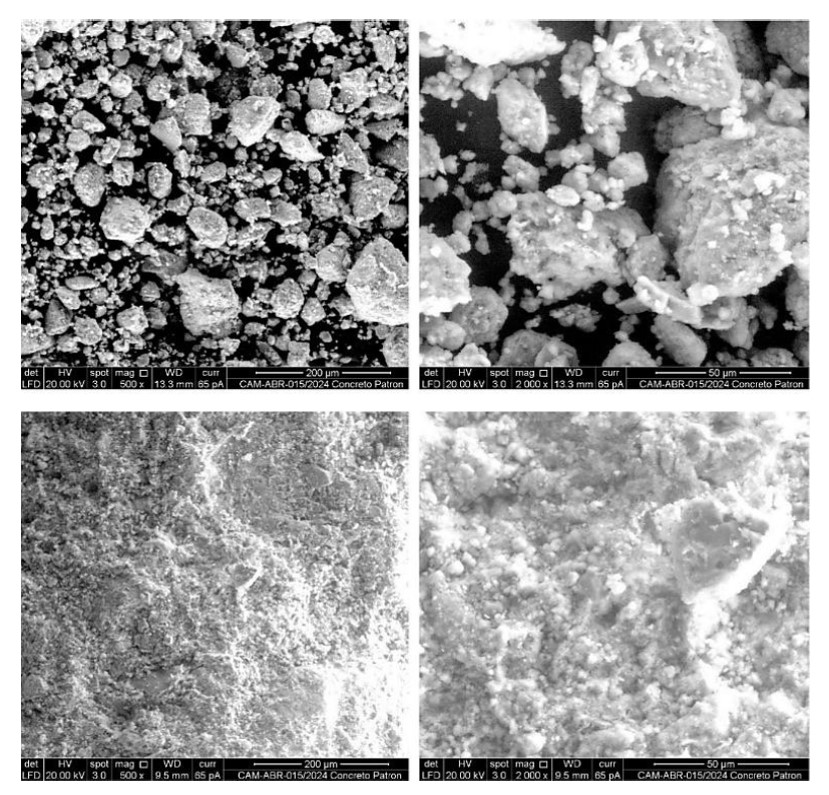
Environmental pollution is closely linked to construction practices, especially due to the reliance on non-sustainable materials. This study addresses the scientific challenge of optimizing the sustainability of non-structural concrete blocks through the addition of sawdust, added as a weight-based replacement for sand. The objective was to develop eco-friendly concrete blocks with sawdust to determine their physical, mechanical, and microstructural characteristics. A control sample was prepared, together with four treatments containing sawdust at 5%, 10%, 15% and 20% as a replacement for sand. Tests were conducted to evaluate compressive strength (CR) of individual masonry units, compressive strength of masonry piles, and diagonal shear strength of masonry walls. The results showed that increasing sawdust content led to higher water absorption compared to the control sample. The optimum performance was observed at a 5% sawdust addition, where the compressive strength of piles and the diagonal shear strength of walls increased by 8.59% and 5.51%, respectively. However, compressive strength in masonry units decreased as the sawdust percentage increased. X-ray diffraction (XRD) and scanning electron microscopy (SEM) analyses revealed the presence of crystals such as quartz, calcite, albite, nahcolite, ettringite, cronstedtite, and an amorphous phase, along with chemical elements like carbon, oxygen, silica, and calcium, as well as a slight reduction in voids. The scientific novelty of this study lies in the integration of sawdust as a sustainable additive to improve specific mechanical properties while reducing environmental impact. It is concluded that it is feasible to produce eco-friendly concrete blocks with low sawdust doses that meet the required mechanical standards and exhibit suitable microstructural characteristics. These blocks can be effectively used in non-load-bearing walls and other construction applications where sustainability is a priority.
Article Details

This work is licensed under a Creative Commons Attribution-NonCommercial-NoDerivatives 4.0 International License.

This work is licensed under a Creative Commons Attribution-NonCommercial-NoDerivatives 4.0 International License.
References
Syamsiyah NR, Mutiari D, Arsandrie Y, Suharyani, Himmah SA. Acoustic performance from a mixture of plastic waste, wood dust, and rice husk. Civ Eng Archit. 2020;8(4):490-9.
Supar K, Rani FAA, Mazlan NL, Musa MK. Partial replacement of fine aggregate using waste materials in concrete as roof tile: a review. IOP Conf Ser: Mater Sci Eng. 2021;1200:012008.
Thakur A, Kasilingam S, Singh AP. Evaluation of concrete bricks with crumb rubber and polypropylene fibres under impact loading. Constr Build Mater. 2022;315:125752.
Raheem AA, Ikotun BD. Incorporation of agricultural residues as partial substitution for cement in concrete and mortar – a review. J Build Eng. 2020;31:101428.
Burgos Cotrina JA, Cubas Benavides EA, Garcia Chumacero JM. Analysis of the combination of glass and polypropylene fibers on the mechanical properties of mortar. J Build Pathol Rehabil. 2025;10:22.
Omar MF, Abdullah MAH, Rashid NA, Abdul Rani AL. Partially replacement of cement by sawdust and fly ash in lightweight foam concrete. IOP Conf Ser: Mater Sci Eng. 2020;743:012035.
De la Cruz Carlos MB, Jiménez Revilla WE, García Chumacero JM, Muñoz Pérez SP, Villegas Granados LM. Influence of sawdust on the mechanical behavior of C28 concrete containing ground glass. Innov Infrastruct Solut. 2024;9:433.
Burga Bustamante G, Muñoz Pérez SP, García Chumacero JM, Sánchez Diaz E, Ruiz Pico AA, Rodriguez Laffite ED, et al. Evaluation of the mechanical behavior of concrete with the addition of dry corn fiber. Innov Infrastruct Solut. 2025;10:29.
Dawood ET, Mahmood MS. Production of sustainable concrete brick units using nano-silica. Case Stud Constr Mater. 2021;14:e00498.
Kilani A, Olubambi A, Ikotun B, Oladejo OS, Famodimu B. Evaluating the reinforcements efficiency of sawdust and corncob wastes in structural concrete: a comprehensive review. J Build Mater Struct. 2023;10:40-63.
Mwango A, Kambole C. Engineering characteristics and potential increased utilisation of sawdust composites in construction—a review. J Build Constr Plan Res. 2019;7(3):59-88.
Raavi SSD, Tripura DD. Predicting and evaluating the engineering properties of unstabilized and cement stabilized fibre reinforced rammed earth blocks. Constr Build Mater. 2020;262:120845.
Meko B, Ighalo JO. Utilization of Cordia Africana wood sawdust ash as partial cement replacement in C 25 concrete. Clean Mater. 2021;1:100012.
Sharba AAK, Hason MM, Hanoon AN, Qader DN, Amran M, Abdulhameed AA, et al. Push-out test of waste sawdust-based steel-concrete – steel composite sections: experimental and environmental study. Case Stud Constr Mater. 2022;17:e01570.
Opiso EM, Supremo RP, Perodes JR. Effects of coal fly ash and fine sawdust on the performance of pervious concrete. Heliyon. 2019;5(11):e02783.
Jeyashree TM, Somesh MS. Characteristic study on concrete elements using agro-waste as a replacement of fine aggregate. Res Eng Struct Mater. 2023;9(4):1255-66.
Muñoz Pérez SP, Sánchez Díaz E, Barboza-Cullqui D, García-Chumacero JM. Use of recycled concrete and rice husk ash for concrete: a review. Journal of Applied Research and Technology. 2024;22(1):138-55.
Muñoz Pérez SP, Santisteban Purizaca JF, Castillo Matute SM, García Chumacero JM, Sánchez Diaz E, Diaz Ortiz EA, et al. Glass fiber reinforced concrete: overview of mechanical and microstructural analysis. Innov Infrastruct Solut. 2024;9:116.
Vasquez Diaz NA, Ruiz Meza AF, García Chumacero JM, Villegas Granados LM. Influence of treated and purified wastewater with biofilter on the strength and durability of concrete. Innov Infrastruct Solut. 2025;10:134.
Chapoñan Inoñan JJ, Delgado Fernández E, Muñoz Pérez SP, Garcia Chumacero JM, Sánchez Diaz E, Diaz Ortiz EA, et al. Influence of polypropylene fibers on the microstructure and physical and mechanical properties of concrete. Innov Infrastruct Solut. 2024;9:488.
Vallejos J, Montenegro M, Muñoz S, García J. Mechanical and microstructural properties of environmentally friendly concrete partially replacing aggregates with recycled rubber and recycled PET. J Sustain Archit Civil Eng. 2024;36(3):94-110.
García Chumacero JM, Gonzales Macedo JL, Sánchez Castillo DJ. Contribution of agricultural ashes and HDPE as a waste material for a sustainable environment applied to the stabilization of a low plasticity clay soil. Innov Infrastruct Solut. 2024;9:67.
García J, Arriola G, Villena L, Muñoz S. Strength of concrete using partial addition of residual wood ash with respect to cement. Rev Politéc. 2023;52(1):45-54.
Muñoz Perez SP, Garcia Chumacero JM, Charca Mamani S, Villena Zapata LI. Influence of the secondary aluminum chip on the physical and mechanical properties of concrete. Innov Infrastruct Solut. 2023;8:45.
Muñoz S, Villena L, Tesen F, Coronel Y, Garcia J, Brast C. Influence of coconut fiber on mortar properties in masonry walls. Electron J Struct Eng. 2023;23(4):52-8.
Bereche J, García J. Replacement of fine aggregate with refractory brick residue in concrete exposed to elevated temperatures. Rev Politéc. 2024;53(2):79-88.
Muñoz Pérez SP, Pardo Becerra JM, García Chumacero JM, Sánchez Diaz E, Diaz Ortiz EA, Rodriguez Laffite ED, et al. Evaluation of the physical and mechanical properties of concrete with the incorporation of recycled concrete aggregate. Innov Infrastruct Solut. 2024;9:204.
Garcia Chumacero JM, Acevedo Torres PL, Corcuera La Portilla CC, Muñoz Perez SP, Villena Zapata LI. Effect of the reuse of plastic and metallic fibers on the characteristics of a gravelly soil with clays stabilized with natural hydraulic lime. Innov Infrastruct Solut. 2023;8:185.
Chaname J, García J, Arriola G. Improvement of the mechanical properties of structural concrete using microporous ethylene vinyl acetate. Rev Politéc. 2024;53(2):17-26.
Ekhuemelo DO, Gbaeren ET, Tembe ET. Evaluation of lime treated mixed sawdustas fractional replacement for sand in the production of sandcrete hollow blocks. Int J Sci Eng Investig. 2017;6(65):21-7.
Assiamah S, Agyeman S, Adinkrah-Appiah K, Danso H. Utilization of sawdust ash as cement replacement for landcrete interlocking blocks production and mortarless construction. Case Stud Constr Mater. 2022;16:e00945.
Raheem AA, Sulaiman OK. Saw dust ash as partial replacement for cement in the production of sandcrete hollow blocks. Int J Eng Res Appl. 2013;3(4):713-21.
Shantveerayya K, Mahesh Kumar CL, Shwetha KG, Jima F, Fufa K. Performance evaluation of hollow concrete blocks made with sawdust replacement. Int J Eng. 2022;35(6):1119-26.
Boob TN. Performance of saw-dust in low cost sandcrete blocks. Am J Eng Res. 2014;3(4):197-206.
Abera MA. Investigating the acceptable quantity of fine aggregate to be replaced with sawdust to obtain strong, light weight, and economical result for HCB production. Int J Adv Res Ideas Innov Technol. 2019;5(5):391-5.
Garcia Chumacero WR, Garcia Chumacero JM, Muñoz Perez SP, Chávez Cotrina CO, Villegas Granados LM. Use of secondary aluminum slag powder on the strength of non-load-bearing lightweight concrete blocks. Civ Eng Archit. 2024;12(6):3733-41.
Abed JM, Khaleel BA. Effect of wood waste as a partial replacement of cement, fine and coarse aggregate on physical and mechanical properties of concrete blocks units. Int J Integr Eng. 2019;11(8):229-39.
Dominguez-Santos D. Structural performance of concrete blocks with wood aggregates for the construction of medium and high-rise buildings. Informes de la Construcción. 2021;73(564):e414. (In Spanish)
Dadzie DK, Dokyi GO, Niakoh N. Comparative study of the properties of sandcrete blocks produced with sawdust as partial replacement of sand. Int J Sci Eng Res. 2018;9(3):1357-63.
Dominguez-Santos D, Mora-Melia D, Pincheira-Orellana G, Ballesteros-Pérez P, Retamal-Bravo C. Mechanical properties and seismic performance of wood-concrete composite blocks for building construction. Materials. 2019;12(9):1500.
Muñoz Pérez SP, Charca Mamani S, Villena Zapata LI, Leiva Piedra JL, Gonzales Ayasta S, Rodriguez Lafitte ED, et al. Infuence of rice husk ash (RHA) with gypsum and ichu fbers in the processing of geopolymers. Innov Infrastruct Solut. 2023;8:211.
Meena RV, Jain JK, Chouhan HS, Beniwal AS. Use of waste ceramics to produce sustainable concrete: a review. Clean Mater. 2022;4:100085.
Guo J, Huang M, Huang S, Wang S. An experimental study on mechanical and thermal insulation properties of rubberized concrete including its microstructure. Appl Sci. 2019;9(14);2943.
Adeboje AO, Kupolati WK, Sadiku ER, Ndambuki JM. Influence of partial substitution of sand with crumb rubber on the microstructural and mechanical properties of concrete in Pretoria, South Africa. Int J Environ Waste Manag. 2019;24(1):39-60.
Agrawal D, Waghe U, Ansari K, Dighade R, Amran M, Qader DN, et al. Experimental effect of pre-treatment of rubber fibers on mechanical properties of rubberized concrete. J Mater Res Technol. 2023;23:791-807.
ASTM. ASTM C136-06: Standard test method for sieve analysis of fine and coarse aggregates. West Conshohocken: ASTM International; 2015.
ASTM. ASTM C29: Standard test method for bulk density (“unit weight”) and voids in aggregate. West Conshohocken: ASTM International; 2017.
ASTM. ASTM C127: Standard test method for relative density (specific gravity) and absorption of coarse aggregate (withdrawn 2024). West Conshohocken: ASTM International; 2024.
ASTM. ASTM C566: Standard test method for total evaporable moisture content of aggregate by drying. West Conshohocken: ASTM International; 2019.
Cabanillas Hernandez G, García Chumacero JM, Villegas Granados LM, Arriola Carrasco GG, Marín Bardales NH. Sustainable use of wood sawdust as a replacement for fine aggregate to improve the properties of concrete: a Peruvian case study. Innov Infrastruct Solut. 2024;9:233.
Cadenas Alvarado LY, Jacinto Huamanchumo RM, Garcia Chumacero JM, Salinas Vásquez NR, Chavez Cotrina CO. Experimental study of hybrid concrete blocks based on sawdust and calcined clay using cement as a binder. Innov Infrastruct Solut. 2024;9:445.
Reglamento Nacional de Edificaciones. Propuesta de NORMA E.070 “ALBAÑILERÍA”. Lima: SENCICO; 2019. (In Spanish)
Ministerio de Vivienda, Construcción y Saneamiento. Comentarios A La Norma Técnica de Edificación E.070 “Albañilería”. Lima: SENCICO; 2008. (In Spanish).
ACI. ACI 211.1: Standard practice for selecting proportions for normal, heavyweight, and mass concrete. United States: ACI; 2022.
ASTM. ASTM C140-13: Standard test methods for sampling and testing concrete masonry units and related units. West Conshohocken: ASTM International; 2013.
ASTM. ASTM C426-22: Standard test method for linear drying shrinkage of concrete masonry units. West Conshohocken: ASTM International; 2023.
ASTM. ASTM C307-18: Standard test method for tensile strength of chemical-resistant mortar, grouts, and monolithic surfacings. West Conshohocken: ASTM International; 2023.
ASTM. ASTM C1314-22: Standard test method for compressive strength of masonry prisms. West Conshohocken: ASTM International; 2022.
ASTM. ASTM E519: Standard test method for diagonal tension (shear) in masonry assemblages. West Conshohocken: ASTM International; 2020.
