
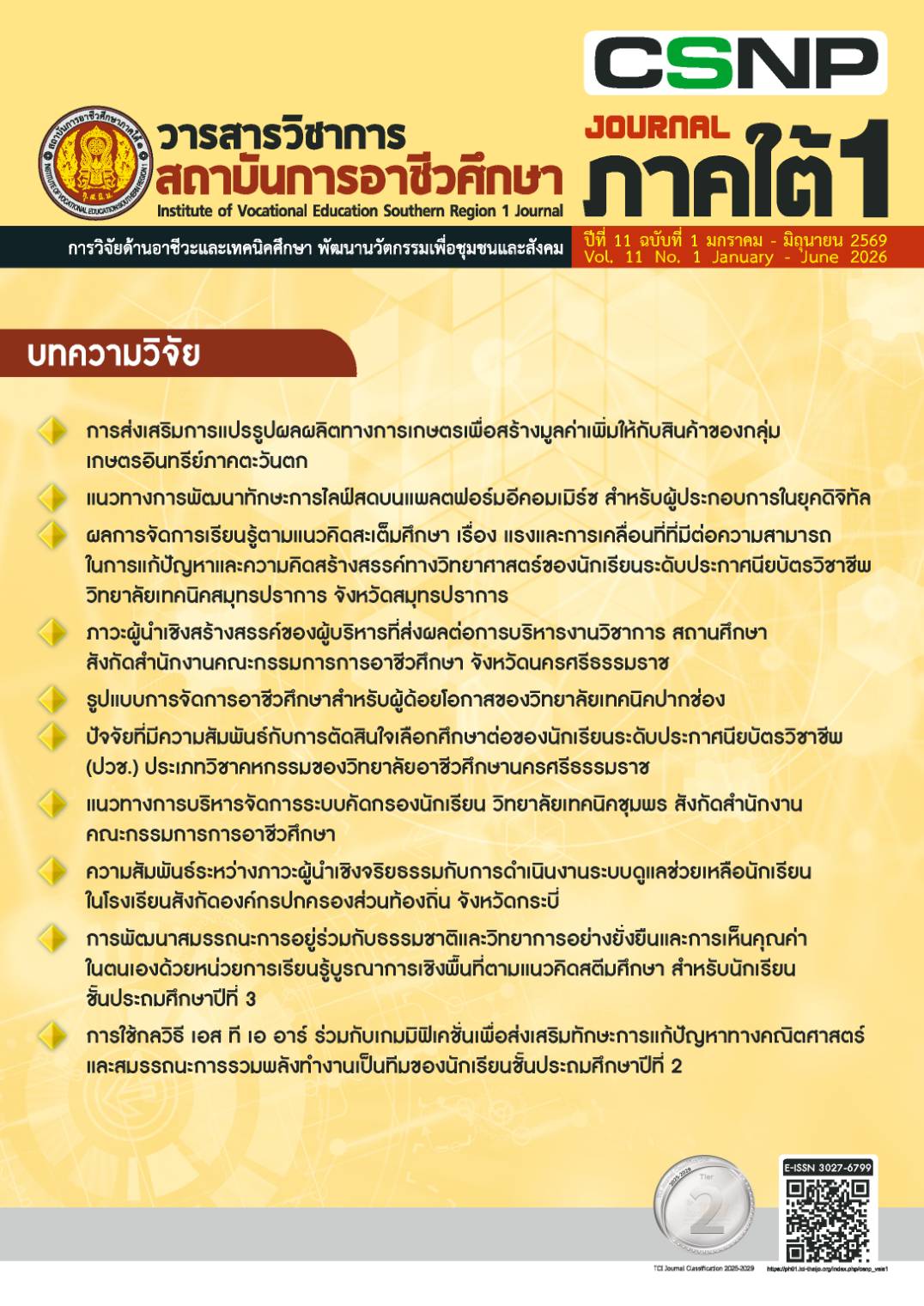
Encouraging Agricultural Products Processing to Create Value-added for Products of the Western Organic Agriculture Group
Article Sidebar
Main Article Content
Abstract
The research aimed to: 1) study the current state of organic agricultural product production and processing in the western region, and 2) study the satisfaction level with the transfer of organic agricultural product processing technology to add value to products for farmer groups in the western region. The target areas for this research included the western provinces of Ratchaburi and Phetchaburi. The study was conducted from March to June 2024. The target group was derived by purposive sampling method consisting of: 1) 30 farmers from the Nong Nang Praew community in Ratchaburi Province, and 2) 30 farmers from the Nong Ya Plong community in Phetchaburi Province. This research received excellent cooperation from public, government, private sectors, and local administrative organizations including Nam Phu Subdistrict Administrative Organization, Nong Ya Plong Subdistrict Administrative Organization, the Head of Nong Nang Praew Community, and the President of Nong Ya Plong Organic Fertilizer Production Cooperative. The research instruments included a structured interview form and a satisfaction questionnaire.
The research findings indicated that 1) the current state of organic agricultural production and processing in the western region of Thailand revealed the following information. The study focused on farmer groups in Ratchaburi and Phetchaburi. The key findings revealed that while Ratchaburi's main organic products are kaffir lime, mango, and guava, the main agricultural products of Phetchaburi included lime, banana, and bamboo shoots. Both regions face significant challenges, i.e., high production costs, climate change, insufficient access to knowledge and technology, rising household debt, inadequate marketing channels, and lack of financial support. 2) The results of technology transfer for product processing for organic agricultural group showed that the Ratchaburi group paid the interest on multi-purpose liquid cleaner from kaffir lime, preserved mango paste, and dried guava. The Phetchaburi group paid the interest in pickled lime, banana powder, and pickled bamboo shoots with a high satisfaction report. This positive reception stems from its direct contribution to increasing income for families and communities.
Article Details

This work is licensed under a Creative Commons Attribution-NonCommercial-NoDerivatives 4.0 International License.
References
สรรพสิทธิ์ ชมภูนุช, ทิวากร แสร์สุวรรณ, ศิรินดา สวนมาดี, และโชติ บดีรัฐ. (2565). บริบทของแผนพัฒนาเศรษฐกิจและสังคมแห่งชาติ ฉบับที่ 13 กับองค์กรปกครองส่วนท้องถิ่น. Journal of Roi Kaensarn Academi, 7(3), 409-424.
Chen, H., & Wang, J. (2023). Innovation and Value Creation in Agricultural Products: A Case Study of Brand Building in Local Specialties. Journal of Rural Studies, 98, 102945.
Venkatesh, V., & Bala, H. (2008). Technology Acceptance Model 3 and a Research Agenda on Interventions. Decision Sciences, 39(2), 273-315.
Ramadhan, F., Kurniawati, M. A., & Indriani, F. (2024). Technology adoption in agriculture: An analysis using the Technology Acceptance Model. International Journal of Agricultural Economics, 9(1), 1-10.
สำนักงานเกษตรและสหกรณ์จังหวัดราชบุรี. (2566). แผนพัฒนาเกษตรและสหกรณ์จังหวัดราชบุรี (พ.ศ. 2566 - 2570). ราชบุรี: สำนักงานปลัดกระทรวงเกษตรและสหกรณ์.
สำนักงานเกษตรและสหกรณ์จังหวัดเพชรบุรี. (2566). แผนพัฒนาเกษตรและสหกรณ์จังหวัดเพชรบุรี (พ.ศ. 2566 - 2570). เพชรบุรี: สำนักงานปลัดกระทรวงเกษตรและสหกรณ์.
ปิญพร บุญเยี่ยม, เบญจมาศ อยู่ประเสริฐ, และบำเพ็ญ เขียวหวาน. (2566). โมเดลการส่งเสริมเกษตรอัจฉริยะในการผลิตพืชผักของเกษตรรุ่นใหม่ในภาคตะวันออกของประเทศไทย. วารสารสันติศึกษาปริทรรศน์ มจร, 11(5), 1721-1732.
ตระกูล จิตวัฒนากร, นันทนา ชวศิริกุลฑล, นพพงศ์ เกิดเงิน, และจำเนียร จวงตระกูล. (2567). การตรวจสอบแบบสามเส้าด้านนักวิจัย: กลยุทธ์เพื่อสร้างความเชื่อถือได้ในงานวิจัยเชิงคุณภาพ. วารสารชุมชนวิจัยและพัฒนาสังคม, 18(3), 521-532.
กัลยา วานิชย์บัญชา. (2561). สถิติสำหรับงานวิจัย (พิมพ์ครั้งที่ 12). กรุงเทพมหานคร: สามลดา.
วีระศักดิ์ บุญญดิษฐ์, สุนทร อรุณโณ, จักรธร สุริแสง, และพงศ์ศักดิ์ บุญมาศ. (2565). หลักการและทฤษฎีการเรียนรู้กับการพัฒนาที่ยั่งยืน. วารสารมหาจุฬาตานี ปริทรรศน์ มหาวิทยาลัยมหาจุฬาลงกรณราชวิทยาลัย, 4(7), 52-60.
Porter, M. E., & Kramer, M. R. (2011). Creating Shared Value. Harvard Business Review, 89(1-2), 62-77.
ฤทัยภัทร ให้ศิริกุล. (2563). แนวทางการบริหารจัดการกลุ่มวิสาหกิจชุมชนสมุนไพรบ้านบัว ตำบลบ้านบัว อำเภอเมือง จังหวัดบุรีรัมย์. วารสารวิจัยและพัฒนา มหาวิทยาลัยราชภัฏบุรีรัมย์, 15(2), 9-23.
Davis, F. D. (1989). Perceived Usefulness, Perceived Ease of Use, and User Acceptance of Information Technology. MIS Quarterly, 13(3), 319-340.
สุดารัตน์ พิมลรัตนกานต์. (2565). การพัฒนาศักยภาพในการแข่งขันของผลิตภัณฑ์ท้องถิ่นเพื่อเพิ่มมูลค่าเพิ่มการจัดการโซ่อุปทานของสินค้าเกษตรใบเตยหอม ในบริบทพื้นที่จังหวัดนครปฐม. วารสารวิทยาการจัดการ มหาวิทยาลัยราชภัฏนครปฐม, 9(1), 277-290.
