
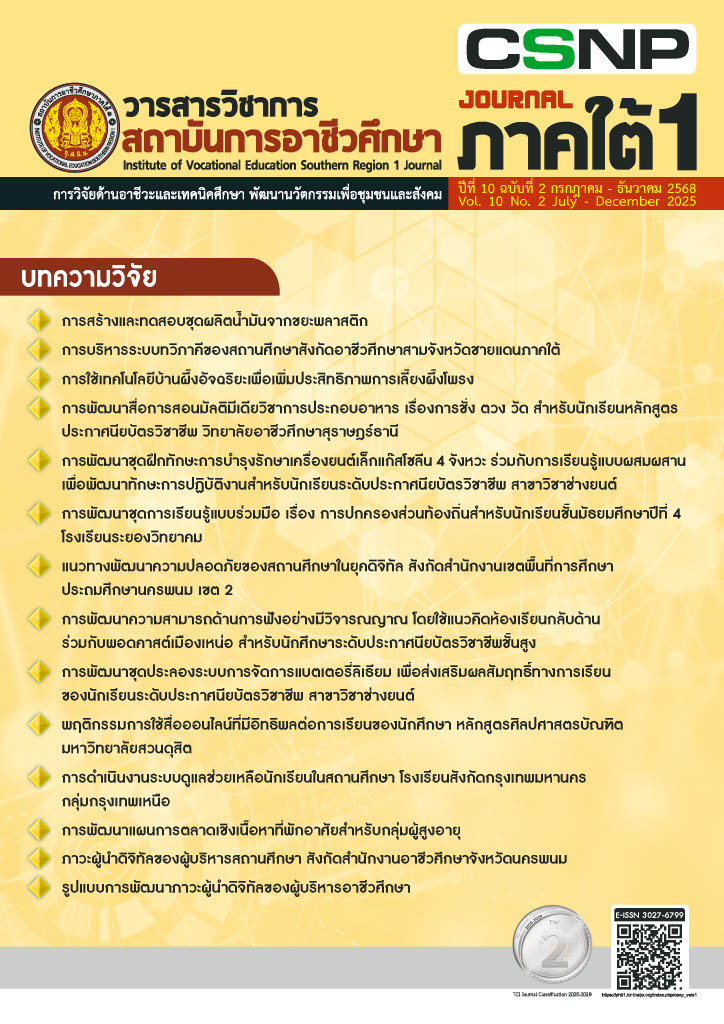
Digital Knowledge Leadership of School Administrators under the Office of the Vocational Education Commission, Nakhon Phanom Province
Article Sidebar
Main Article Content
Abstract
The purposes of this research were to: (1) examine the current and desired states of digital knowledge leadership skills of educational institution administrators and (2) assess the needs for digital knowledge leadership skills of these administrators. The sample group consisted of 160 participants including educational institution administrators, teachers, and support staff. The sample size was determined using Krejcie and Morgan table and selected through stratified random sampling. Two questionnaires were employed for data collection: 1) a questionnaire on the current state of digital knowledge leadership of the educational administrators, with a content validity index ranging from .80 to 1.00, the discrimination power of .65 to .88, and overall reliability of .98; and 2) a questionnaire on the desired state of digital knowledge leadership, with a content validity index ranging from .60 to 1.00, the discrimination power of .63 to .95, and overall reliability of .98. The data were analyzed using percentages, mean, standard deviation, and priority needs index (PNI) modification.
The research findings revealed that: 1) the current state of digital knowledge leadership among the educational administrators was overall rated at a high level while the desired state was overall rated at the highest level. 2) The essential needs of school administrators in the digital era, both overall and by specific aspects, ranked from the highest to the lowest, are as follows: vision, digital technology competency, learning organization, teamwork and collaboration, and creative thinking and innovation, respectively.
Article Details

This work is licensed under a Creative Commons Attribution-NonCommercial-NoDerivatives 4.0 International License.
References
จิณณวัตร ปะโคทัง. (2562). ภาวะผู้นำยุคดิจิทัล สำหรับผู้บริหารสถานศึกษามืออาชีพ. อุบลราชธานี: ศิริธรรมออฟเซ็ท.
สุนันทา สมใจ, และวิชุดา กิจธรธรรม. (2561). การบริหารสถานศึกษาด้วยภาวะผู้นำทางเทคโนโลยี. วารสารวิทยาลัยดุสิตธานี, 12(1), 350-362.
ชัญญาภัค ใยดี. (2560). การศึกษาแนวทางการพัฒนาภาวะผู้นำเชิงเทคโนโลยีของผู้บริหารสถานศึกษา สังกัดองค์การบริหารส่วนจังหวัดนครราชสีมา. วารสารดุษฎีบัณฑิตทางสังคมศาสตร์, 8(1), 150-163.
สำนักงานคณะกรรมการการอาชีวศึกษา. (2563). หลักเกณฑ์และแนวปฏิบัติการจัดการอาชีวศึกษา. กรุงเทพมหานคร: สำนักงานคณะกรรมการการอาชีวศึกษา.
Krejcie, R. V., & Morgan, D. W. (1970). Determining Sample Size for Research Activities. Educational and Psychological Measurement, 30(3), 607-610.
สุวิมล ว่องวาณิช. (2562). การวิจัยประเมินความต้องการจำเป็น (พิมพ์ครั้งที่ 4). กรุงเทพมหานคร: สำนักพิมพ์จุฬาลงกรณ์มหาวิทยาลัย.
สุชญา โกมลวานิช, สิทธิชัย สอนสุภี, บุญฤทธิ์ เพ็ชรวิศิษฐ์, และเกื้อจิตต์ ฉิมทิม. (2563). องค์ประกอบของภาวะผู้นำดิจิทัลของผู้บริหารสถานศึกษา สังกัดสำนักงานเขตพื้นที่การศึกษามัธยมศึกษาเขต 23. การประชุมวิชาการเสนอผลงานวิจัยระดับบัณฑิตศึกษาแห่งชาติ ครั้งที่ 21. (หน้า 700-708). ขอนแก่น: มหาวิทยาลัยขอนแก่น.
ฝนทิพย์ หาญชนะ, และคึกฤทธิ์ ศิลาลาย. (2565). ภาวะผู้นำดิจิทัลของผู้บริหารสถานศึกษาตามความคิดเห็นของครู โรงเรียนสหวิทยา เขตชลบุรี 1 สังกัดสำนักงานเขตพื้นที่การศึกษามัธยมศึกษาชลบุรี ระยอง. Journal of Roi Kaensarn Academi, 7(6), 117-133.
ขวัญชนก แสงท่านั่ง. (2563). รูปแบบการพัฒนาสถานศึกษาสู่องค์กรแห่งนวัตกรรม สำหรับสถานศึกษาขั้นพื้นฐาน. วารสารสังคมศาสตร์และมานุษยวิทยาเชิงพุทธ, 5(7), 153-168.
ดาวรุวรรณ ถวิลการ. (2564). ภาวะผู้นำดิจิทัล. ขอนแก่น: โรงพิมพ์มหาวิทยาลัยขอนแก่น.
เฉลิมพล วงศ์พระลับ, และวานิช ประเสริฐพร. (2564). ภาวะผู้นำดิจิทัลของผู้บริหารสถานศึกษา ในศตวรรษที่ 21 ของสถานศึกษาในสังกัดอาชีวศึกษาจังหวัดขอนแก่น. วารสาร มจร อุบลปริทรรศน์. 6(3), 137-150.
ทินกร บัวชู, และทิพภาพร บัวชู. (2562). ภาวะผู้นำดิจิทัลของผู้บริหารสถานศึกษา. วารสารครุศาสตร์สาร: Journal of Educational Studies, 13(2), 285-294.
