Design and Fabrication of Hybrid Operational Modes Magnetorheological Mount
DOI:
https://doi.org/10.69650/rast.2026.266217Keywords:
MR Mount, Hybrid Operational Mode, Structural Design, Magnetic Circuit Design, PrototypeAbstract
Magnetorheological (MR) mounts, developed based on the field-dependent damping characteristics of magnetorheological fluids (MRFs), are key vibration isolation components in vehicle powertrain systems and are capable of reducing energy losses induced by structural vibrations. Existing studies have mainly focused on single-mode MR mounts, whose vibration isolation performance is considerably inferior to that of hybrid-mode designs. In this study, a hybrid-mode MR mount integrating both squeeze and flow operational modes is proposed. The proposed design incorporates upper and lower Symmetrical squeeze gaps together with four circumferentially distributed flow channels.
The structural configuration of the MR mount is presented in detail, and a static structural finite element analysis is performed to evaluate the maximum principal stresses of the load-bearing components under compressive and tensile loading conditions, which are 368.5 MPa and 230.61 MPa, respectively.
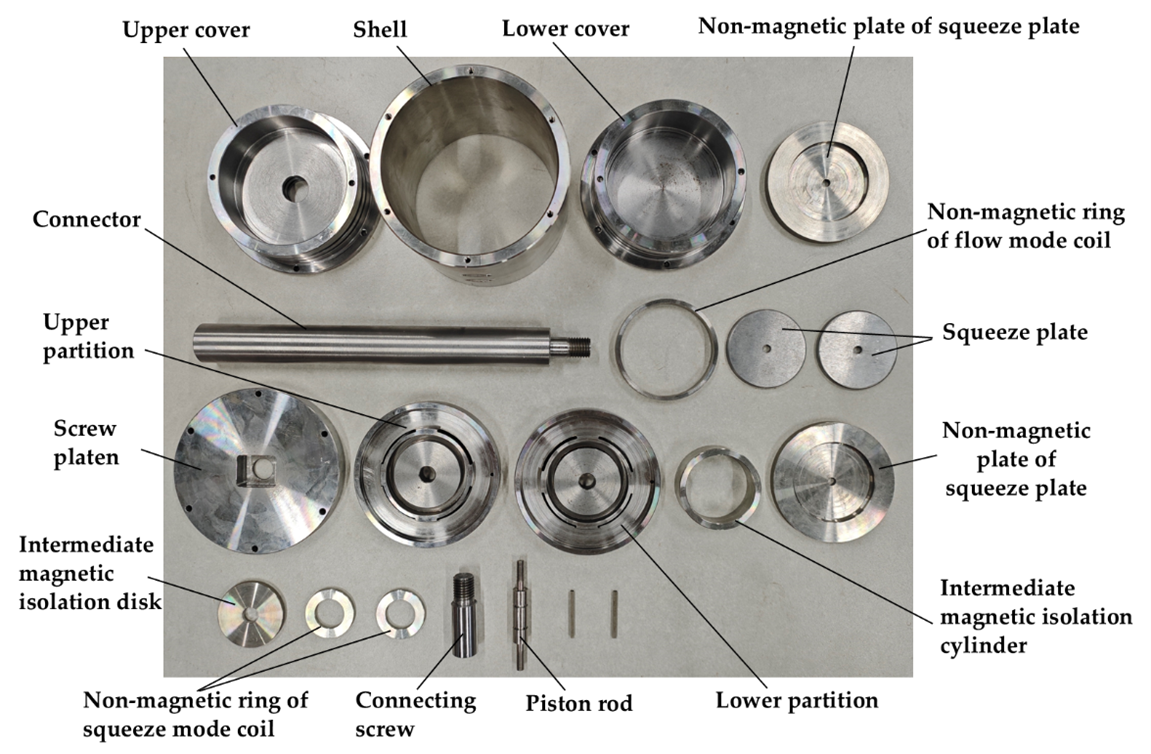
The results demonstrate that the designed MR mount exhibits a maximum load-bearing capacity of 7000 N. Subsequently, a comprehensive magnetic circuit design is carried out. The magnetic circuit design indicates that, to ensure effective operation of the MR mount, the number of coil turns must exceed 201 in the squeeze mode and 316 in the flow mode. Finally, the assembly process of the MR mount prototype is described in detail, including the installation sequence of the key structural components, the injection procedure of the MRFs, and the final sealing and fixation steps, thereby demonstrating the feasibility and practical manufacturability of the proposed hybrid-mode MR mount design.
References
Chen, S., Yao, B. and Zhou, J., Research on the mechanical properties of magnetorheological fluid under electromagnetic-thermal coupling. Journal of Magnetism and Magnetic Materials. 593 (2024) 171837, doi: https://doi.org/10.1016/j.jmmm.2024.171837.
Dave, P. N. and Khosla, E. in Handbook of Magnetic Hybrid Nanoalloys and their Nanocomposites: Rheological Characterization Tools: A Review, Ch. 23, Springer International Publishing, (2022) 659-678, doi: https://doi.org/10.1007/978-3-030-90948-2_21.
Osial, M., Pregowska, A., Warczak, M. and Giersig, M., Magnetorheological fluids: A concise review of composition, physicochemical properties, and models. Journal of Intelligent Material Systems and Structures. 34 (2023) 1864-1884, doi: https://doi.org/10.1177/1045389x231157357.
Sharma, S. V., Hemalatha, G. and C, D., Magnetorheological Fluid: Basic Principle, Application, and Trends. Scientia Iranica. 32 (2025), doi: https://doi.org/10.24200/sci.2024.61094.7148.
Zhang, Y., Guo, J., Yang, J. and Li, X., Recent Structural Developments and Applications of Magnetorheological Dampers (MRD): A Review. Magnetochemistry. 9 (2023) 90, doi: https://doi.org/10.3390/magnetochemistry9040090.
Wang, H., Bi, C., Liu, W. and Zhou, F., Squeeze Behaviors of Magnetorheological Fluids under Different Compressive Speeds. Materials (Basel) 16 (2023) 3109, doi: https://doi.org/10.3390/ma16083109.
Abd Fatah, A. Y., Mazlan, S. A., Koga, T., Zamzuri, H., Zeinali, M. and Imaduddin, F., A review of design and modeling of magnetorheological valve. International Journal of Modern Physics B. 29 (2015) 1530004, doi: https://doi.org/10.1142/s0217979215300042.
Shiao, Y. and Huynh, T.-L., Suspension Control and Characterization of a Variable Damping Magneto-Rheological Mount for a Micro Autonomous Railway Inspection Car. Applied Sciences. 12 (2022) 7336, doi: https://doi.org/10.3390/app12147336.
Qiang cai, H. W., zhaoxue Deng, xinxin Wei. Design and Optimization of Magnetic Circuit for Magnetorheological Mount with Tapered Channel Under the Flow Mode. Journal of Chongqing University of Technology(Natural Science). 35 (2021) 16-22, doi: https://doi.org/10.3969/j.issn.1674-8425(z).2021.04.003.
Deng, Z., Yang, Q., Cai, Q. and Liu, T., Design and Test of a Magneto-Rheological Mount Applied to Start/Stop Mode of Vehicle Powertrains. Shanghai Jiaotong Daxue Xuebao/Journal of Shanghai Jiaotong University. 55 (2021) 56-66, doi: https://doi.org/10.16183/j.cnki.jsjtu.2019.192.
Liu, Q., Bai, G. D., Liu, Z. H., Bai, X. X. F., Du, H., Chen, P. and Qian, L. J., Magnetorheological semi-active mount system for engines: Prototyping and testing. Proceedings of the Institution of Mechanical Engineers, Part D: Journal of Automobile Engineering. 234 (2020) 3081-3094, doi: https://doi.org/10.1177/0954407020925724.
Ciocanel, C., Nguyen, T. and Elahinia, M. Design and modeling of a mixed mode magnetorheological (MR) fluid mount. Vol. 6928, SPIE, 2008. SS, doi: https://doi.org/10.1117/12.775993.
Maurya, C. S. and Sarkar, C., Magnetorheological fluids: a comprehensive review of operational modes and performance under varied circumstances. Rheologica Acta. 63 (2024) 765-785, doi: https://doi.org/10.1007/s00397-024-01470-y.
Nguyen, T. M., Ciocanel, C. and Elahinia, M. H., A squeeze-flow mode magnetorheological mount: Design, modeling, and experimental evaluation. Journal of Vibration and Acoustics, Transactions of the ASME. 134 (2012), doi: https://doi.org/10.1115/1.4005011.
Huang, J., Li, S., Zhou, Y., Xu, T., Li, Y., Wang, H. and Wang, S., A heavy-duty magnetorheological fluid mount with flow and squeeze model. Smart Materials and Structures. 30 (2021) 085012, doi: https://doi.org/10.1088/1361-665X/ac0673.
Deng, Z., Yang, Q., Zhao, S. and Wei, H., Multi-objective optimization of magneto-rheological mount structure based on vehicle vibration control. Journal of Intelligent Material Systems and Structures. 32 (2021) 1155-1166, doi: https://doi.org/10.1177/1045389X20975498.
Navthar, R. R. and Narwade, P. A., Design and analysis of Cylinder and Cylinder head of 4-stroke SI Engine for weight reduction. International Journal of Engineering Science and Technology. 4 (2012) 847-853.
Zhang, C., Xie, D., Huang, Q. and Wang, Z., Experimental Research on the Vibration of Ship Propulsion Shaft under Hull Deformation Excitations on Bearings. Shock and Vibration. 2019 (2019) 4367061, doi: https://doi.org/10.1155/2019/4367061.
Cai, Q., Han, B., Deng, Z. and Wei, X., Analysis of magnetorheological suspension characteristics in extrusion-shear hybrid mode. Automotive Engineer, 11 (2020) 37-41, doi: https://doi.org/10.3969/j.issn.1674-6546.2020.11.009.
Peng, B. Design and Optimization of Magnetorheological Mount Structure Based on Multi-Field Coupling Analysis. Master's thesis, Chongqing University of Technology, China, (2022).
Yang, X., Chen, Y., Liu, Y. and Zhang, R., Modeling and Experiments of an Annular Multi-Channel Magnetorheological Valve. Actuators 11 (2022) 19, doi: https://doi.org/10.3390/act11010019.
Downloads
Published
How to Cite
Issue
Section
License
Copyright (c) 2026 School of Renewable Energy and Smart Grid Technology (SGtech)

This work is licensed under a Creative Commons Attribution-NonCommercial-NoDerivatives 4.0 International License.
All copyrights of the above manuscript, including rights to publish in any media, are transferred to the SGtech.
The authors retain the following rights;
1. All proprietary rights other than copyright.
2. Re-use of all or part of the above manuscript in their work.
3. Reproduction of the above manuscript for author’s personal use or for company/institution use provided that
(a) prior permission of SGtech is obtained,
(b) the source and SGtech copyright notice are indicated, and
(c) the copies are not offered for sale.