Development of Empirical Models for Estimating Daily Downward Longwave Radiation Using Meteorological Data in Thailand
DOI:
https://doi.org/10.69650/rast.2026.266083Keywords:
Downward Longwave Radiation, Empirical Models, Air Temperature, Relative Humidity, Vapor Pressure, Cloud CoverAbstract
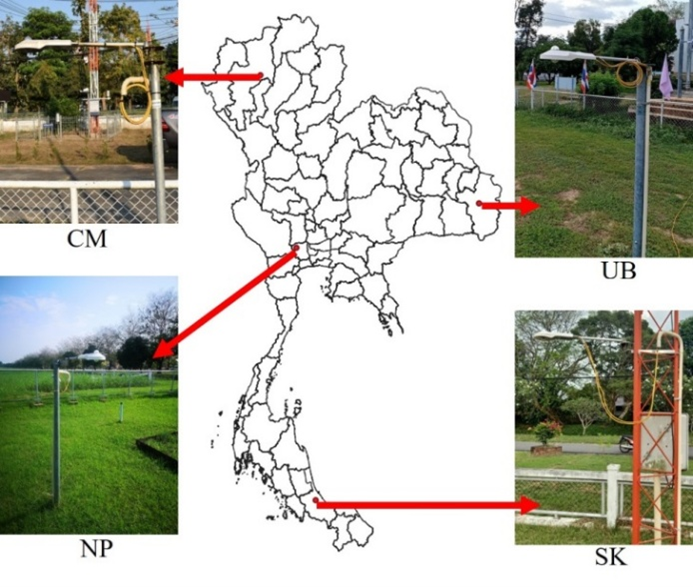
This study developed models to estimate daily downward longwave radiation under general sky conditions using meteorological data. The input variables included air temperature, vapor pressure, daily minimum and maximum temperatures, relative humidity, and cloud cover. Data were collected from four meteorological stations, namely Chiang Mai, Ubon Ratchathani, Nakhon Pathom, and Songkhla, during the period from 2018 to 2023. Model development was based on data from 2018 to 2021 using graphical analysis and multiple linear regressions to identify strong relationships and build predictive equations. Seven models were formulated, each using different combinations of meteorological variables. These models were then validated using independent data from 2022–2023. The results showed that downward longwave radiation is largely correlated with meteorological parameters. The developed models provided accurate estimates, closely matching observed radiation values. The root mean square error relative to the mean measured values (RMSE) ranged from 1.7% to 4.4%, and mean bias error relative to the mean measured values (MBE) ranged from -1.4% to 3.9%. The developed model gave a more accurate value of daily longwave radiation. The findings indicate that the proposed models are effective tools for estimating longwave radiation in areas without direct measurements, supporting further research in climate and energy studies.
References
Bignami, F., Marullo, S., Santoleri, R. and Schiano, M. E., Longwave radiation budget in the Mediterranean Sea. Journal of Geophysical Research: Oceans. 100 (1995) 2501-2514, doi: https://doi.org/10.1029/94JC02496.
Crawford, T. M. and Duchon, C. E., An Improved Parameterization for Estimating Effective Atmospheric Emissivity for Use in Calculating Daytime Downwelling Longwave Radiation. Journal of Applied Meteorology. 38 (1999) 474-480.
Brutsaert, W., On a derivable formula for long-wave radiation from clear skies. Water Resources Research. 11 (1975) 742-744, doi: https://doi.org/10.1029/WR011i005p00742.
Prata, A. J., A new long‐wave formula for estimating downward clear‐sky radiation at the surface. Quarterly Journal of the Royal Meteorological Society. 122 (1996) 1127-1151, doi: https://doi.org/10.1002/qj.49712253306.
Josey, S. A., Oakley, D. and Pascal, R. W., On estimating the atmospheric longwave flux at the ocean surface from ship meteorological reports. Journal of Geophysical Research: Oceans. 102 (1997) 27961-27972, doi: https://doi.org/10.1029/97JC02420.
Clark, N. E., Eber, L., Laurs, R. M., Renner, J. A. and Saur, J. F. T. Heat exchange between ocean and atmosphere in the eastern North Pacific for 1961-71. NOAA Tech. Rep. NMFS SSRF-682, National Oceanic and Atmospheric Administration, National Marine Fisheries Service, (1974) 1-108.
Finch, J. W. and Best, M. J., The accuracy of downward short- and long-wave radiation at the earth's surface calculated using simple models. Meteorological Applications. 11 (2004) 33-39, doi: https://doi.org/10.1017/S1350482703001154.
Idso, S. B. and Jackson, R. D., Thermal radiation from the atmosphere. Journal of Geophysical Research (1896-1977). 74 (1969) 5397-5403, doi: https://doi.org/10.1029/JC074i023p05397.
Lhomme, J. P., Vacher, J. J. and Rocheteau, A., Estimating downward long-wave radiation on the Andean Altiplano. Agricultural and Forest Meteorology. 145 (2007) 139-148, doi: https://doi.org/10.1016/j.agrformet.2007.04.007.
Yang, K., He, J., Tang, W., Qin, J. and Cheng, C. C. K., On downward shortwave and longwave radiations over high altitude regions: Observation and modeling in the Tibetan Plateau. Agricultural and Forest Meteorology. 150 (2010) 38-46, doi: https://doi.org/10.1016/j.agrformet.2009.08.004.
Wang, K. and Dickinson, R. E., Global atmospheric downward longwave radiation at the surface from ground-based observations, satellite retrievals, and reanalyses. Reviews of Geophysics. 51 (2013) 150-185, doi: https://doi.org/10.1002/rog.20009.
Wild, M., Ohmura, A., Gilgen, H., Morcrette, J.-J. and Slingo, A., Evaluation of Downward Longwave Radiation in General Circulation Models. Journal of Climate. 14 (2001) 3227-3239.
Pashiardis, S., Kalogirou, S. A. and Pelengaris, A., Characteristics of longwave radiation through the statistical analysis of downward and upward longwave radiation and inter-comparison of two sites in Cyprus. Journal of Atmospheric and Solar-Terrestrial Physics. 164 (2017) 60-80, doi: https://doi.org/10.1016/j.jastp.2017.08.007.
Chang, K. and Zhang, Q., Modeling of downward longwave radiation and radiative cooling potential in China. Journal of Renewable and Sustainable Energy. 11 (2019) 066501, doi: https://doi.org/10.1063/1.5117319.
Zhu, F., Li, X., Qin, J., Yang, K., Cuo, L., Tang, W. and Shen, C., Integration of Multisource Data to Estimate Downward Longwave Radiation Based on Deep Neural Networks. IEEE Transactions on Geoscience and Remote Sensing. 60 (2022) 1-15, doi: https://doi.org/10.1109/TGRS.2021.3094321.
Júnior, J. M. L., Ceballos, J. C., da Costa, S. M. S., de Mesquita, F. L. L., de Jesus, H. S. and Gonçalves, A. R., A physical parameterization for cloudy-sky downward longwave radiation: Validation for tropical and subtropical regions in Brazil. Journal of Atmospheric and Solar-Terrestrial Physics. 271 (2025) 106512, doi: https://doi.org/10.1016/j.jastp.2025.106512.
Tetens, O., Über einige meteorologische Begriffe [On some meteorological terms]. Journal of Geophysics. 6 (1930) 297-309.
Shafei, A. Designing an early-warning system to forecast extreme climate conditions using Machine-Learning and Deep-learning methods. Doctoral dissertation, Sapienza University of Rome, (2025).
Islam, M. M., Hasan, M., Mia, M. S., Al Masud, A. and Islam, A. R. M. T., Early warning systems in climate risk management: Roles and implementations in eradicating barriers and overcoming challenges. Natural Hazards Research. 5 (2025) 523-538, doi: https://doi.org/10.1016/j.nhres.2025.01.007.
Camps-Valls, G., Fernández-Torres, M.-Á., Cohrs, K.-H., Höhl, A., Castelletti, A., Pacal, A., Robin, C., Martinuzzi, F., Papoutsis, I., Prapas, I., Pérez-Aracil, J., Weigel, K., Gonzalez-Calabuig, M., Reichstein, M., Rabel, M., Giuliani, M., Mahecha, M. D., Popescu, O.-I., Pellicer-Valero, O. J., Ouala, S., Salcedo-Sanz, S., Sippel, S., Kondylatos, S., Happé, T. and Williams, T., Artificial intelligence for modeling and understanding extreme weather and climate events. Nature Communications. 16 (2025) 1919, doi: https://doi.org/10.1038/s41467-025-56573-8.
Buntoung, S., Janjai, S., Pariyothon, J. and Nunez, M., Distribution of precipitable water over Thailand using MTSAT-1R satellite data. Science, Engineering and Health Studies. 15 (2021) 21020001, doi: https://doi.org/10.14456/sehs.2021.1.
Phoemwong, C., Wattan, R., Pattarapanitchai, S. and Janjai, S., Satellite-based estimation of net radiation to support evapotranspiration modeling in agriculture. Remote Sensing Applications: Society and Environment. 40 (2025) 101746, doi: https://doi.org/10.1016/j.rsase.2025.101746.
Humphries, U. W., Waqas, M., Hlaing, P. T., Dechpichai, P. and Wangwongchai, A., Assessment of CMIP6 GCMs for selecting a suitable climate model for precipitation projections in Southern Thailand. Results in Engineering. 23 (2024) 102417, doi: https://doi.org/10.1016/j.rineng.2024.102417.
Mahasakpan, N., Chaisongkaew, P., Inerb, M., Nim, N., Phairuang, W., Tekasakul, S., Furuuchi, M., Hata, M., Kaosol, T., Tekasakul, P. and Dejchanchaiwong, R., Fine and ultrafine particle- and gas-polycyclic aromatic hydrocarbons affecting southern Thailand air quality during transboundary haze and potential health effects. Journal of Environmental Sciences. 124 (2023) 253-267, doi: https://doi.org/10.1016/j.jes.2021.11.005.
Tian, Y., Zhong, D., Ghausi, S. A., Wang, G. and Kleidon, A., Understanding variations in downwelling longwave radiation using Brutsaert's equation. Earth Syst. Dynam. 14 (2023) 1363-1374, doi: https://doi.org/10.5194/esd-14-1363-2023.
Feng, C., Zhang, X., Wei, Y., Zhang, W., Hou, N., Xu, J., Jia, K., Yao, Y., Xie, X., Jiang, B., Cheng, J. and Zhao, X., Estimating Surface Downward Longwave Radiation Using Machine Learning Methods. Atmosphere. 11 (2020) 1147, doi: https://doi.org/10.3390/atmos11111147.
Downloads
Published
How to Cite
Issue
Section
License
Copyright (c) 2026 School of Renewable Energy and Smart Grid Technology (SGtech)

This work is licensed under a Creative Commons Attribution-NonCommercial-NoDerivatives 4.0 International License.
All copyrights of the above manuscript, including rights to publish in any media, are transferred to the SGtech.
The authors retain the following rights;
1. All proprietary rights other than copyright.
2. Re-use of all or part of the above manuscript in their work.
3. Reproduction of the above manuscript for author’s personal use or for company/institution use provided that
(a) prior permission of SGtech is obtained,
(b) the source and SGtech copyright notice are indicated, and
(c) the copies are not offered for sale.