Accelerated Charcoal Briquette Production: Innovative Drying Technology for Performance Assessment and Energy Consumption
DOI:
https://doi.org/10.69650/rast.2026.264894Keywords:
Charcoal Briquettes, Drying Temperature, Temperature Controller, PID Tuning, CharcoalAbstract
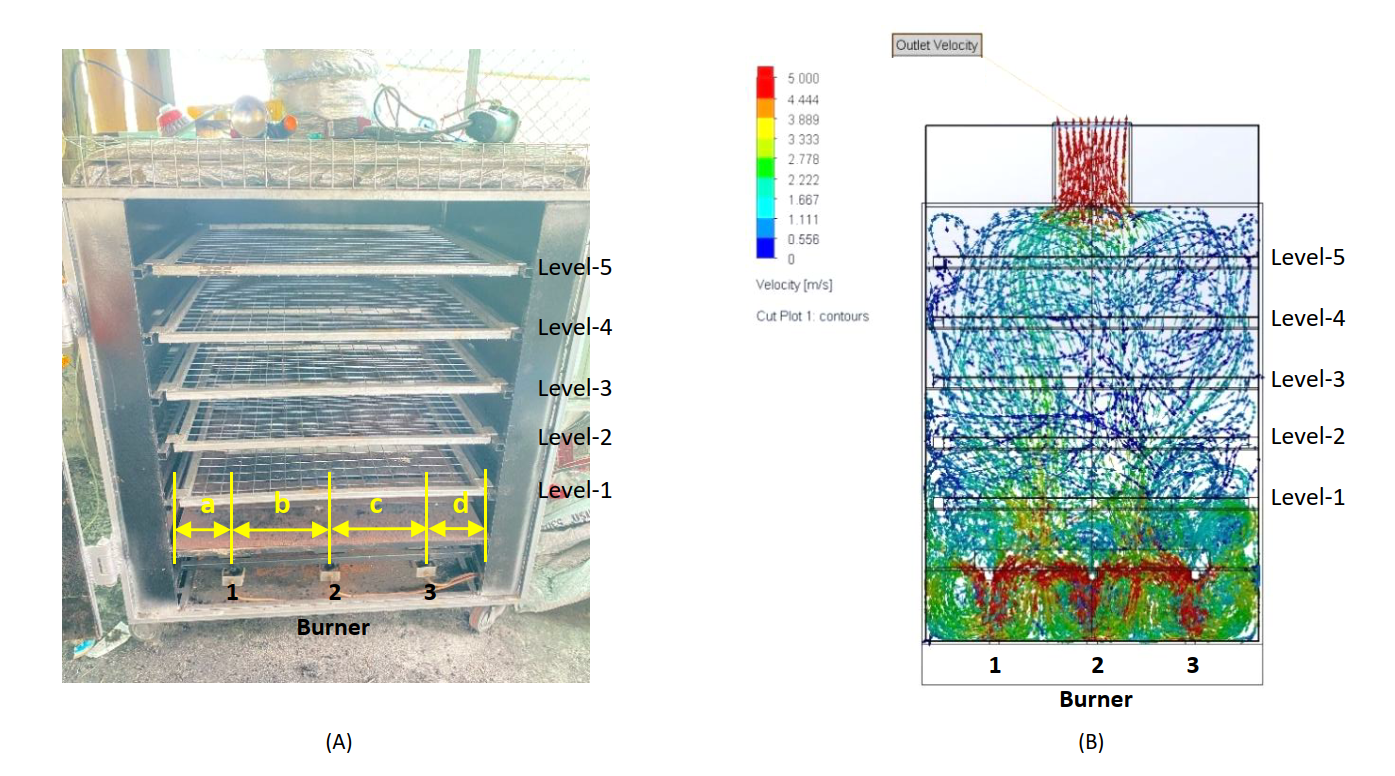
Currently, the process of charcoal briquette production comprises three primary stages and typically spans 5–7 days. Each stage aims to maximize the thermal efficiency of the final product. The initial phase involves the preparation of raw materials, including the formulation of mixtures and the selection of components or treatments that enhance the calorific value of the briquettes. The second stage focuses on high-yield briquette formation, optimizing compaction and shaping techniques to produce charcoal briquettes in large quantities. The final, most time-consuming stage is the drying process, which significantly influences the overall production cycle. This study aims to design an accelerated high-temperature drying system to reduce the processing time for charcoal briquettes, specifically targeting moisture contents between 25–30% post-formation. The proposed system is designed to handle 50 kg of briquettes per batch, arranged in five layers (10+ kg per layer, 5 layers total), and utilizes three infrared burners, measured and controlled by a PID (Proportional-Integral-Derivative) control system. The parameters are tailored based on the drying behavior of charcoal to achieve a final moisture content of less than 8%, in compliance with industry standards. Experimental results indicate that the five-layer drying chamber effectively generates uniform heat distribution and enhances internal air circulation, enabling consistent and thorough drying. The drying sequence starts from the bottom layer and progresses upward. Among the tested conditions, drying at 150°C demonstrated the highest efficiency, providing the most suitable drying time and the lowest fuel consumption rate, thereby improving both energy efficiency and production throughput.
References
Samart, S., Wathanyu, W., Alongkhon, N., Sirilak, K., Jutturit, T. and Worrajak, M., The monitoring for control and analysis of electrical energy used in agricultural production: Case study of product building, Thung Luang Royal Project Foundation. Journal of Innovative Technology Research. 3 (2019) 77–90.
Chaichaloempreecha, A., Winyuchakrit, P. and Limmeechokchai, B., Assessment of renewable energy and energy efficiency plans in Thailand’s industrial sector. Energy Procedia. 138 (2017) 841-846, doi: https://doi.org/10.1016/j.egypro.2017.10.105.
Chitsopon, K. and Bunmephiphit, C., Energy Conservation in Palm Oil Mill by Installing Inverters for Motors. Journal of Renewable Energy and Smart Grid Technology. 20 (2025) 8-12, doi: https://doi.org/10.69650/rast.2025.259834.
Peamsuwan, R. and deeto, s., The Production and Properties of Fuel Briquettes from Animal and Agricultural Bio-Waste to Renewable Energy Source in Rural Community. Journal of Renewable Energy and Smart Grid Technology. 16 (2021) 56-67.
Tun, M. M., Juchelkova, D., Win, M. M., Thu, A. M. and Puchor, T., Biomass energy: An overview of biomass sources, energy potential, and management in Southeast Asian countries. Resources. 8 (2019) 81, doi: https://doi.org/10.3390/resources8020081.
Tursi, A., A review on biomass: importance, chemistry, classification, and conversion. Biofuel Research Journal. 22 (2019) 962–979, doi: https://doi.org/10.18331/BRJ2019.6.2.3.
Duangjaiboon, K., Kittiwan, M. and Kaewpengkrow, P. R., Properties analysis of pellets fuel from sewage sludge and biomass for renewable energy. Journal of Engineering and nnovation. 16 (2023) 29–37.
Aroonrat, K. and Wongwises, S., Biomass energy in Thailand: Potential, utilization, and future trends. Renewable and Sustainable Energy Reviews. 46 (2015) 386–397, doi: https://doi.org/10.1016/j.rser.2015.02.010.
Laohalidanond, K., Chaiyawong, P. and Kerdsuwan, S., Municipal Solid Waste Characteristics and Green and Clean Energy Recovery in Asian Megacities. Energy Procedia. 79 (2015) 391-396, doi: https://doi.org/10.1016/j.egypro.2015.11.508.
Tun, M. M., Juchelkova, D., Win, M. M., Thu, A. M. and Puchor, T., Biomass energy: An overview of biomass sources, energy potential, and management in Southeast Asian countries. Resources. 8 (2019) 81, doi: https://doi.org/10.3390/resources8020081.
Prasertsan, S. and Sajjakulnukit, B., Biomass and biogas energy in Thailand: Potential, utilization, and barriers. Renewable Energy. 31 (2006) 599–610, doi: https://doi.org/10.1016/j.renene.2005.08.005.
Yokoyama, S.-y., Ogi, T. and Nalampoon, A., Biomass energy potential in Thailand. Biomass and Bioenergy. 18 (2000) 405-410, doi: https://doi.org/10.1016/S0961-9534(00)00004-0.
Sukmawaty, S., Syahrul, S., Amuddin, A., Rahmi, S. H. and Syahrul, A. I., Optimization of biomass-fueled vertical corn drying: Efficiency, energy balance, and sustainability. Results in Engineering. 26 (2025) 105338, doi: https://doi.org/10.1016/j.rineng.2025.105338.
Sitthikhankaew, R., Pumpung, K., Sanguwan, S., Kunphet, S., Seeponkai, N. and Moraray, P., Development of charcoal briquette produced from small fragments charcoal of Thong Saen Khan community biomass power plant using solid alcohol to ignite and combust charcoal briquette. RMUTL Engineering Journal. 5 (2020) 25–35, doi: https://doi.org/10.14456/rmutlengj.2020.10.
Palamanit, A., Throngleart, P., Thongshai, P., Deangpea, R. and Chaiprapat, S., Effects of binder types and ratios on quality of palmyra palm shell charcoal briquettes by using solar greenhouse dryer. Thai Science and Technology Journal. 28 (2020) 1107–1125, doi: https://doi.org/10.14456/tstj.2020.88.
Ossei-Bremang, R. N., Adjei, E. A., Kemausuor, F., Mockenhaupt, T. and Bar-Nosber, T., Effects of compression pressure, biomass ratio and binder proportion on the calorific value and mechanical integrity of waste-based briquettes. Bioresource Technology Reports. 25 (2024) 101724, doi: https://doi.org/10.1016/j.biteb.2023.101724.
Vichan, N., Chaiwong, K., Promraksa, P. and Kanoi, A., The production of charcoal briquette with charcoal residue from banana chip production. Journal of Innovative Technology Research. 3 (2019) 11–22.
Budsaereechai, S., Sooyanang, N. and Wongkong, P., Study and improvement of high pressure biomass briquetting machine with hydraulic system for pressing biomass without binder for solid fuel. Kasem Bundit Engineering Journal. 11 (2021) 91–106.
Auntaisong, P. and Maneechot, R., The constructure and efficiency evaluation of charcoal briquette machine from cassia pods. Udon Thani Rajabhat University Journal of Science and Technology. 7 (2019) 147–157.
Yuman, P., Development of a cold production biomass charcoal briquette machine to use waste from coffee bean processing. Industrial Technology Lampang Rajabhat University Journal. 9 (2016) 34–48.
Charoenchai, N. and Norkaew, P., Charcoal briquette dryer improvement and drying performance investigation. Industrial Technology Lampang Rajabhat University Journal. 2 (2010) 74–80.
Poomsa-ad, N. and Wiset, L., Macadamia drying by microwave dryer combined with hot air. Journal of Science and Technology, Ubon Ratchathani University. 17 (2015) 36–40.
Tumuluru, J. S., Wright, C. T., Hess, J. R. and Kenney, K. L., A review of biomass densification systems to develop uniform feedstock commodities for bioenergy application. Biofuels, Bioproducts and Biorefining. 5 (2011) 683-707, doi: https://doi.org/10.1002/bbb.324.
Kaliyan, N. and Morey, R. V., Factors affecting strength and durability of densified biomass products. Biomass and Bioenergy. 33(3) (2009) 337–359, doi: https://doi.org/10.1016/j.biombioe.2008.08.005
Tumuluru, J. S., Effect of process variables on the density and durability of the pellets made from high moisture corn stover. Biosystems Engineering 119 (2014) 44-57, doi: https://doi.org/10.1016/j.biosystemseng.2013.11.012.
Mani, S., Tabil, L. G. and Sokhansanj, S., Effects of compressive force, particle size and moisture content on mechanical properties of biomass pellets from grasses. Biomass and Bioenergy. 30 (2006) 648–654, doi: https://doi.org/10.1016/j.biombioe.2005.01.004.
Prabhu, C. N., Dhanushkodi, S. and Sudhakar, K., Dual chamber solar dryers: Maximizing thermal performance for diverse product drying. Results in Engineering. 25 (2025) 103967, doi: https://doi.org/10.1016/j.rineng.2025.103967.
American Society for Testing and Materials. Standard test method for moisture in the analysis sample of coal and coke (ASTM D3173-03: 2008), ASTM International.
Jewiarz, M., Wróbel, M., Mudryk, K. and Szufa, S., Impact of the drying temperature and grinding technique on biomass grindability. Energies. 13 (2020) 3392, doi: https://doi.org/10.3390/en1313339.
Say, S., Erdem, T., Ekinci, K., Erdem, B., Sehri, M. and Sümer, S., Drying kinetics of olive pomace-derived charcoal briquettes with energy consumption. Semina: Ciências Agrárias. 43 (2022) 1805-1822, doi: https://doi.org/10.5433/1679-0359.2022v43n4p1805.
He, H., Wang, Y., Sun, Y., Sun, W. and Wu, K., From raw material powder to solid fuel pellet: A state-of-the-art review of biomass densification. Biomass and Bioenergy. 186 (2024) 107271, doi: https://doi.org/10.1016/j.biombioe.2024.107271.
Leite, V. R., Krinski, I. M., Linero, H. C., Mariani, V. C. and Moura, L. M., Influence of temperature on kinetics and moisture diffusion during convective drying of spent coffee grounds. Thermal Science and Engineering Progress. 68 (2025) 104293, doi: https://doi.org/10.1016/j.tsep.2025.104293.
Guibunda, F. A., Waita, S., Nyongesa, F. W., Snyder, G. J. and Chaciga, J., Optimizing biomass briquette drying: A computational fluid dynamics approach with a case study in Mozambique. Energy. 360 2 (2024) 100012, doi: https://doi.org/10.1016/j.energ.2024.100012.
Downloads
Published
How to Cite
Issue
Section
License
Copyright (c) 2026 School of Renewable Energy and Smart Grid Technology (SGtech)

This work is licensed under a Creative Commons Attribution-NonCommercial-NoDerivatives 4.0 International License.
All copyrights of the above manuscript, including rights to publish in any media, are transferred to the SGtech.
The authors retain the following rights;
1. All proprietary rights other than copyright.
2. Re-use of all or part of the above manuscript in their work.
3. Reproduction of the above manuscript for author’s personal use or for company/institution use provided that
(a) prior permission of SGtech is obtained,
(b) the source and SGtech copyright notice are indicated, and
(c) the copies are not offered for sale.