Quantifying Land Use from Commercial Onshore Wind Energy Farms in Thailand Utilizing Geo-Informatics Technology
DOI:
https://doi.org/10.69650/rast.2026.264649Keywords:
GIS, Geo-Informatics Technology, Land Use, Power Plant, Sustainable Development, Onshore Wind FarmsAbstract
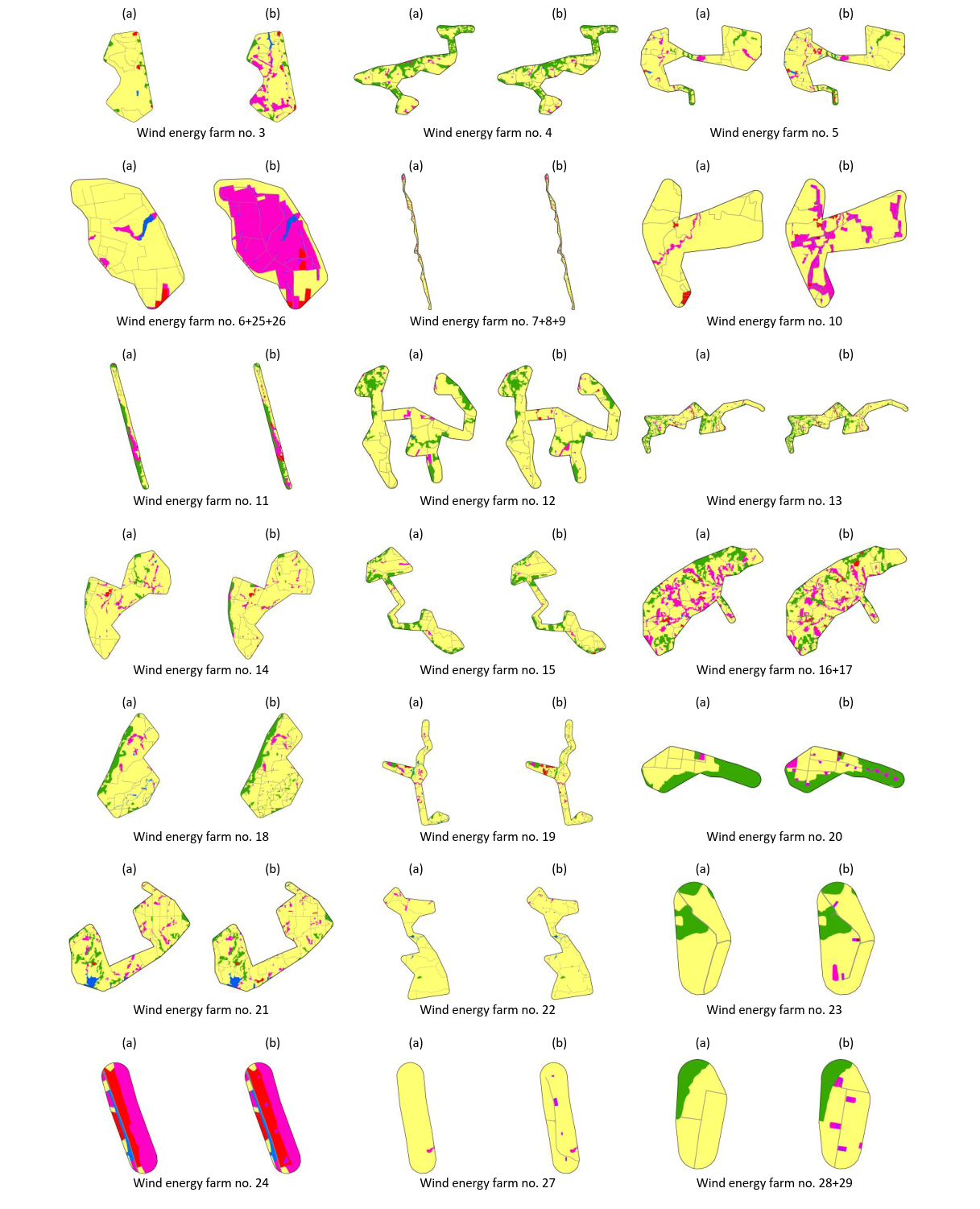
This study quantifies the spatial footprint of 29 commercial onshore wind energy farms in Thailand (263 km2 in total) using Geo-Informatics Technology which integrates remote sensing and GIS. Satellite imagery before and after construction was analyzed to compute the Land Use Intensity of Electricity (LUIE), defined as direct area per unit of generated electricity. Before construction, agricultural lands were the dominant land cover within wind energy farms (80.63 %), followed by forest lands (8.89 %), miscellaneous lands (5.7%), urban and built-up lands (2.71%), water bodies (1.10%), and roads (0.98%). After construction, agricultural lands remained dominant (79.06%), with forest lands (7.81%), water bodies (6.57%), urban and built-up lands (3.0%), roads (1.54%), miscellaneous lands (1.38%), and land use from the infrastructure of the wind energy farms (0.64%). The most notable changes were that water bodies significantly increased from 1.10% to 6.57% while built‑up areas and roads slightly increased from 2.71% and 0.98% to 3.00 % and 1.54 %, respectively. Wind farm infrastructure directly occupied 3.19 km² (1.21% of the 263 km²). Wind turbine foundations and hardstands accounted for most of the land use (50.25% of 3.19 km2), followed by new roads (46.80% of 3.19 km2), and substations and other facilities (2.9% of 3.19 km2). The median LUIE was 42.6 m²/GWh, demonstrating high spatial efficiency. The findings of the study demonstrate the minimal agricultural land decrease (from 80.63% to 79.06%). This confirms compatibility between wind energy development and agricultural co-use in Thailand's rural landscapes, providing empirical data for future wind energy farm planning and land use policy.
References
Energy Policy and Planning Office, Ministry of Energy. Thailand’s Power Development Plan 2018 - 2037 Revision 1. Energy Policy and Planning Office, Ministry of Energy, (2020) 12-24. <https://www.eppo.go.th/images/Infromation_service/public_relations/PDP2018/PDP2018Rev1.pdf>
Office of Natural Resources and Environmental Policy and Planning, Ministry of Natural Resource¬¬¬¬s and Environment. Thailand's long-term low greenhouse gas emission development strategy. Office of Natural Resources and Environmental Policy and Planning, Ministry of Natural Resources and Environment, (2022) 4-10. <https://unfccc.int/sites/default/files/resource/Thailand%20LT-LEDS%20%28Revised%20Version%29_08Nov2022.pdf>
Maguire, K., Tanner, S. J., Winikoff, J. B., Williams, R. Utility-scale solar and wind development in rural areas : land cover change (2009-20). Report No. ERR-33, U.S. Department of Agriculture, Economic Research Service, (2024) 11, doi: https://doi.org/10.32747/2024.8374829.ers.
You, K. and Begg, M. Analysis of land use by variable renewable energy production by 2050. Institute of Public Affairs. (2023) 1-16.
Pinson, P., Giebel, G. and Clausen, N. E. in Climate Vulnerability: 3.03 - Renewable Energy Resources – Onshore/Offshore Wind Energy, Ch. 3.03.1, Academic Press, (2013) 53-64, doi: https://doi.org/10.1016/B978-0-12-384703-4.00310-5.
Patel, K. and Makwana, V. H., Review on Wind Energy Conversion System Topologies for different Wind Turbines-Generators. Journal of Emerging Technologies and Innovative Research. 5 (2018) 11-21.
Hendrawati, D., Soeprijanto, A. and Ashari, M., Turbine Wind Placement with Staggered Layout as a Strategy to Maximize Annual Energy Production in Onshore Wind Farms. International Journal of Energy Economics and Policy. 9 (2019) 334-340.
Harrison-Atlas, D., Lopez, A. and Lantz, E., Dynamic land use implications of rapidly expanding and evolving wind power deployment. Environmental Research Letters. 17 (2022) 044064, doi: http://doi.org/10.1088/1748-9326/ac5f2c.
Sobrinho Júnior, M. F., Morais, E. R. C. d. and Silva, P. C. M. d., SOIL USE AND OCCUPATION OF WIND FARM AGRICULTURAL AREAS. Mercator. 19 (2020) 1-12, doi: http://doi.org/10.4215/rm2020.e19030.
Grossman, N. Thailand’s Sustainable Development Sourcebook: Issues & Information: Ideas & Inspiration. 2nd edn., Editions Didier Millet, 2017.
Lovering, J., Swain, M., Blomqvist, L. and Hernandez, R. R., Land-use intensity of electricity production and tomorrow’s energy landscape. PLoS ONE. 17 (2022) e0270155, doi: https://doi.org/10.1371/journal.pone.0270155.
Baxter, W., Grossman, N. and Wegner, N. A call to action : Thailand and the sustainable development goals. Bangkok : Editions Didier Miller EDM, 2016.
Geo-Informatics and Space Technology Development Agency. (2009). Space technology and geo-informatics. 1st edn., 2009.
Khunrattanasiri, W., Boonyarit, T. and Srikongruk, J., Study of Land Use Changes Using Landsat Satellite Image Data in Bo Luang Subdistrict, Hot District, Chiang Mai Province. SciTech Research Journal. 6 (2023) 21-33.
Sangmuang, S., Rachdawong, P. and Charoenpol, K., The Application of Geo-informatics Technology to Analyze Land Use Changes Using Satellite Imagery. Chulachomklao Royal Military Academy Journal, 21 (2023) 12-27.
Anderson, J., Hardy, E., Roach, J. and Witmer, R. A land use and land cover classification system for use with remote sensor data. Report No. 964, United States Government Printing Office, Washington, (1976) 1-28, doi: https://doi.org/10.3133/pp964.
Denholm, P., Hand, M., Jackson, M. and Ong, S. Land-use requirements of modern wind power plants in the United States. Report No. NREL/TP-6A2-45834. National Renewable Energy Laboratory, Colorado, United States, (2009) 1-39.
Fthenakis, V. and Kim, H. C., Land use and electricity generation: A life-cycle analysis. Renewable and Sustainable Energy Reviews. 13 (2009) 1465-1474, doi: https://doi.org/10.1016/j.rser.2008.09.017.
Miller, L. M. and Keith, D. W., Observation-based solar and wind power capacity factors and power densities. Environmental Research Letters. 13 (2018) 104008, doi: https://doi.org/10.1088/1748-9326/aae102.
Nøland, J. K., Auxepaules, J., Rousset, A., Perney, B. and Falletti, G., Spatial energy density of large-scale electricity generation from power sources worldwide. Scientific Reports. 12 (2022) 21280, doi: https://doi.org/10.1038/s41598-022-25341-9.
Jordaan, S. M., Lee, J., McClung, M. R. and Moran, M. D., Quantifying the ecosystem services values of electricity generation in the US Chihuahuan Desert: A life cycle perspective. Journal of Industrial Ecology. 25 (2021) 1089-1101, doi: https://doi.org/10.1111/jiec.13111.
Office of Energy Regulatory Commission. (2015, June 26). The announcement of Energy Regulatory Commission for safety distance and installed capacity for wind electricity producers. Thai Government Gazette. <https://ratchakitcha.soc.go.th/documents/2044284.pdf>
Geo-Informatics and Space Technology Development Agency. Standard specifications for fundamental geographic data set: Land use data layer. <http://www.lddservice.org/services/PDF/paperacademic/FFGD_landUse.pdf> (2023).
Tantawat, W., Vorarat, S. and Phdungsilp, A., Assessment of CO2 emissions and costs of decommissioning of commercial onshore wind farms in Thailand. International Energy Journal. 22 (2022) 415-424, doi: https://doi.org/10.64289/iej.22.0412.2840367.
Tantawat, W. Energy Return on Energy Investment and CO2 Emissions of Wind Energy Farms in Thailand. Doctoral dissertation, Dhurakij Pundit University (2023).
Vorarat, S. and Tantawat, W., Life Cycle Cost Analysis of Commercial Onshore Wind Farms in Thailand. Journal of Renewable Energy and Smart Grid Technology. 18 (2023) 1-13.
Buntaotook, P., Soytong, P., Intacharoen, P. and Petchprayoon, P. Application of geographic information system in change analysis of land use affecting land surface temperature in Chon Buri province. Journal of MCU Social Science Review. 12 (2023) 290-303.
Land Development Department, Ministry of Agriculture and Cooperatives. Din Online: Soil and Land Use Information Service, <https://dinonline.ldd.go.th/> (2025).
Nicholls, J., Lawlor, E., Neitzert, E. and Goodspeed, T. A guide to Social Return on Investment. Social Value International. <https://socialvalueselfassessmenttool.org/wp-content/uploads/intranet/758/pdf-guide.pdf> (2012).
Downloads
Published
How to Cite
Issue
Section
License
Copyright (c) 2026 School of Renewable Energy and Smart Grid Technology (SGtech)

This work is licensed under a Creative Commons Attribution-NonCommercial-NoDerivatives 4.0 International License.
All copyrights of the above manuscript, including rights to publish in any media, are transferred to the SGtech.
The authors retain the following rights;
1. All proprietary rights other than copyright.
2. Re-use of all or part of the above manuscript in their work.
3. Reproduction of the above manuscript for author’s personal use or for company/institution use provided that
(a) prior permission of SGtech is obtained,
(b) the source and SGtech copyright notice are indicated, and
(c) the copies are not offered for sale.