Simulation and Analysis of a Solar-Powered Electric Vehicle Charging Station Based on MPPT
DOI:
https://doi.org/10.69650/rast.2026.263727Keywords:
Solar Photovoltaic (PV), Electric Vehicle (EV), Maximum Power Point Tracking (MPPT), Perturb and Observe (P&O), DC-DC Boost Converter, Battery Energy Storage System (BESS)Abstract
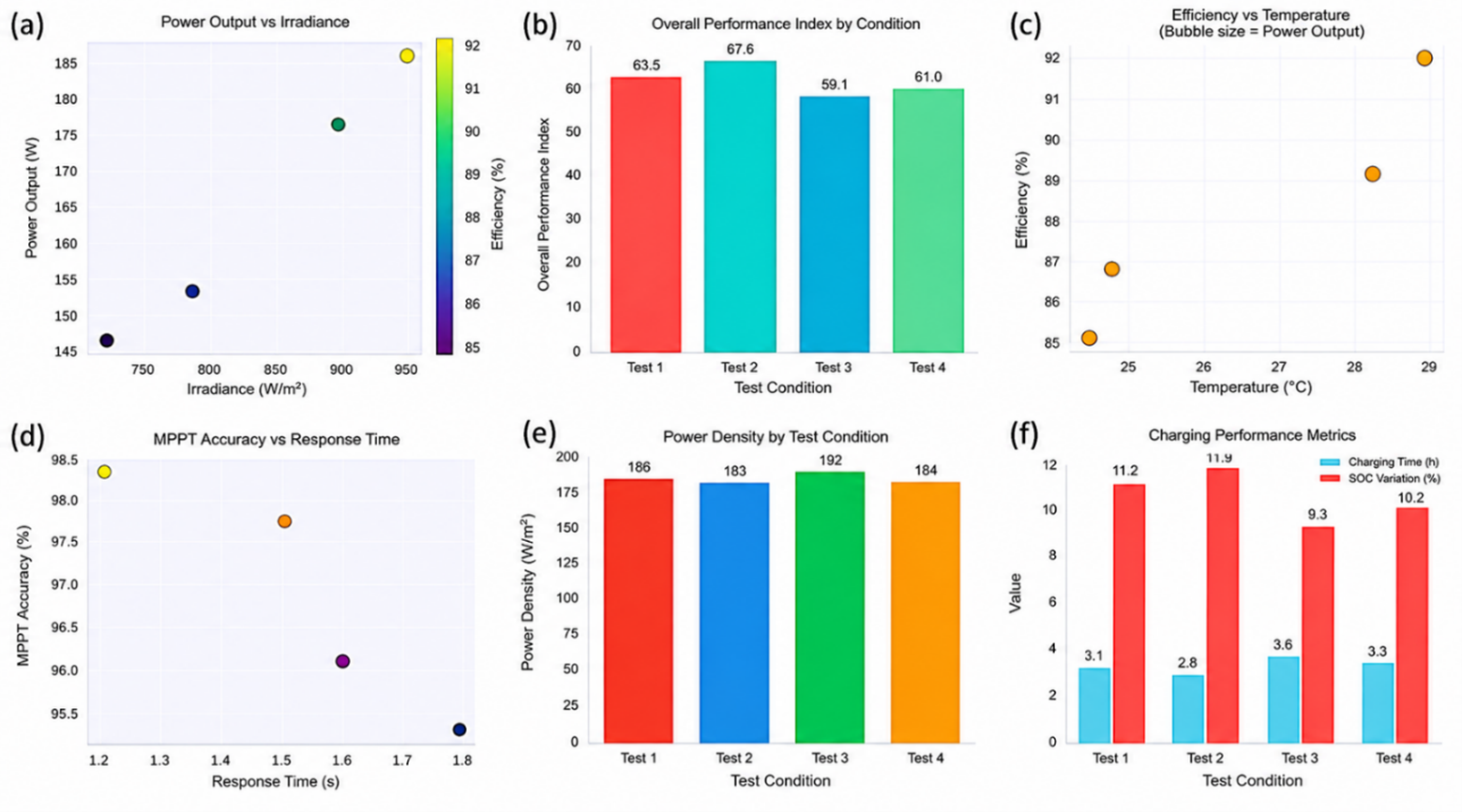
As electric vehicles (EVs) are rapidly increasing, the need for clean, efficient, and grid-independent EV charging stations is growing. Existing charging stations are prone to efficiency degradation, voltage fluctuation and low flexibility to changing solar irradiance. In this research, a PV-Storage-based EV charging infrastructure combined with a boost converter besides a hybrid maximum power point tracking (MPPT) algorithm (P&O and PID) is introduced. This system is capable of providing stable charging and high efficiency of power conversion under different operating conditions. The simulation has demonstrated the peak efficiency of 92.3%, MPPT tracking efficiency of 98.5%, and the voltage gain ratio of 6.73, which allows the system to deliver a high output above 250 V even with low irradiance (720 W/m²). The hybrid MPPT approach significantly reduces the oscillations and response time, given that the hybrid approach converges more quickly than conventional approaches. The robustness and scalability of the system is validated through benchmarking with the latest state-of-the-art (2020-2025). The findings confirmed the system as viable and sustainable for next-generation EV charging infrastructure, which is promising for energy security, less reliance on the traditional grid and promoting a more efficient renewable energy utilization. Future research will take into account the hardware implementation of the system using WBG devices with hybrid renewable energy sources and vehicle-to-grid (V2) energy exchange for improving the resilience and adaptability of the system.
References
Bialasiewicz, J. T., Renewable Energy Systems with Photovoltaic Power Generators: Operation and Modeling. IEEE Transactions on Industrial Electronics. 55 (2008) 2752-2758, doi: https://doi.org/10.1109/TIE.2008.920583.
IEA. Global EV Outlook 2024, <https://www.iea.org/reports/global-ev-outlook-2024IEA> (2024).
U.S. Department of Energy. Electric Vehicle Benefits and Considerations, <https://afdc.energy.gov/fuels/electricity-benefits> (2024).
United States Environmental Protection Agency. Electric Vehicle Myths, <https://www.epa.gov/greenvehicles/electric-vehicle-myths> (2024).
Intergovernmental Panel on Climate Change (IPCC). Climate Change 2022 - Mitigation of Climate Change: Working Group III Contribution to the Sixth Assessment Report of the Intergovernmental Panel on Climate Change. Cambridge University Press, 2023, doi: https://doi.org/10.1017/9781009157926.
Indian Renewable Energy Development Agency (IREDA). Solar Energy, <https://www.ireda.in/solar-energy> (2024).
Esram, T. and Chapman, P. L., Comparison of Photovoltaic Array Maximum Power Point Tracking Techniques. IEEE Transactions on Energy Conversion. 22 (2007) 439-449, doi: https://doi.org/10.1109/TEC.2006.874230.
Femia, N., Petrone, G., Spagnuolo, G. and Vitelli, M., Optimization of perturb and observe maximum power point tracking method. IEEE Transactions on Power Electronics. 20 (2005) 963-973, doi: https://doi.org/10.1109/TPEL.2005.850975.
Ishaque, K. and Salam, Z., A review of maximum power point tracking techniques of PV system for uniform insolation and partial shading condition. Renewable and Sustainable Energy Reviews. 19 (2013) 475-488, doi: https://doi.org/10.1016/j.rser.2012.11.032.
Safari, A. and Mekhilef, S. Implementation of incremental conductance method with direct control. in TENCON 2011 - 2011 IEEE Region 10 Conference. (2011), 944-948, doi: https://doi.org/10.1109/TENCON.2011.6129249.
Elgendy, M. A., Zahawi, B. and Atkinson, D. J., Assessment of Perturb and Observe MPPT Algorithm Implementation Techniques for PV Pumping Applications. IEEE Transactions on Sustainable Energy. 3 (2012) 21-33, doi: https://doi.org/10.1109/TSTE.2011.2168245.
Patel, H. and Agarwal, V., Maximum Power Point Tracking Scheme for PV Systems Operating Under Partially Shaded Conditions. IEEE Transactions on Industrial Electronics. 55 (2008) 1689-1698, doi: https://doi.org/10.1109/TIE.2008.917118.
Erickson, R. W. and Maksimović, D. Fundamentals of Power Electronics. 2nd edn., Springer New York, 2001, doi: https://doi.org/10.1007/b100747.
Ben-Yaakov, S. and Evzelman, M. Generic and unified model of Switched Capacitor Converters. in 2009 IEEE Energy Conversion Congress and Exposition. (2009), 3501-3508, doi: https://doi.org/10.1109/ECCE.2009.5316060.
Yilmaz, M. and Krein, P. T., Review of Battery Charger Topologies, Charging Power Levels, and Infrastructure for Plug-In Electric and Hybrid Vehicles. IEEE Transactions on Power Electronics. 28 (2013) 2151-2169, doi: https://doi.org/10.1109/TPEL.2012.2212917.
Kumar, B. V., Singh, R. K. and Mahanty, R., A modified non-isolated bidirectional DC-DC converter for EV/HEV's traction drive systems. in 2016 IEEE International Conference on Power Electronics, Drives and Energy Systems (PEDES). (2016), 1-6, doi: https://doi.org/10.1109/PEDES.2016.7914345.
Mellit, A. and Kalogirou, S. A., Artificial intelligence techniques for photovoltaic applications: A review. Progress in Energy and Combustion Science. 34 (2008) 574-632, doi: https://doi.org/10.1016/j.pecs.2008.01.001.
Subudhi, B. and Pradhan, R., A Comparative Study on Maximum Power Point Tracking Techniques for Photovoltaic Power Systems. IEEE Transactions on Sustainable Energy. 4 (2013) 89-98, doi: https://doi.org/10.1109/TSTE.2012.2202294.
Watil, A. and Chojaa, H., Enhancing grid-connected PV-EV charging station performance through a real-time dynamic power management using model predictive control. Results in Engineering. 24 (2024) 103192, doi: https://doi.org/10.1016/j.rineng.2024.103192.
Yilmaz, M. and Krein, P. T., Review of the Impact of Vehicle-to-Grid Technologies on Distribution Systems and Utility Interfaces. IEEE Transactions on Power Electronics. 28 (2013) 5673-5689, doi: https://doi.org/10.1109/TPEL.2012.2227500.
Limmer, S. and Rodemann, T., Peak load reduction through dynamic pricing for electric vehicle charging. International Journal of Electrical Power & Energy Systems. 113 (2019) 117-128, doi: https://doi.org/10.1016/j.ijepes.2019.05.031.
Nafeh, A. E.-S. A., Omran, A. E.-F. A., Elkholy, A. and Yousef, H. M., Optimal economical sizing of a PV-battery grid-connected system for fast charging station of electric vehicles using modified snake optimization algorithm. Results in Engineering. 21 (2024) 101965, doi: https://doi.org/10.1016/j.rineng.2024.101965.
Davidov, S. and Pantoš, M., Stochastic expansion planning of the electric-drive vehicle charging infrastructure. Energy. 141 (2017) 189-201, doi: https://doi.org/10.1016/j.energy.2017.09.065.
Madhusudanan, G. and Padhmanabhaiyappan, S., Efficient sizing of a battery-PV grid-connected system for rapid charging stations of electric vehicles using WOA-MARR-GAN approach. Journal of Energy Storage. 134 (2025) 118073, doi: https://doi.org/10.1016/j.est.2025.118073.
Laitsos, V. M., Bargiotas, D., Daskalopulu, A., Arvanitidis, A. I. and Tsoukalas, L. H., An Incentive-Based Implementation of Demand Side Management in Power Systems. Energies. 14 (2021) 7994, doi: https://doi.org/10.3390/en14237994.
Aktar, A. K., Taşcıkaraoğlu, A., Erdinç, O. and Güner, S., Impacts of Distribution-Level Joint Scheduling of Electric Vehicle Battery Charging and Swapping Stations on Reliability Improvement. IEEE Transactions on Industry Applications. 60 (2024) 7844-7857, doi: https://doi.org/10.1109/TIA.2024.3416093.
Zeng, F., Pan, Y., Yuan, X., Wang, M. and Guo, Y. Transformer-Based User Charging Duration Prediction Using Privacy Protection and Data Aggregation. Electronics. 13 (2024) 2022, doi: https://doi.org/10.3390/electronics13112022.
Abbas, A., Farhan, M., Shahzad, M., Liaqat, R. and Ijaz, U. Power Tracking and Performance Analysis of Hybrid Perturb–Observe, Particle Swarm Optimization, and Fuzzy Logic-Based Improved MPPT Control for Standalone PV System. Technologies. 13 (2025) 112, doi: https://doi.org/10.3390/technologies13030112.
Ismail, M., Marei, M. I. and Mokhtar, M. Adaptive Hybrid MPPT for Photovoltaic Systems: Performance Enhancement Under Dynamic Conditions. Sustainability. 18 (2026) 80, doi: https://doi.org/10.3390/su18010080.
Ríos, S. J., Sánchez-Gutiérrez, E. and Falcones, S. High-Efficiency Bidirectional DC–DC Converter Control for PV-Integrated EV Charging Stations: A Real-Time MBPC Approach. World Electric Vehicle Journal. 17 (2026) 229, doi: https://doi.org/10.3390/wevj17050229.
Jain, K., Gupta, M. and Bohre, A. K. Implementation and Comparative Analysis of P&O and INC MPPT Method for PV System. in 2018 8th IEEE India International Conference on Power Electronics (IICPE). (2018), 1-6, doi: https://doi.org/10.1109/IICPE.2018.8709519.
Khan, F., Bansal, H. O. and Singh, D., Modified Quadratic High-Gain DC–DC Converter for Solar-Powered EV Charging Systems: Simulation, Hardware Prototype, and CHIL-Based Real-Time Validation. IEEE Access. 13 (2025) 158385-158408, doi: https://doi.org/10.1109/ACCESS.2025.3606879.
Downloads
Published
How to Cite
Issue
Section
License
Copyright (c) 2026 School of Renewable Energy and Smart Grid Technology (SGtech)

This work is licensed under a Creative Commons Attribution-NonCommercial-NoDerivatives 4.0 International License.
All copyrights of the above manuscript, including rights to publish in any media, are transferred to the SGtech.
The authors retain the following rights;
1. All proprietary rights other than copyright.
2. Re-use of all or part of the above manuscript in their work.
3. Reproduction of the above manuscript for author’s personal use or for company/institution use provided that
(a) prior permission of SGtech is obtained,
(b) the source and SGtech copyright notice are indicated, and
(c) the copies are not offered for sale.