The Design of an Efficient Charcoal Kiln Optimizing for Converting Areca Spathe Biomass into High-Yield Charcoal
DOI:
https://doi.org/10.69650/rast.2025.262406Keywords:
Areca Spathe Biomass, Biomass Conversion , Charcoal Kiln DesignAbstract
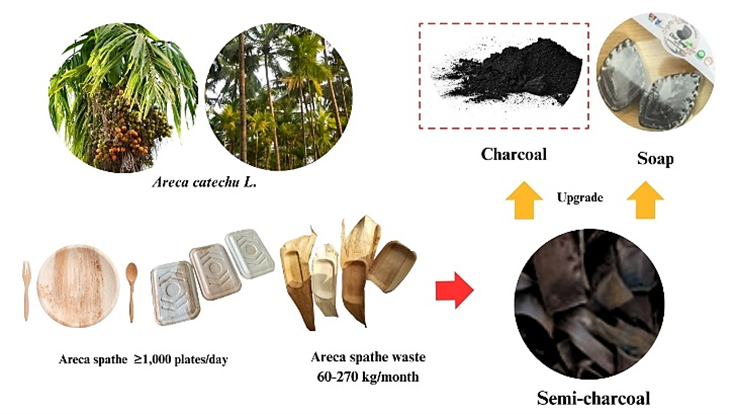
This study explores the use of Areca spathe biomass, a by-product from plate manufacturing, as a feedstock for charcoal production. A 50-liter custom-designed kiln was developed with an adjustable combustion chamber and variable air perforation sizes (1.59, 3.18, and 4.76 mm) to optimize the carbonization process. Temperature sensors were integrated to monitor thermal distribution, while computational simulations modeled airflow and heat dynamics to enhance efficiency. Experimental results showed that the highest charcoal yield, 41.53%, was achieved within one hour using 1.59 mm air perforations. Simulations closely aligned with empirical data, showing only ±0.65% deviation at 552.11°C. The findings revealed that shorter carbonization durations generally increased yield by reducing over-decomposition; however, the relationship was not entirely linear. Extremely short times led to incomplete carbonization, while longer durations reduced yield due to carbon burn-off and ash formation, particularly in trials like ASB9. An optimal carbonization window was identified, balancing heat exposure to maximize yield without degrading the product. The optimized kiln produced high-purity, porous charcoal with low volatile content. While promising, further research is needed to refine operational parameters for consistent quality. This study supports sustainable development by enhancing energy efficiency, lowering production costs, and enabling potential applications such as activated carbon production and soil amendment. Additionally, it offers a viable model for community-scale charcoal production, providing both environmental and economic benefits.
References
Coomes, O. T. and Miltner, B. C., Indigenous charcoal and biochar production: potential for soil improvement under shifting cultivation systems. Land Degradation & Development. 28 (2017) 811-821, doi: https://doi.org/10.1002/ldr.2500.
Hardy, B., Leifeld, J., Knicker, H., Dufey, J. E., Deforce, K. and Cornélis, J. T., Long term change in chemical properties of preindustrial charcoal particles aged in forest and agricultural temperate soil. Organic Geochemistry. 107 (2017) 33-45, doi: https://doi.org/10.1016/j.orggeochem.2017.02.008.
Petchaihan, L. and Wongsiriamnuey, T. Factors affecting biochar production from agricultural residue. Master’s thesis, Faculty of Engineering and Agro-Industry, Maejo University, Chiang Mai. (2022).
Cornelissen, G., Pandit, N. R., Taylor, P., Pandit, B. H., Sparrevik, M. and Schmidt, H.P., Emissions and char quality of flame-curtain "Kon Tiki" kilns for farmer-scale charcoal/biochar production. PLoS ONE. 11 (2016) e0154617, doi: https://doi.org/10.1371/journal.pone.0154617.
Jayakumar, M., Hamda, A. S., Abo, L. D., Daba, B. J., Prabhu, S. V., Rangaraju, M., Jabesa, A., Periyasamy, S., Suresh, S. and Baskar, G., Comprehensive review on lignocellulosic biomass derived biochar production, characterization, utilization and applications. Chemosphere. 345 (2023) 140515, doi: https://doi.org/10.1016/j.chemosphere.2023.140515.
Boateng, A. A., Garcia-Perez, M., Mašek, O., Brown, R. and del Campo, B. 2nd ed. in Biochar for environmental management, Ch. Biochar production technology, Routledge. (2015) 63-87.
Sundberg, C., Karltun, E., Gitau, J. K., Kätterer, T., Kimutai, G. M., Mahmoud, Y., Njenga, M., Nyberg, G., Roing de Nowina, K., Roobroeck, D. and Sieber, P., Biochar from cookstoves reduces greenhouse gas emissions from smallholder farms in Africa. Mitigation and adaptation strategies for global change. 25 (2020) 953-967, doi: https://doi.org/10.1007/s11027-020-09920-7.
Mia, S., Uddin, N., Mamun Hossain, S. A. A., Amin, R., Mete, F. Z. and Hiemstra, T., Production of biochar for soil application: a comparative study of three kiln models. Pedosphere. 25 (2015) 696-702, doi: https://doi.org/10.1016/S1002-0160(15)30050-3.
Patel, M. R. and Panwar, N. L., Development, process optimization and assessment of sustainable mobile biochar kiln for agricultural use. Journal of Cleaner Production. 477 (2024) 143866, doi: https://doi.org/10.1016/j.jclepro.2024.143866.
Moser, K., Wopienka, E., Pfeifer, C., Schwarz, M., Sedlmayer, I. and Haslinger, W., Screw reactors and rotary kilns in biochar production–A comparative review. Journal of Analytical and Applied Pyrolysis. 174 (2023) 106112, doi: https://doi.org/10.1016/j.jaap.2023.106112.
Sangsuk, S., Buathong, C. and Suebsiri, S., High-energy conversion efficiency of drum kiln with heat distribution pipe for charcoal and biochar production. Energy for Sustainable Development. 59 (2020) 1-7, doi: https://doi.org/10.1016/j.esd.2020.08.008.
Petchaihan, L., Chaichana, T., Sasujit, K. and Pintana, P. Model study of small char furnace for biomass carbonization process. in 7th ASEAN Bioenergy and Bioeconomy Conference. (2023), 16-22.
Panyoyai, N., Petchaihan, L., Wongsiriamnuay, T., Hiransatitporn, B. and Khamdaeng, T., Simulation of temperature distribution in biochar kiln with different feedstock types. Engineering Access. 5 (2019) 59-64, doi: https://doi.org/10.14456/mijet.2019.9.
Wilson, K. J., Bekker, W. and Feher, S. I., Producing, Characterizing and Quantifying Biochar in the Woods Using Portable Flame Cap Kilns. Journal of Visualized Experiments. 203 (2024) e65543, doi: https://doi.org/10.3791/65543.
Puettmann, M., Sahoo, K., Wilson, K. and Oneil, E., Life cycle assessment of biochar produced from forest residues using portable systems. Journal of Cleaner Production. 250 (2020) 119564, doi: https://doi.org/10.1016/j.jclepro.2019.119564.
Mohammadi, A., Cowie, A. L., Mai, T. L. A., Brandão, M., de la Rosa, R. A., Kristiansen, P. and Joseph, S., Climate-change and health effects of using rice husk for biochar-compost: Comparing three pyrolysis systems. Journal of Cleaner Production. 162 (2017) 260-272, doi: https://doi.org/10.1016/j.jclepro.2017.06.026.
Djousse Kanouo, B. M., Allaire, S. E. and Munson, A. D., Quality of biochars made from eucalyptus tree bark and corncob using a pilot-scale retort kiln. Waste and Biomass Valorization. 9 (2018) 899–909, doi: https://doi.org/10.1007/s12649-017-9884-2.
Srisophon, M., Khamdaeng, T., Panyoyai, N., & Wongsiriamnuay, T. Characterization of thermal distribution in 50-Liter biochar kiln at different heating times. in IOP Conference Series: Earth and Environmental Science. (2020), 012079, doi: https://doi.org/10.1088/1755-1315/463/1/012079.
Maneekhat, C. and Khamdaeng, T. Thermal characteristics of Anila-type biochar kiln. Master degree of Engineering, Thesis, Maejo University (2022).
Pintana, P., Thanompongchart, P., Phimphilai, K. and Tippayawong, N., Improvement of airflow distribution in a glutinous rice cracker drying cabinet. Energy Procedia. 138 (2017) 325-330, doi: https://doi.org/10.1016/j.egypro.2017.10.128.
Pankaew, S., Tantikul, S., Wongsiriamnuay, T., Khamdaeng, T., Tippayawong, N. and Panyoyai, N., Simulation and experimental analysis of shell and tube heat exchanger for the drying system. in IOP Conference Series: Earth and Environmental Science. (2020), 012132, doi: https://doi.org/10.1088/1755-1315/463/1/012132.
Thai Meteorological Department. Current weather conditions, <https://tmd.go.th/weather/province/chiang-mai> (2024).
Rout, S., Sahoo, G., Mishra, U. N., Sheera, A. and Prusty, A. K., An Overview of Acacia. Biotica Research Toda. 3 (2021) 691-693.
Sittioad, C., Tantikul, S., Wongsiriamnuay, T., Khamdaeng, T., Tippayawong, N. and Panyoyai, N. Temperature distribution and properties of biochar from a two-heating-stage kiln. in 3rd International Conference on Energy and Power. (2022), 020046, doi: https://doi.org/10.1063/5.0115161.
Naruethanan, T., Tantikul, S., Wongsiriamnuay, T., Khamdaeng, T., Tippayawong, N. and Panyoyai, N., Energy efficiency and economic analysis of a biochar production system. in 3rd International Conference on Energy and Power. (2022), 020047, doi: https://doi.org/10.1063/5.0115185.
Tiew, S. C., Abakar, Y. A., Mohammed, I. Y., Abubakar, L. G., Bawa, M. A., Obiajunwa, O. and Abubakar, N. A., Modelling and fluid dynamic analysis of combustion process and energy efficiency of a digital stove for domestic application. Nigerian Journal of Tropical Engineering. 18 (2024) 244–252, doi: https://doi.org/10.59081/njte.18.2.010.
Mopoung, S. Activated carbon, 1st edn., Naresuan University Press, Faculty of Science, Naresuan University (2015).
Liu, J., Zhang, Y., Wang, Y., Chen, L., Xu, Y. and Zhao, H., Temperature distribution simulation and structural optimization of low-temperature combustion chamber in carbonization furnace. Journal of Chemical Industry and Engineering Progress. 32 (2013) 2112.
Sushmitha, D. and Srinath, S. Thermal Modeling of a High-Pressure Autoclave Reactor for Hydrothermal Carbonization. in Srinivasacharya, D. and Reddy, K. (eds) Numerical Heat Transfer and Fluid Flow. Lecture Notes in Mechanical Engineering. Springer, Singapore. (2019), doi: https://doi.org/10.1007/978-981-13-1903-7_63.
Hailu, G. Product Development Using CFD Simulation of Energy Efficient Institutional Bio-char Rocket Stove. Journal of Energy Technology and Policy. 8 (2018) 22-28, doi: https://doi.org/10.7176/JETP.
Hagemann, N., Spokas, K., Schmidt, H. P., Kägi, R., Böhler, M. A. and Bucheli, T. D., Activated carbon, biochar and charcoal: linkages and synergies across pyrogenic carbon’s ABCs. Water. 10 (2018.) 182, doi: https://doi.org/10.3390/w10020182.
Kawasaki, N., Tominaga, H., Ogata, F., Inoue, K. and Kankawa, M., Development of novel carbon fiber produced from waste fiber by cabonization. Journal of Oleo Science. 61 (2012) 593-600, doi: https://doi.org/10.5650/jos.61.593.
Zohuri, B. Functionality, Advancements and Industrial Applications of Heat Pipes. Academic Press, 2020, doi: https://doi.org/10.1016/B978-0-12-819819-3.00006-7.
Namaswa, T., Burslem, D. F. and Smith, J., Emerging trends in appropriate kiln designs for small-scale biochar production in low to middle income countries. Bioresource Technology Reports. 24 (2023) 101641, doi: https://doi.org/10.1016/j.biteb.2023.101641.
U.S. Environmental Protection Agency. National Ambient Air Quality Standards (NAAQS), <https://www.epa.gov/naaqs> (2021).
World Health Organization. WHO global air quality guidelines: Particulate matter (PM2.5 and PM10), ozone, nitrogen dioxide, sulfur dioxide and carbon monoxide, <https://www.who.int/> (2021).
Downloads
Published
How to Cite
Issue
Section
License
Copyright (c) 2025 School of Renewable Energy and Smart Grid Technology (SGtech)

This work is licensed under a Creative Commons Attribution-NonCommercial-NoDerivatives 4.0 International License.
All copyrights of the above manuscript, including rights to publish in any media, are transferred to the SGtech.
The authors retain the following rights;
1. All proprietary rights other than copyright.
2. Re-use of all or part of the above manuscript in their work.
3. Reproduction of the above manuscript for author’s personal use or for company/institution use provided that
(a) prior permission of SGtech is obtained,
(b) the source and SGtech copyright notice are indicated, and
(c) the copies are not offered for sale.