A Model for Estimating Hourly Erythemal UV Radiation from Satellite Data
DOI:
https://doi.org/10.69650/rast.2025.262196Keywords:
Erythema, Ultraviolet Radiation, Modeling, Meteorology, Satellite DataAbstract
Erythemal ultraviolet (EUV) irradiance, with a wavelength range of 280–400 nm, is associated with both health risks and physiological benefits. While moderate EUV exposure stimulates vitamin D synthesis—essential for bone health and immune function—excessive exposure can cause skin damage, ocular complications, and increased risk of skin cancer, highlighting the need for accurate UV monitoring. However, ground-based measurements remain limited due to the high cost of instrumentation. This study introduces a semi-empirical model for estimating hourly EUV irradiance in Thailand using meteorological and satellite data. The model was developed using cloud index, visibility, total column ozone, and the cosine of the solar zenith angle across four stations: Chiang Mai, Ubon Ratchathani, Nakhon Pathom, and Songkhla. The baseline model, constructed using data from 2016 to 2019, achieved a mean bias difference (MBD) of 3.57%, a root mean square difference (RMSD) of 21.80%, and an R² of 0.81. However, its performance declined in areas with high aerosol loading and low visibility, particularly in Chiang Mai, where seasonal biomass burning is prevalent. To improve accuracy, a modified model was developed by incorporating aerosol optical depth (AOD) at stations where such data were available.
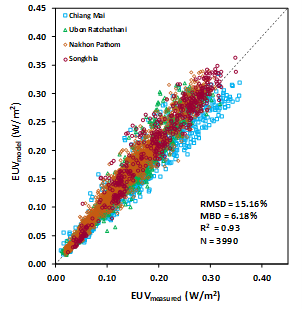
The enhanced model yielded an MBD of 6.18%, an RMSD of 15.16%, and an R² of 0.93. These results highlight the critical role of aerosols in UV attenuation and demonstrate the model’s potential for scalable, cost-effective applications in UV risk assessment, especially in regions lacking high-resolution ground monitoring infrastructure.
References
Gueymard, C. A., The sun’s total and spectral irradiance for solar energy applications and solar radiation models. Solar Energy. 76 (2004) 423-453, doi: https://doi.org/10.1016/j.solener.2003.08.039.
Roshan, D. R., Koc, M., Abdallah, A., Martin-Pomares, L., Isaifan, R. and Fountoukis, C., UV Index Forecasting under the Influence of Desert Dust: Evaluation against Surface and Satellite-Retrieved Data. Atmosphere. 11 (2020) 96, doi: https://doi.org/10.3390/atmos11010096.
Wu, J., Qin, W., Wang, L. Hu, B., Song, Y. and Zhang, M., Mapping clear-sky surface solar ultraviolet radiation in China at 1 km spatial resolution using Machine Learning technique and Google Earth Engine. Atmospheric Environment. 286 (2022),119219, doi: https://doi.org/10.1016/j.atmosenv.2022.119219.
Farman, J. C., Gardiner, B. and Shanklin, J., Large losses of total zone in Antarctic reveal seasonal ClOx/NOx interaction, Nature. 315 (1985) 207-210, doi: http://dx.doi.org/10.1038/315207a0.
Varotsos, C. A., Efstathiou, M. N. and Christodoulakis, J., The lesson learned from the unprecedented ozone hole in the Arctic in 2020; A novel nowcasting tool for such extreme events. Journal of Atmospheric and Solar-Terrestrial Physics. 207 (2020) 105330, doi: https://doi.org/10.1016/j.jastp.2020.105330.
Bais, A. F., Lucas, R. M., Bornman, J. F., Williamson, C. E., Sulzberger, B., Austin, A. T., Wilson, S. R., Andrady, A. L., Bernhard, G., McKenzie, R. L., Aucamp, P. J., Madronich, S., Neale, R. E., Yazar, S., Young, A. R., de Gruijl, F. R., Norval, M., Takizawa, Y., Barnes, P. W., Robson, T. M., Robinson, S. A., Bailaré, C. L., Flint, S. D., Neale, P. J., Hylander, S., Rose, K. C., Wängberg, S. -Å., Häder, D. -P., Worrest, R. C., Zepp, R. G., Paul, N. D., Cory, R. M., Solomon, K. R., Longstreth, J., Pandey, K. K., Redhwi, H. H., Torikai, A. and Heikkilä A. M., Environmental effects of ozone depletion, UV radiation and interactions with climate change: UNEP Environmental Effects Assessment Panel, update 2017. Photochem Photobiol Sci. 17 (2018) 127-179, doi: https://doi.org/10.1039/c7pp90043k.
Bernhard, G. H., Neale, R. E., Barnes, P. W., Neale, P. J., Zepp, R. G., Wilson, S. R. Andrady, A. L., Bais, A. F., McKenzie, R. L., Aucamp, P. J., Young, P. J., Liley, J. B., Lucas, R. M., Yazar, S., Rhodes, L. E., Byrne, S. N., Hollestein, L. M., Olsen, C. M., Young, A. R., Robson, T. M., Bornman, J. F., Jansen, M. A. K., Robinson, S. A., Ballaré, C. L., Williamson, C. E., Rose, K. C., Banaszak, A. T., Häder, D. -P, Hylander, S., Wängberg, S. -Å., Austin, A. T., Hou, W. -C., Paul, N. D., Madronich, S., Sulzberger, B., Solomon, K. R., Li, H., Schikowski, T., Longstreth, J., Pandey, K. K., Heikkilä, A. M. and White, C. C., Environmental effects of stratospheric ozone depletion, UV radiation and interactions with climate change: UNEP Environmental Effects Assessment Panel, update 2019. Photochem Photobiol Sci. 19 (2020) 542-584, doi: https://doi.org/10.1039/d0pp90011g.
Holick, M. F., Resurrection of vitamin D deficiency and rickets. The Journal of Clinical Investigation. 116 (2006) 2062-2072, doi: https://doi.org/10.1172/JCI29449.
Roberts, J. E., Ultraviolet radiation as a risk factor for cataract and macular degeneration. Eye & Contact Lens: Science & Clinical Practice. 37 (2011) 246-249, doi: https://doi.org/10.1097/ICL.0b013e31821cbcc9.
Hu, B., Wang, Y. and Liu, G., Infuences of the clearness index on UV solar radiation for two locations in the Tibetan Plateau-Lhasa and Haibei. Advances in Atmospheric Sciences. 25 (2008) 885-896, doi: https://doi.org/10.1007/s00376-008-0885-8.
Choosri, P., Janjai, S., Nunez, M., Buntoung, S. and Chanalert, W., Development of a method for mapping monthly average hourly diffuse erythemal ultraviolet radiation. Journal of Atmospheric and Solar-Terrestrial Physics. 161 (2017) 19-27, doi: https://doi.org/10.1016/j.jastp.2017.06.003.
Lamy, K., Portafaix, T., Brogniez, C., Godin-Beekmann, S., Bencherif, H., Morel, B. Pazmino, A., Metzger, J. M., Auriol, F., Deroo, C., Duflot, V., Goloub, P., and Long, C. N., Ultraviolet radiation modelling from ground-based and satellite measurements on Reunion Island, southern tropics. Atmospheric Chemistry and Physics. 18 (2018) 227–246, doi: https://doi.org/10.5194/acp-18-227-2018.
García-Rodríguez, S. García-Rodríguez, A., Granados-López, D., García, I. and Alonso-Tristán, C., Ultraviolet Erythemal Irradiance (UVER) under Different Sky Conditions in Burgos, Spain: Multilinear Regression and Artificial Neural Network Models. Applied Sciences. 13 (2023) 10979, doi: https://doi.org/10.3390/app131910979.
Buntoung, S., Laiwarin, P., Pattarapanitchai, S., Masiri, I., Wattan, R., Tohsing, K., Kangwanwit, W. and Janjai, S., Development of maps for monthly average hourly vitamin D–weighted solar ultraviolet radiation over Thailand using a semi‑empirical model with ground‑based and satellite‑based inputs. Theoretical and Applied Climatology. 155 (2024) 2499-2507, doi: https://doi.org/10.1007/s00704-023-04799-1.
Lean, J. L., Modelling solar UV irradiance variability. Advances in Space Research. 8 (1988) 85-94, doi: https://doi.org/10.1016/0273-1177(88)90176-7.
Díaz, J. P., Expósito, F. J., Arbelo, M., Hernández-Leal, P. A., Torres, C. and Carreño, V., Radiative transfer modeling in the UV-VIS region with the presence of Saharan mineral desert aerosols. Advances in Space Research. 26 (2000) 1009-1012, doi: https://doi.org/10.1016/S0273-1177(00)00048-X.
McKenzie, R., Smale, D. and Kotkamp, M., Relationship between UVB and erythemally weighted radiation. Photochem Photobiol Sci. 3 (2004) 252-256, doi: https://doi.org/10.1039/b312985c.
Na, H. R., Heisler, G. M., Nowak, D. J. and Grant, R. H., Modeling of urban trees’ effects on reducing human exposure to UV radiation in Seoul, Korea. Urban Forestry & Urban Greening. 13 (2014) 785-792, doi: https://doi.org/10.1016/j.ufug.2014.05.009.
Escobedo, J. F., Gomes, E. N., Oliveira, A. P. and Soares, J., Modeling hourly and daily fractions of UV, PAR and NIR to global solar radiation under various sky conditions at Botucatu, Brazil. Applied Energy. 86 (2009) 299-309, doi: https://doi.org/10.1016/j.apenergy.2008.04.013.
Leal, S. S., Tíba, C. and Piacentini, R., Daily UV radiation modeling with the usage of statistical correlations and artificial neural networks. Renewable Energy. 36 (2011) 3337-3344, doi: https://doi.org/10.1016/j.renene.2011.05.007.
Prasad, S. S., Deo, R. C., Downs, N. J., Casillas-Pérez, D., Salcedo-Sanz, S. and Parisi, A. V., Very short-term solar ultraviolet-A radiation forecasting system with cloud cover images and a Bayesian optimized interpretable artificial Intelligence model. Expert Systems with Applications. 236 (2024) 121273, doi: https://doi.org/10.1016/j.eswa.2023.121273.
Kottek, M., Grieser, J., Beck, C., Rudolf, B. and Rubel, F., World map of the Köppen-Geiger climate classification updated. Meteorologische Zeitschrift. 15 (2006) 259–263, doi: https://doi.org/10.1127/0941-2948/2006/0130.
Srivanit, M. and Iamtrakul, P., Spatial patterns of greenspace cool islands and their relationship to cooling effectiveness in the tropical city of Chiang Mai, Thailand. Environ Monit Assess. 191 (2019) 1-16, doi: https://doi.org/10.1007/s10661-019-7749-9.
Khamkaew, C., Chantara, S. and Wiriya, W., Atmospheric PM2. 5 and its elemental composition from near source and receptor sites during open burning season in Chiang Mai, Thailand. International Journal of Environmental Science and Development. 7 (2016) 436-440, doi: https://doi.org/10.7763/IJESD.2016.V7.815.
Thongsame, W., Henze, D. K., Kumar, R., Barth, M. and Pfister, G., Evaluation of WRF-Chem PM2.5 simulations in Thailand with different anthropogenic and biomass-burning emissions. Atmospheric Environment: X. 23 (2024) 1-20, doi: https://doi.org/10.1016/j.aeaoa.2024.100282.
Saelim, R., Musikasuwan, S. and Chetae, N., Land surface temperature changes in Songkhla, Thailand from 2001 to 2018. Naresuan University Journal: Science and Technology. 28 (2020) 39-45, doi: https://doi.org/10.14456/nujst.2020.24.
Noppradit, P., Pradit, S., Muenhor, D., Doungsuwan, N., Whangsani, U., Sama, N. and Towatana, P., Investigation of 37 years weather record and its relation to human health: a case study in Songkhla province, southern Thailand. International Journal of Agricultural Technology. 17 (2021) 1507-1520.
Liang, Y., Che, H., Gui, K., Zheng, Y., Yang, X., Li, X., Liu, C., Sheng, Z., Sun, T. and Zhang, X., Impact of biomass burning in South and Southeast Asia on background aerosol in Southwest China. Aerosol and Air Quality Research. 19 (2019) 1188–1204, doi: https://doi.org/10.4209/aaqr.2018.08.0324.
Dejchanchaiwong, R., Tekasakul, P., Morris, J., Ingviya, T., Latif, M. T., Amil, N., Hata, M., Furuuchi, M., Dominick, D. and Malinee, R. in Environmental Nanopollutants: Sources, Occurrence, Analysis and Fate: Biomass Burning in Southeast Asia and Influences on Atmospheric Nanoparticle, Ch. 3, The Royal Society of Chemistry, (2022) 49-81, doi: https://doi.org/10.1039/9781839166570-00049.
Fan, W., Li, J., Han, Z., Wu, J., Zhang, S., Zhang, C. and Li, J., Impacts of biomass burning in Southeast Asia on aerosols over the low-latitude plateau in China: An analysis of a typical pollution event. Frontiers in Environmental Science. 11 (2023) 1-18, doi: https://doi.org/10.3389/fenvs.2023.1101745.
Webb, A., Gröbner, J. and Blumthaler, M., A practical guide to operating broadband instruments measuring erythemally weighted irradiance. Report No. EUR22595, EU Publications Office, (2006) 1-17.
Webb, A., Gardiner, B. G., Martin, T. J., Leszcynski, K., Metzdorf, J. and Mohnen, V. A. Guidelines for site quality control of UV monitoring. Report No. WMO/GAW, 126, World Meteorological Organization (WMO), (1998).
Seckmayer, G., Basis, A., Bernhard F., Blumthaler, M., Booth,C. R., Lantz, K. and McKenzie, R. L. Instruments to Measure Solar Ultraviolet RadiationPart 2: Broadband Instruments Measuring Erythemally WeightedSolar Irradiance. Report No. WMO/GAW, 164, World Meteorological Organization (WMO), (2007).
Ångström, A., On the atmospheric transmission of sun radiation and on dust in the air. Geografiska Annaler. 2 (1929) 156-166.
Janjai, S., Kumharn, W. and Laksanaboonsong, J., Determination of Angstrom’s turbidity coefficient over Thailand. Renewable Energy. 28 (2003) 1685-1700, doi: https://doi.org/10.1016/S0960-1481(03)00010-7.
Iqbal, M. An introduction to solar radiation. 1st edn., Academic Press, 1983.
Cano, D., Monget, J. M., Albuisson, M., Guillard, H., Regas, N. and Wald, L., A method for the determination of the global solar radiation from meteorological satellite data. Solar Energy. 37 (1986) 31–39, doi: https://doi.org/10.1016/0038-092X(86)90104-0.
Eniola, V., Suriwong, T., Sirisamphanwong, C. and Ungchittrakool, K., Hour-ahead Forecasting of Photovoltaic Power Output based on Hidden Markov Model and Genetic Algorithm. International Journal of Renewable Energy Research. 9 (2019) 933-943, doi: https://doi.org/10.20508/ijrer.v9i2.9348.g7659.
Adeyemi, K. O., Eniola, V., Kalu-Uka, G. M., Zarmi, M., Uthman, M. and Bala, E., Forecasting Photovoltaic Energy Generation Using Multilayer Perceptron Neural Network. International Journal of Renewable Energy Research. 12 (2022) 1742-1753, doi: https://doi.org/10.20508/ijrer.v12i4.13306.g8599.
Cordero, R. R., Seckmeyer, G. and Labbe, F., Cosine error influence on ground-based spectral UV irradiance measurements. Metrologia. 45 (2008) 406-414, doi: https://doi.org/10.1088/0026-1394/45/4/005.
Weiß, C. H., StatSoft, Inc., Tulsa, OK.: STATISTICA, Version 8. AStA. 91 (2007) 339–341, doi: https://doi.org/10.1007/s10182-007-0038-x.
Suriyawong, P., Chuetor, S., Samae, H., Piriyakarnsakul, S., Amin, M., Furuuchi, M., Hata, M., Inerb, M. and Phairuang, W. Airborne particulate matter from biomass burning in Thailand: Recent issues, challenges, and options. Heliyon. 9 (2023) 1-14, doi: https://doi.org/10.1016/j.heliyon.2023.e14261.
Bran, S. H., Macatangay, R., Surapipith, V., Chotamonsak, C., Chantara, S., Han, Z. and Li, J., Surface PM2.5 mass concentrations during the dry season over northern Thailand: Sensitivity to model aerosol chemical schemes and the effects on regional meteorology. Atmospheric Research. 277 (2022) 1-14, doi: https://doi.org/10.1016/j.atmosres.2022.106303.
Downloads
Published
How to Cite
Issue
Section
License
Copyright (c) 2025 School of Renewable Energy and Smart Grid Technology (SGtech)

This work is licensed under a Creative Commons Attribution-NonCommercial-NoDerivatives 4.0 International License.
All copyrights of the above manuscript, including rights to publish in any media, are transferred to the SGtech.
The authors retain the following rights;
1. All proprietary rights other than copyright.
2. Re-use of all or part of the above manuscript in their work.
3. Reproduction of the above manuscript for author’s personal use or for company/institution use provided that
(a) prior permission of SGtech is obtained,
(b) the source and SGtech copyright notice are indicated, and
(c) the copies are not offered for sale.