
การคัดเลือกแบคทีเรียชอบเค็มที่ผลิตเอนไซม์โปรติเอสและไลเปสจากไตปลาทูหมัก
Article Sidebar
Main Article Content
บทคัดย่อ
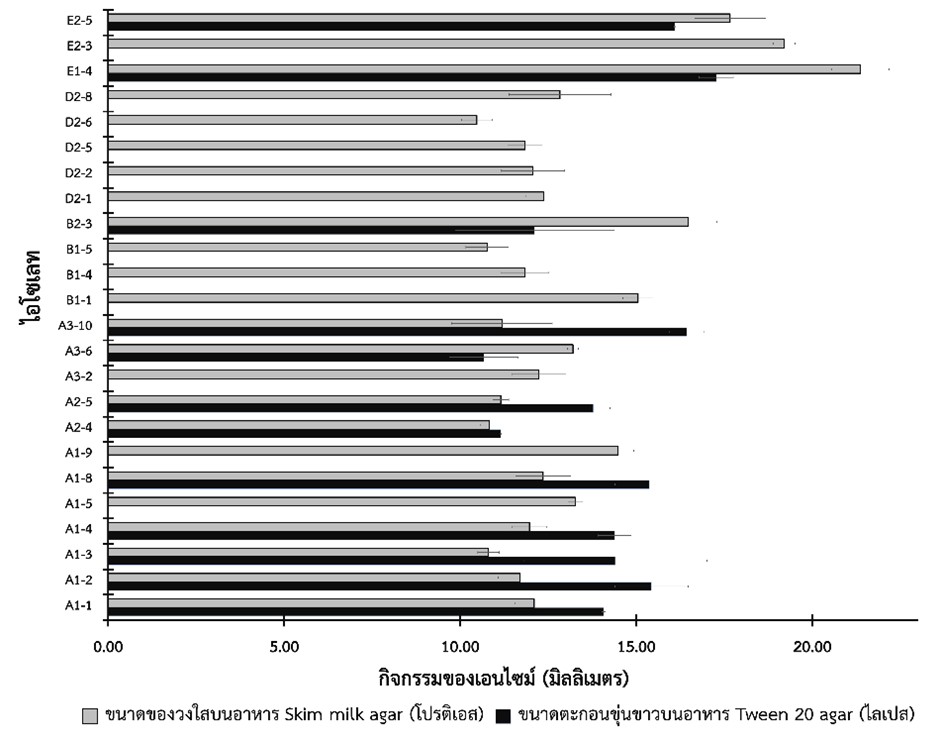
งานวิจัยนี้มีวัตถุประสงค์เพื่อศึกษาคุณสมบัติทางเคมีและคัดเลือกแบคทีเรียชอบเค็มที่ผลิตเอนไซม์โปรติเอสและไลเปสจากตัวอย่างไตปลาทูหมักจำนวน 13 ตัวอย่าง ที่ถูกเก็บมาจากภาคใต้ตอนบนของประเทศไทย ผลการวิเคราะห์ทางเคมีพบว่ามีค่า pH ระหว่าง 4.70 - 5.80 มีปริมาณกรดแลคติก 3.40 - 4.60% และมีปริมาณเกลือ 4.00 - 22.44% เมื่อทำการแยกแบคทีเรียชอบเค็มบนอาหาร Nutrient agar (NA) ที่มีการเติม 5% NaCl สามารถคัดเลือกแบคทีเรียชอบเค็มได้ จำนวน 130 ไอโซเลท และเมื่อนำมาทดสอบความสามารถในการผลิตเอนไซม์โปรติเอสโดยวิธี agar well diffusion พบว่ามี 24 ไอโซเลท (18.46%) ที่มีกิจกรรมการย่อยบนอาหาร Skim milk agar ซึ่งมีขนาดวงใส 10.53 - 21.36 มิลลิเมตร จากนั้น นำแบคทีเรียชอบเค็มที่ผลิตเอนไซม์โปรติเอสได้มาทดสอบความสามารถในการผลิตเอนไซม์ไลเปสบนอาหาร Tween 20 agar พบว่า มีเพียง 12 ไอโซเลท ที่สามารถสร้างตะกอนขุ่นขาวขนาด 10.67 - 17.27 มิลลิเมตร โดยแบคทีเรียชอบเค็มที่มีความสามารถในการผลิตเอนไซม์โปรติเอสและไลเปสสูงที่สุดคือ E1-4 ซึ่งเมื่อนำมาจัดจำแนกสายพันธุ์โดยการวิเคราะห์ลำดับนิวคลีโอไทด์ของยีน 16S rRNA พบว่ามีความสัมพันธ์ใกล้เคียงกับแบคทีเรียสายพันธุ์ Bacillus safensis NBRC 100820 (98.11% similarity) แสดงให้เห็นว่า E1-4 เป็นแบคทีเรียชอบเค็มที่มีความสามารถในการผลิตเอนไซม์โปรติเอสและไลเปส ซึ่งสามารถนำไปศึกษาเพื่อประยุกต์ใช้ในงานด้านเทคโนโลยีชีวภาพต่อไป
Article Details

อนุญาตภายใต้เงื่อนไข Creative Commons Attribution-NonCommercial-NoDerivatives 4.0 International License.
เอกสารอ้างอิง
ปิยะวรรณ กาสลัก. (2552). เอกสารประกอบการสอนวิชา 305411 เทคโนโลยีอาหารหมักดอง. นครราชสีมา: สาขาวิชาเทคโนโลยีอาหาร สำนักวิชาเทคโนโลยีการเกษตร มหาวิทยาลัยเทคโนโลยีสุรนารี. หน้า 69.
ลัญจกร จันทร์อุดม และมณฑกานต์ ทองสม. (2561). การคัดแยกแบคทีเรียที่ผลิตฮีสทามีนและการวิเคราะห์คุณภาพผลิตภัณฑ์อาหารทะเลหมักในพื้นที่จังหวัดนครศรีธรรมราช. วารสารวิชชา มหาวิทยาลัยราชภัฎนครศรีธรรมราช37(1): 12 - 24.
อำพรรณ ชัยกุลเสรีวัฒน์, ชนิตา ชูพรม และอายูรีน มานะ. (2558). การคัดแยกแบคทีเรียชอบเค็มที่ผลิตเอนไซม์โปรติเอสจากปลาร้า. วารสารเทคโนโลยีการอาหาร มหาวิทยาลัยสยาม 10(1): 1 - 8.
อุษณีย์ อภิบาลแบ, สมพร ประเสริฐส่งสกุล, อภิชัย บัวชูก้าน และสมรักษ์ พันธ์ผล. (2556). การคัดเลือกแบคทีเรียกรดแลคติกจากอาหารหมักที่มีความเข้มข้นเกลือสูงและศึกษาฤทธิ์การยับยั้งเชื้อแบคทีเรีย. ใน: การประชุมหาดใหญ่วิชาการ ครั้งที่ 4 วันที่ 10 พฤษภาคม 2556. มหาวิทยาลัยหาดใหญ่, สงขลา. 32 - 39.
Abdelli, F., Jardak, M., Elloumi, J., Stien, D., Cherif, S., Mnif, S. and Aifa, S. (2019). Antibacterial, anti-adherent and cytotoxic activities of surfactin (s) from a lipolytic strain Bacillus safensis F4. Biodegradation 30: 287 - 300.
Agbobatinkpo, P.B., Thorsen, L., Nielsen, D.S., Azokpota, P., Akissoe, N., Hounhouigan, J.D. and Jakobsen, M. (2013). Biodiversity of aerobic endospore-forming bacterial species occurring in Yanyanku and Ikpiru, fermented seeds of Hibiscus sabdariffa used to produce food condiments in Benin. International Journal of Food Microbiology 163(2-3): 231 - 238. doi: 10.1016/j.ijfoodmicro. 2013.02.008.
AOAC. (2000). Official Method of Analysis of the Association of Official Analytical Chemistry. 17th edition. Virginia: The Association of Official Analysis Chemists.
Boby, F., Bhuiyana, D.M.N.H., Khanb, D.M.S. and Parvez, M.M. (2025). Draft genome sequence data on Bacillus safensis FB03 isolated from the rhizosphere soil of leguminous plant in Bangladesh. Data in Brief 60: 111527. doi: 10.1016/j.dib.2025.111527.
Chancharoonpong, C. and Palagool, N. (2020). Screening of halophilic bacteria and product characteristic from salty-fermented fish (Pla-ra). Science and Technology RMUTT Journal 10(1): 269 - 276.
Daroonpunt, R., Tanaka, N., Uchino, M. and Tanasupawat, S. (2018). Characterization and Screening of Lipolytic Bacteria from Thai Fermented Fish. Sains Malaysiana 47(1): 91 - 97. doi: 10.17576/jsm-2018-4701-11.
Heo, S., Lee, J.H. and Jeong, D.W. (2020). Food-derived coagulase-negative Staphylococcus as starter cultures for fermented foods. Food Science and Biotechnology 29(8): 1023 - 1035. doi: 10.1007/s1 0068-020-00789-5.
Kamilari, E., O'Connor, P.M., Farias, F.M.D., Johnson, C.N., Buttimer, C., Deliephan, A., Hill, D., Fursenko, O., Wiese, J., Stanton, C., Hill, C. and Ross, R.P. (2025). Bacillus safensis APC 4099 has broad-spectrum antimicrobial activity against both bacteria and fungi and produces several antimicrobial peptides, including the novel circular bacteriocin safencin E. Applied and Environmental Microbiology 91(1): e01942-24. doi: 10.1128/aem.01942-24.
Kanjan, P., and Hongpattaraere, T. (2016). Antibacterial metabolites secreted under glucose-limited environment of the mimicked proximal colon model by lactobacilli abundant in infant feces. Applied Microbiology and Biotechnology 100(17): 7651 - 7664. doi: 10.1007/s00253-016-76 06-5
Kanjan, P. and Sakpetch, P. (2020). Functional and safety assessment of Staphylococcus simulans PMRS35 with high lipase activity isolated from high salt-fermented fish (Budu) for starter development. LWT - Food Science and Technology 24: 109183. doi: 10.1016/j.lwt.2020.109183.
Kanlayakrit, W. and Bovornreungroj, P. (2005). Isolation and characterization of salt-loving protease producing bacteria form fish sauce samples. Kasetsart Journal Natural Science 39: 88 - 97.
Kumar, A., Dhiman, S., Krishan, B. Samtiya, M., Kumari, A., Pathak, N., Kumari, A., Aluko, R. and Dhewa, T. (2024). Microbial enzymes and major applications in the food industry: a concise review. Food Production, Processing and Nutrition 6: 85. doi: 10.1186/s43014-024-00261-5.
Lateef, A., Adelere, I.A. and Gueguim-Kana, E.B. (2015). The biology and potential biotechnological applications of Bacillus safensis. Biologia 70(4): 411 - 419. doi: 10.1515/biolog-2015-0062.
Margesin, R., and Schinner, F. (2001). Potential of halotolerant and halophilic microorganisms for biotechnology. Extremophiles 5(2): 73 - 83. doi: 10.1007/s007920100184.
Pan, T. Li, M., Guo, J., Zhao, D., Liu, X., Huang, H., Wang, N., Yu, S., Guan, J., Liu, M., Zhang, S., Wang, C. and Yang, G. (2024). Bacillus safensis from sauerkraut alleviates acute lung injury induced by Methicillin-Resistant Staphylococcus aureus through the regulation of M2 macrophage polarization via its metabolite esculin. Journal of Agricultural and Food Chemistry 73(1): 409 - 424. doi: 10.1021/acs. jafc.4c05508.
Rong, S., Xu, H., Li, L., Chen, R., Gao, X. and Xu, Z. (2020). Antifungal activity of endophytic Bacillus safensis B21 and its potential application as a biopesticide to control rice blast. Pesticide Biochemistry and Physiology 162: 69 - 77. doi: 10.1016/j.pestbp.2019.09.003.
Saidumohamed, B.E., Baburaj, A.P., Johny, T.K., Sheela, U.B., Sreeranganathan, M. and Bhat, S.G. (2021). A magainin-2 like bacteriocin BpSl14 with anticancer action from fish gut Bacillus safensis SDG14. Analytical Biochemistry 627: 114261. doi: 10.1016/j.ab.2021.114261.
Saimmai, A. Chooklin, C. S., Chingjit, S., Rattana, N., Maneerat, S., Hwanhlem, N., Saisa-ard, K. and Dikit, P. (2017). Monitoring the lactic acid bacterial diversity during Budu fermentation by culturing method and PCR-DGGE technique. In: The 29th Annual Meeting of the Thai Society for Biotechnology and International Conference, Bangkok, Thailand. 52 - 61.
Samad, N.S., Amid, A., Jimat, D.N. and Shukor, N.A.A. (2017). Isolation and identification of halophilic bacteria producing halotolerant protease. Science Heritage Journal 1(1): 7 - 9. doi: 10.26480/gws.01. 2017.07.09.
Sekar, A. and Kim, K. (2020). Halophilic bacteria in the food industry. In: Encyclopedia of Marine Biotechnology, S.K. Kim (Ed.). pp. 2061. doi: 10.1002/9781119143802.ch91.
Silhavy, T.J., Kahne, D. and Walker, S. (2010). The bacterial cell envelope. Cold Spring Harbor Perspectives in Biology 2(5): a000414. doi: 10.1101/cshperspect.a000414.
Ventosa, A., Nieto, J.J., and Oren, A. (1998). Biology of moderately halophilic aerobic bacteria. Microbiology and Molecular Biology Reviews 62(2): 504 - 544. doi: 10.1128/MMBR.62.2.504-544.1998.
Vijayaraghavan, P. and Vincent, S.G.P. (2013). A simple method for the detection of protease activity on agar plates using bromocresolgreen dye. Journal of Biochemical Technology 4(3): 628 - 630.
Yiamsombut, S., Kuncharoen, N., Techo, S., Chamroensaksri, N. and Tanasupawat, S. (2022). Characterization and lipolytic activity of Staphylococcus strains isolated from Thai Fermented Fish Products. Journal of Fisheries and Environment 46(2): 88 - 99.
Zhang, X., Zhang, D., Yan, Y., Wang, R., Chi, Y., Zhang, D., Zhou, P. and Chu, S. (2024). Enhancing aerobic composting performance of high-salt oily food waste with Bacillus safensis YM1. Bioresource Technology 397: 130475. doi.10.1016/j.biortech.2024.130475.
Zhu, X.C., Xu, S.G., Wang, Y.R., Zou, M.T., Mridha, M.A.U., Javed, K. and Wang, Y. (2023). Unveiling the Potential of Bacillus safensis Y246 for Enhanced Suppression of Rhizoctonia solani. Journal of Fungi 9(11): 1085. doi: 10.3390/jof9111085.
