
ฤทธิ์ต้านการอักเสบในหลอดทดลองและต้านเชื้อแบคทีเรียของสารสกัดไพลสามชนิดด้วยการประยุกต์กรรมวิธีสกัดจากภูมิปัญญาการแพทย์แผนไทย
Article Sidebar
Main Article Content
บทคัดย่อ
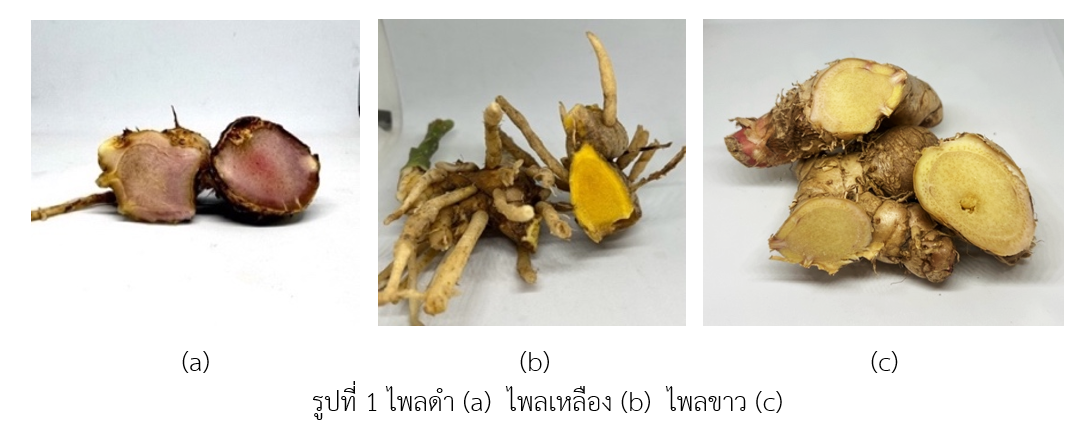
ไพล เป็นสมุนไพรที่มีการใช้ประโยชน์อย่างแพร่หลายในประเทศไทย โดยเฉพาะในด้านการแพทย์แผนไทยและอุตสาหกรรมสุขภาพ ไพลมีอยู่หลายชนิด ได้แก่ ไพลเหลือง (Zingiber cassumunar Roxb.) ไพลดำ (Z. ottensii Valeton) และไพลขาว (Z. kerrii Craib) ซึ่งแต่ละชนิดมีลักษณะทางกายภาพและฤทธิ์ทางชีวภาพที่แตกต่างกันแต่มีสรรพคุณทางยาคล้ายคลึงกัน เช่น ฤทธิ์ต้านการอักเสบ ต้านอนุมูลอิสระ และต้านจุลชีพ งานวิจัยนี้มุ่งเน้นการพัฒนากรรมวิธีการสกัดสารสำคัญจากไพลสามชนิดโดยอาศัยหลักการทางภูมิปัญญาแพทย์แผนไทย คือ การต้มยา และการหุงยาด้วยน้ำมันซึ่งนำกรรมวิธีดังกล่าวมาประยุกต์ใช้ในห้องปฏิบัติการเพื่อพัฒนากรรมวิธีการสกัดไพลสามชนิด โดยอาศัยวิธีการการสกัดด้วยวิธีรีฟลักซ์ (Reflux Extraction) ซึ่งใช้น้ำและน้ำมันปาล์มเป็นตัวทำละลายในการสกัด กำหนดเวลาในการสกัดเป็นระยะเวลา 3 ชั่วโมง ทำให้ได้สารสกัดจำนวน 6 ตัวอย่าง ได้แก่ สารสกัดน้ำมันไพลสามชนิด (BOE YOE WOE) และสารสกัดน้ำไพลสามชนิด (BWE YWE WWE) ทำการทดสอบฤทธิ์ต้านการอักเสบในหลอดทดลองและฤทธิ์ต้านเชื้อแบคทีเรีย Streptococcus mutans ของสารสกัด จากผลการทดสอบแสดงให้เห็นถึงศักยภาพของสารสกัดไพลสามชนิด พบว่า สารสกัดน้ำมันไพลสามชนิด ได้แก่ ไพลดำ (BOE) ไพลเหลือง (YOE) และ ไพลขาว (WOE) มีฤทธิ์ต้านการอักเสบในหลอดทดลอง ในขณะที่สารสกัดน้ำไพลดำ (BWE) และไพลขาว (WWE) พบฤทธิ์ต้านการอักเสบในหลอดทดลอง แต่ไม่พบฤทธิ์ต้านการอักเสบในหลอดทดลองจากสารกัดน้ำไพลเหลือง โดยทำการทดสอบเปรียบเทียบกับยามาตรฐาน Diclofenac diethylammonium ซึ่งสารสกัดน้ำมันไพลดำ (BOE) และสารสกัดน้ำไพลดำ (BWE) เป็นสารสกัดที่มีประสิทธิภาพในการต้านการอักเสบในหลอดทดลองที่ดีที่สุด มีค่า IC50 เท่ากับ 5.21 ± 0.33 3.72 ± 0.11 mg/ml ตามลำดับ ในขณะเดียวกันสารสกัดไพลสามชนิดทั้ง 6 ตัวอย่าง ไม่พบฤทธิ์ต้านเชื้อแบคทีเรีย S. mutans เมื่อทดสอบด้วยวิธี Disc Diffusion เปรียบเทียบกับยามาตรฐาน Erythromycin จากการทดลองแสดงให้เห็นว่าการประยุกต์ใช้วิธีการสกัดจากภูมิปัญญาทางการแพทย์แผนไทยด้วยเทคนิครีฟลักซ์ส่งผลให้สารสกัดมีประสิทธิภาพ และกระบวนการในการสกัดที่มีขั้นตอนอย่างชัดเจน ทำให้สามารถพัฒนาสารสกัดที่มีคุณภาพเพื่อนำไปพัฒนาเป็นผลิตภัณฑ์สุขภาพในการใช้ประโยชน์ทางการแพทย์แผนไทย
Article Details

อนุญาตภายใต้เงื่อนไข Creative Commons Attribution-NonCommercial-NoDerivatives 4.0 International License.
เอกสารอ้างอิง
กรรณิการ์ แก้วจันทร์. (2567). การพัฒนาวิธีการสกัดไพลด้วยวิธีการทอดแบบน้ำมันท่วม. วารสารหมอยาไทยวิจัย 10(1):
- 42.
พนิดา รัตนปิติกรณ์. (2561). น้ำมันหอมระเหยที่สกัดจากพืชและการประยุกต์ใช้เป็นสารต่อต้านจุลินทรีย์ในผลิตภัณฑ์อาหาร. วารสารเทคโนโลยีการอาหาร มหาวิทยาลัยสยาม 13(2): 1 - 10.
ณวัชพงศ์ ไชรัตน์ และจุรีภรณ์ อิ้มพัฒน์. (2554). อัตลักษณ์ทางเคมีของขิงแห้งที่เป็นเครื่องยาไทย. ใน: รายงานวิจัยฉบับสมบูรณ์. มหาวิทยาลัยแม่ฟ้าหลวง, เชียงราย.
ธเนศพล พันธ์เพ็ง, สุกก์สลิล บูรณะทรัพย์ขจร และสุวีรวรรณ ลิ้มสุวรรณ. (2564). การปรุงยาสมุนไพรตามกรรมวิธีทางการแพทย์แผนไทย 28 วิธี. พิมพ์ครั้งที่ 1. กรุงเทพฯ: คณะแพทยศาสตร์ศิริราชพยาบาล มหาวิทยาลัยมหิดล. หน้า 31 – 48 และ 85 - 92.
อัจจิมา ศรีวิลาศ. (2551). ฤทธิ์ต้านเชื้อแบคทีเรียของสารสกัดจากผลหมาก. วารสารวิทยาศาสตร์และเทคโนโลยี 17(2): 123 - 130.
Bagad, A.S., Joseph, J.A., Bhaskaran, N. and Agarwal, A. (2013). Comparative evaluation of anti-inflammatory activity of curcuminoids, turmerones, and aqueous extract of Curcuma longa. Advances in Pharmacological Sciences 2013: 805756. doi: 10.1155/2013/805756.
Chaiyana, W. and Phongpradist, R. (2016). Development of microemulsion-based gel from oil extracts of Plai (Zingiber cassumunar Roxb.) for anti-inflammatory activity. Chiang Mai University, Chiang Mai.
Moreira da Silva, T., Pinheiro, C.D., Puccinelli Orlandi, P., Pinheiro, C.C. and Soares Pontes, G. (2018). Zerumbone from Zingiber zerumbet (L.) Smith: A potential prophylactic and therapeutic agent against the cariogenic bacterium Streptococcus mutans. BMC Complementary and Alternative Medicine 18: 301. doi: 10.1186/s12906-018-2360-0.
Dethoup, T. and Jantasorn, A. (2023). Potential application of dry medicinal plant powders in controlling black spot on Chinese kale and chili anthracnose diseases. Agriculture and Natural Resources
(2): 289 - 300.
Fakir, J.S., Ahire, C.M., Surana, K.R., Kalam, A., Ahamad, A.A., Davanage, M.D. and Mahajan, S.K. (2024). Formulation and Evaluation of Antibacterial and Anti-Inflammatory Emulgel Containing Eugenia caryophyllus Buds Extract. Biosciences Biotechnology Research Asia 21(3): 1183 - 1196. doi: 10.1300 5/bbra/3296.
Han, A.R., Kim, H., Piao, D., Jung, C.H. and Seo, E.K. (2021). Phytochemicals and bioactivities of Zingiber cassumunar Roxb. Molecules 26(8): 2377. doi: 10.3390/molecules26082377.
Karadağlıoğlu, Ö.İ., Güleç Alagöz, L. and Ulusoy, N. (2020). The influence of different solvent ratios on the antimicrobial activity of essential oils against Streptococcus mutans. Malaysian Journal of Microbiology 16(3): 203 - 210. doi: 10.21161/m jm.190579.
Muanrita, P., Poomiratb, S., and Sakpakdeejaroen, I. (2025). Validation of HPLC method for quantitative determination of zerumbone in the rhizome of Zingiber ottensii Valeton. Talanta Open 11: 100405. doi: 10.1016/j.talo.2025.100405.
Pintatum, A., Kumsang, Y. and Wongkrajang, K. (2020a). Chemical compositions and antioxidant activities of essential oils from three Zingiber species. International Journal of Pharmacy and Pharmaceutical Sciences 12(3): 112 - 118.
Pintatum, A., Laphookhieo, S., Logie, E., Berghe, W.V. and Maneerat, W. (2020b). Chemical composition of essential oils from different parts of Zingiber kerrii Craib and their antibacterial, antioxidant, and tyrosinase inhibitory activities. Biomolecules 10(2): 228. doi: 10.3390/biom10020228
Prabu, G. R., Gnanamani, A. and Sadulla, S. (2006). Guaijaverin-a plant flavonoid as potential antiplaque agent against Streptococcus mutans. Journal of Applied Microbiology, 101(2): 487 - 495. doi: 10.111 1/j.1365-2672.2006.02912.
Rynjah, D., Chakraborty, T., Das, A., Islam, J., Bordoloi, S.S., Baishya, B. and Hasan, N. (2021). Development in the formulations of ginger for therapeutic applications. International Journal of Pharmaceutical Sciences and Research 12(7): 3537 - 3548.
Sinsup, P., Teeranachaideekul, V., Makarasen, A., Chuenchom, L., Prajongtat, P., Techasakul, S., Yingyuad, P. and Dechtrirat, D. (2011). Zingiber cassumunar Roxb. Essential oil-loaded electrospun poly (lactic acid)/ Poly (ethylene oxide) fiber blend membrane for antibacterial wound dressing application. membranes 11(9): 648. doi: 10.3390/membranes11090648.
Sulaiman, M.R., Perimal, E.K., Akhtar, M.N., Mohamad, A.S., Khalid, M. ., Tasrip, N. ., Mokhtar, F., Zakaria, Z.A., Lajis, N.H. and Israf, D.A. (2010). Anti-inflammatory effect of zerumbone on acute and chronic inflammation models in mice. Fitoterapia 81(7): 855 - 858. doi: 10.1016/j.fitote.2010.05.009.
