
The Antibacterial Activity of Lemongrass Essential Oil in Polymethyl Methacrylate Nanocapsule
Article Sidebar
Main Article Content
Abstract
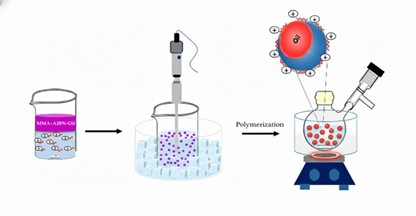
Lemongrass essential oil was encapsulated in polymethyl methacrylate (PMMA) nanocapsules using the miniemulsion polymerization method. The polymethyl methacrylate/oil (PMMA/Oil) nanocapsules exhibited high colloidal stability. The antibacterial activity of lemongrass essential oil and PMMA/Oil nanocapsules was determined using the disc diffusion technique to inhibit of Bacillus subtilis, Staphylococcus aureus, Escherichia coli, and Pseudomonas aeruginosa, two-week period. It was found that the lemongrass essential oil inhibited the growth of B. subtilis, S. aureus, E. coli, and P. aeruginosa after 12 h, with inhibition zone diameters of 13.67 ± 0.94 mm, 9.67 ± 1.31 mm, 8.33 ± 0.94 mm, and 11.50 ± 0.41 mm, respectively. Subsequently, the efficacy in inhibiting the growth of all four strains was observed to decrease. In addition, the PMMA/Oil nanocapsules were able to inhibit the growth of B. subtilis, S. aureus, E. coli, and P. aeruginosa at 12 h, with inhibition zone diameters of 25.67 ± 0.94 mm, 21.57 ± 1.14 mm, 16.50 ± 1.08 mm, and 23.67 ± 0.94 mm, respectively. These values indicated that the PMMA/Oil nanocapsules inhibited microbial greater than those of the lemongrass essential oil alone. Furthermore, the PMMA/Oil nanocapsules were able to inhibit the growth of B. subtilis and P. aeruginosa for up to 336 h, with inhibition zone diameters of 25.83 ± 0.62 mm and 24.83 ± 0.24 mm, respectively. In contrast, the growth of S. aureus and E. coli showed larger inhibition zones the PMMA/Oil nanocapsules at 336 h, with inhibition zone diameters of 50.50 ± 0.50 mm and 27.00 ± 1.41 mm, respectively. These results indicate the release of lemongrass essential oil from the nanocapsules, resulting in enhanced and prolonged antimicrobial activity for up to 336 h.
Article Details

This work is licensed under a Creative Commons Attribution-NonCommercial-NoDerivatives 4.0 International License.
References
Ahangaran, F., Navarchian, A. H. and Picchioni, F. (2019). Material encapsulation in poly(methyl methacrylate) shell: A review. Journal of Applied Polymer Science 136: 48039.
Bakkali, F., Averbeck, S., Averbeck, D. and Idaomar, M. (2008). Biological effects of essential oils: A review. Food and Chemical Toxicology 46: 446 - 475.
D’Agostino, M., Tesse, N., Frippiat, J.P., Machouart, M. and Debourgogne, A. (2019). Essential oils and their natural active compounds presenting antifungal properties. Molecules 24: 3713 - 3735.
Deva, V., Upadhyay, A., Tiwari, R., Yanmandru, V.K., Katiyar, S., Anjum, N., Kalia, P., Dharmalingam, S.R. and Patil, A. (2023). Preparation and standardization methods of herbal drug formulations. European Chemical Bulletin 12(4): 6822 - 6837.
Hudzicki, J. (2009). Kirby-Bauer disk diffusion susceptibility test protocol. 1st ed. United States: American Society for Microbiology.
Idrees, H., Zaidi, S.Z.J., Sabir, A., Khan, R.U., Zhang, X. and Hassan, S. (2020). A review of biodegradable natural polymer-based nanoparticles for drug delivery applications. Nanomaterials 10: 1970 - 1991.
Lee, D.H., Sim, G.S., Kim, J.H., Lee, G.S., Pyo, H.B. and Lee, B.C. (2007). Preparation and characterization of quercetin-loaded polymethyl methacrylate microcapsules using a polyol-in-oil-in-polyol miniemulsion solvent evaporation method. Journal of Pharmacy and Pharmacology 59(12): 1611 - 1620.
Luangtana-anan, M., Opanasopit, P., Ngawhirunpat, T., Nunthanid, J., Sriamornsak, P., Limmatvapirat, S. and Lim, L.Y. (2005). Effect of chitosan salts and molecular weight on a nanoparticulate carrier for therapeutic protein. Pharmaceutical Development and Technology 10: 189 - 196.
Majewska, E., Owska, M.K., Kowska, E.G.S., Kowalska, D. and Tarnowska, K. (2019). Lemongrass (Cymbopogon citratus) essential oil: Extraction, composition, bioactivity and uses for food preservation—A review. Polish Journal of Food and Nutrition Sciences 69(4): 327 - 341.
Mukarram, M., Choudhary, S., Khan, M.A., Poltronieri, P., Khan, M.M.A., Ali, J., Kurjak, D. and Shahid, M. (2021). Lemongrass essential oil components with antimicrobial and anticancer activities. Antioxidants 11(1): 1 - 23.
Ouyang, X., Zhou, L., Xu, X., Yang, Z., Wang, L., Lu, L., Liu, G. and Zhang, G. (2021). Preparation and properties of poly (MMA-co-TMPTA)/fragrance microcapsules. Colloids and Surfaces A: Physicochemical and Engineering Aspects 614: 126103.
Patel, J.B., Tenover, F.C., Turnidge, J.D. and Jorgensen, J.H. (2015). Susceptibility test methods: dilution and disk diffusion methods. Manual of Clinical Microbiology 68: 1253 - 1273.
Rakin, M., Dimitrijevic, L.J.S., Mihajlovski, K. and Marinkovic, S. (2007). Investigation of antimicrobial activity of encapsulated essential oil. Materials Science Forum 555: 424 - 429.
Reis, D.R., Ambrosi, A. and Luccio, M.D. (2022). Encapsulated essential oils: A perspective in food preservation. Future Foods 5: 100126.
Russell, S. and Bruns, N. (2023). Encapsulation of fragrances in micro- and nano-capsules, polymeric micelles, and polymersomes. Macromolecular Rapid Communications 44: 2300120.
Tasker, A.L., Hitchcock, J.P., He, L., Baxter, E.A., Biggs, S. and Cayre, O. J. (2016). The effect of surfactant chain length on the morphology of poly(methyl methacrylate) microcapsules for fragrance oil encapsulation. Journal of Colloid and Interface Science 484: 10 - 16.
Wang, Y., Xu, Y., Zhao, H., Cao, R., Huang, B. and Xu, L. (2025). Preparation and characterization of microencapsulated phase change materials with enhanced thermal performance for cold storage. Materials 18(9): 2074.
Yammine, J., Chihib, N.E., Gharsallaoui, A. and Ismail, A. (2023). Advances in essential oils encapsulation: development, characterization and release mechanisms. Polymer Bulletin 81(5): 1 - 46.
Zukowska, G. and Durczynska, Z. (2024). Properties and applications of essential oils: A review. Journal of Ecological Engineering 25(2): 333 - 340.
