
ฤทธิ์ต้านเชื้อแบคทีเรียของนาโนแคปซูลน้ำมันหอมระเหยตะไคร้ใน โพลิเมทิลเมธาไครเลท
Article Sidebar
Main Article Content
บทคัดย่อ
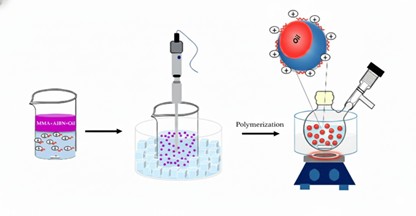
น้ำมันหอมระเหยจากตะไคร้กลั่นด้วยชุดกลั่น Clevenger ถูกห่อหุ้มด้วย polymethyl methacrylate โดยวิธีมินิอิมัลชันพอลิเมอไรเซชันได้นาโนแคปซูล polymethyl methacrylate/oil (PMMA/Oil) มีลักษณะเป็นอิมัลชันสีขุ่นขาว อนุภาคที่ได้มีความเสถียรทางคอลลอยด์สูง จากการวิเคราะห์ขนาดของอนุภาคด้วยเทคนิคการกระเจิงของแสงพบว่ามีขนาดอนุภาคเฉลี่ย 171 nm และร้อยละของการห่อหุ้มร้อยละ 91 การทดสอบฤทธิ์ทางชีวภาพโดย Disc Diffusion technique ของน้ำมันหอมระเหยจากตะไคร้ร้อยละ 1.5 โดยมวลต่อปริมาตร และ nano capsules PMMA/Oil โดยทดสอบการยับยั้งการเจริญของเชื้อแบคทีเรียได้แก่ Bacillus subtilis Staphylococcus aureus Escherichia coli และ Pseudomonas aeruginosa ในระยะเวลา 2 สัปดาห์ พบว่าน้ำมันหอมระเหยจากตะไคร้ยับยั้งการเจริญของเชื้อ B. subtilis S. aureus E. coli และ P. aeruginosa ได้เมื่อเวลาผ่านไป 12 ชั่วโมง โดยมีเส้นผ่านศูนย์การการยับยั้งการเจริญของเชื้อ 13.67 ± 0.94 mm 9.67 ± 1.31 mm 8.33 ± 0.94 mm และ 11.50 ± 0.41 mm ตามลำดับ หลังจากนั้นประสิทธิภาพในการยับยั้งการเจริญของเชื้อทั้ง 4 ชนิดได้ลดลง ในขณะที่ nano capsules PMMA/Oil สามารถยับยั้งการเจริญของเชื้อ B. subtilis S. aureus E. coli และ P. aeruginosa ได้ในเวลา 12 ชั่วโมง โดยมีเส้นผ่านศูนย์การการยับยั้งการเจริญของเชื้อ 25.67 ± 0.94 mm 21.57 ± 1.14 mm 16.50 ± 1.08 mm และ 23.67 ± 0.94 ตามลำดับ ซึ่ง nano capsules PMMA/Oil สามารถยับยั้งการเจริญของเชื้อได้มากว่าน้ำมันหอมระเหยจากตะไคร้ นอกจากนี้ nano capsules PMMA/Oil (1.52 %w/w) ยังสามารถยับยั้งการเจริญของเชื้อ B. subtilis และ P. aeruginosa ได้นานถึง 336 ชั่งโมง โดยมีเส้นผ่านศูนย์การการยับยั้งการเจริญของเชื้อ 25.83 ± 0.62 mm และ 24.83 ± 0.24 mm ตามลำดับ ในขณะที่ nano capsules PMMA/Oil สามารถยับยั้งการเจริญของเชื้อ S. aureus และ E. coli ในเวลา 336 ชั่วโมง ได้มากขึ้นโดยมีเส้นผ่านศูนย์การการยับยั้ง 50.50 ± 0.50 mm และ 27.00 ± 1.41 mm ตามลำดับซึ่งแสดงให้เห็นการปลดปล่อยน้ำมันหอมระเหยจากตะไคร้จากนาโนแคปซูล
Article Details

อนุญาตภายใต้เงื่อนไข Creative Commons Attribution-NonCommercial-NoDerivatives 4.0 International License.
เอกสารอ้างอิง
Ahangaran, F., Navarchian, A. H. and Picchioni, F. (2019). Material encapsulation in poly(methyl methacrylate) shell: A review. Journal of Applied Polymer Science 136: 48039.
Bakkali, F., Averbeck, S., Averbeck, D. and Idaomar, M. (2008). Biological effects of essential oils: A review. Food and Chemical Toxicology 46: 446 - 475.
D’Agostino, M., Tesse, N., Frippiat, J.P., Machouart, M. and Debourgogne, A. (2019). Essential oils and their natural active compounds presenting antifungal properties. Molecules 24: 3713 - 3735.
Deva, V., Upadhyay, A., Tiwari, R., Yanmandru, V.K., Katiyar, S., Anjum, N., Kalia, P., Dharmalingam, S.R. and Patil, A. (2023). Preparation and standardization methods of herbal drug formulations. European Chemical Bulletin 12(4): 6822 - 6837.
Hudzicki, J. (2009). Kirby-Bauer disk diffusion susceptibility test protocol. 1st ed. United States: American Society for Microbiology.
Idrees, H., Zaidi, S.Z.J., Sabir, A., Khan, R.U., Zhang, X. and Hassan, S. (2020). A review of biodegradable natural polymer-based nanoparticles for drug delivery applications. Nanomaterials 10: 1970 - 1991.
Lee, D.H., Sim, G.S., Kim, J.H., Lee, G.S., Pyo, H.B. and Lee, B.C. (2007). Preparation and characterization of quercetin-loaded polymethyl methacrylate microcapsules using a polyol-in-oil-in-polyol miniemulsion solvent evaporation method. Journal of Pharmacy and Pharmacology 59(12): 1611 - 1620.
Luangtana-anan, M., Opanasopit, P., Ngawhirunpat, T., Nunthanid, J., Sriamornsak, P., Limmatvapirat, S. and Lim, L.Y. (2005). Effect of chitosan salts and molecular weight on a nanoparticulate carrier for therapeutic protein. Pharmaceutical Development and Technology 10: 189 - 196.
Majewska, E., Owska, M.K., Kowska, E.G.S., Kowalska, D. and Tarnowska, K. (2019). Lemongrass (Cymbopogon citratus) essential oil: Extraction, composition, bioactivity and uses for food preservation—A review. Polish Journal of Food and Nutrition Sciences 69(4): 327 - 341.
Mukarram, M., Choudhary, S., Khan, M.A., Poltronieri, P., Khan, M.M.A., Ali, J., Kurjak, D. and Shahid, M. (2021). Lemongrass essential oil components with antimicrobial and anticancer activities. Antioxidants 11(1): 1 - 23.
Ouyang, X., Zhou, L., Xu, X., Yang, Z., Wang, L., Lu, L., Liu, G. and Zhang, G. (2021). Preparation and properties of poly (MMA-co-TMPTA)/fragrance microcapsules. Colloids and Surfaces A: Physicochemical and Engineering Aspects 614: 126103.
Patel, J.B., Tenover, F.C., Turnidge, J.D. and Jorgensen, J.H. (2015). Susceptibility test methods: dilution and disk diffusion methods. Manual of Clinical Microbiology 68: 1253 - 1273.
Rakin, M., Dimitrijevic, L.J.S., Mihajlovski, K. and Marinkovic, S. (2007). Investigation of antimicrobial activity of encapsulated essential oil. Materials Science Forum 555: 424 - 429.
Reis, D.R., Ambrosi, A. and Luccio, M.D. (2022). Encapsulated essential oils: A perspective in food preservation. Future Foods 5: 100126.
Russell, S. and Bruns, N. (2023). Encapsulation of fragrances in micro- and nano-capsules, polymeric micelles, and polymersomes. Macromolecular Rapid Communications 44: 2300120.
Tasker, A.L., Hitchcock, J.P., He, L., Baxter, E.A., Biggs, S. and Cayre, O. J. (2016). The effect of surfactant chain length on the morphology of poly(methyl methacrylate) microcapsules for fragrance oil encapsulation. Journal of Colloid and Interface Science 484: 10 - 16.
Wang, Y., Xu, Y., Zhao, H., Cao, R., Huang, B. and Xu, L. (2025). Preparation and characterization of microencapsulated phase change materials with enhanced thermal performance for cold storage. Materials 18(9): 2074.
Yammine, J., Chihib, N.E., Gharsallaoui, A. and Ismail, A. (2023). Advances in essential oils encapsulation: development, characterization and release mechanisms. Polymer Bulletin 81(5): 1 - 46.
Zukowska, G. and Durczynska, Z. (2024). Properties and applications of essential oils: A review. Journal of Ecological Engineering 25(2): 333 - 340.
