
Preliminary Test of Antibacterial Activities in Streptomyces sp. SR1301 Isolated from Soil in the Resource Protected Area, Rambhai Barni Rajabhat University
Article Sidebar
Main Article Content
Abstract
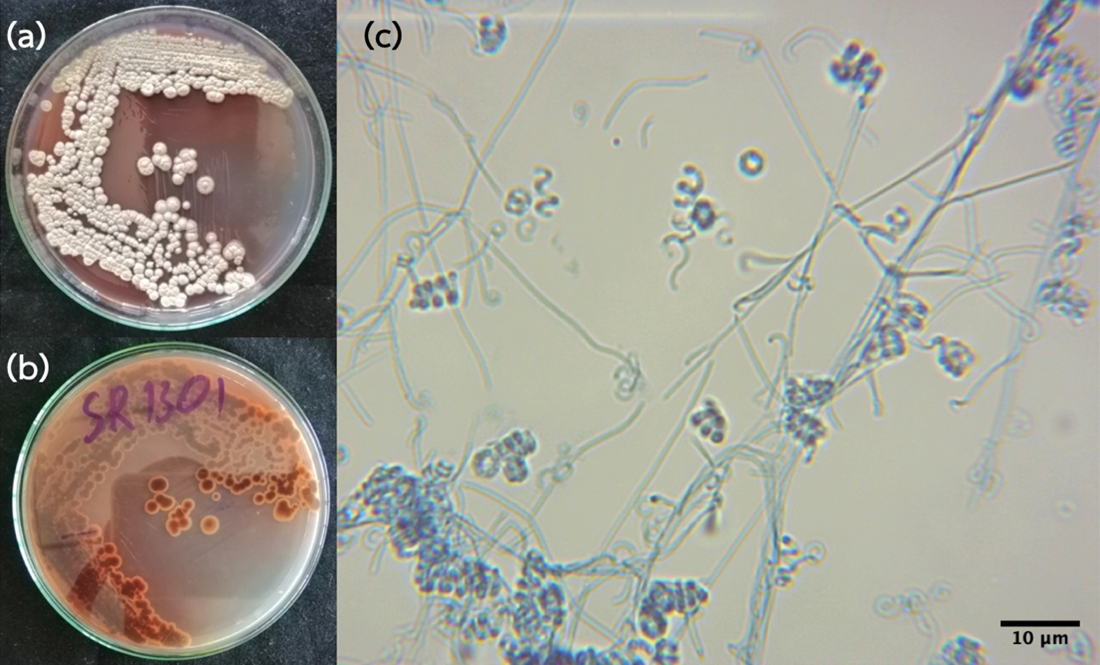
Actinomycetes are prolific producers of bioactive compounds, most notably antibiotics with significant therapeutic potential. The global escalation of antimicrobial resistance is compounded by a significant decline in the discovery of novel therapeutic agents. Therefore, this study aimed to isolate actinomycetes from soil samples within the resource-protected area of Rambhai Barni Rajabhat University, Chanthaburi. Isolated strains were screened for antimicrobial activity, and the most potent isolates were identified to the species level. Actinomycetes were isolated from soil samples using the serial dilution method and cultivated on humic acid-vitamin (HV) agar. Preliminary antimicrobial screening was performed using the perpendicular streak method. The most potent isolate was selected for crude extract preparation to determine the minimum inhibitory concentration (MIC) and minimum bactericidal concentration (MBC) against target microorganisms using broth microdilution and streak plate methods. The most active isolate was characterized through morphological observation and 16S rRNA gene sequencing analysis. Results revealed a total of 39 actinomycete isolates, four of which exhibited inhibitory activity against Bacillus cereus TISTR 2372 and Staphylococcus aureus ATCC 25923. The observed inhibition zones ranged from 11.30 to 28.50 mm. Isolate SR1301 exhibited the best inhibition against both bacteria with an average inhibition distance of 28.50 ± 1.52 and 25.80 ± 1.47 mm, respectively. The crude extract exhibited an MIC of 64 µg/ml against both test pathogens, while the MBC values were 256 µg/ml for B. cereus and 128 µg/ml for S. aureus. Phylogenetic analysis based on 16S rRNA gene sequencing identified isolate SR1301 as being closely related to Streptomyces samsunensis M1463T. In conclusion, Streptomyces isolate SR1301 demonstrated significant inhibitory potential against Gram-positive pathogens. These findings suggest that its crude extract warrants further investigation and purification for potential pharmaceutical applications.
Article Details

This work is licensed under a Creative Commons Attribution-NonCommercial-NoDerivatives 4.0 International License.
References
Barka, E.A., Vatsa, P., Sanchez, L., Gaveau-Vaillant, N., Jacquard, C., Klenk, H.P., Clément, C., Ouhdouch, Y. and Van Wezel, G.P. (2016). Taxonomy, physiology, and natural products of actinobacteria. Microbiology and Molecular Biology Reviews 80(1): 1 - 43. doi: 10.1128/mmbr.00019-15.
Chimnoi, W. (1999). Genetic diversity of some bacteria in the area of plant genetic conservation project in Nakhon Ratchasima province. Master of Science, Chulalongkorn university Bangkok: 103 pages.
Choi, J.W., Lee, Y., Kim, J., Kwon, H., Deyrup, S.T., Lee, J.W., Lee, D., Kang, H., Joo, H. and Shim, S.H. (2023). Discovery of bioactive metabolites by acidic stress to a geldanamycin producer, Streptomyces samsunensis. Journal of Natural Products 86(4): 947 - 957. doi: 10.1021/acs.jnatprod.2c01151.
Chun, J. and Goodfellow, M. (1995). A Phylogenetic Analysis of the Genus Nocardia with 16S rRNA Gene Sequences. International Journal of Systematic Bacteriology 45(2): 240 - 245. doi: 10.1099/00207713-45-2-240.
CLSI. (2018). Methods for dilution antimicrobial susceptibility tests for bacteria that grow aerobically, CLSI standard M07. Wayne, PA: Clinical and Laboratory Standards Institute. 11th ed. pp. 15 - 35.
Cook, A.E. and Meyers, P.R. (2003). Rapid identification of filamentous actinomycetes to the genus level using genus-specific 16S rRNA gene restriction fragment patterns. International Journal of Systematic and Evolutionary Microbiology 53(6): 1907 - 1915. doi: 10.1099/ijs.0.02680-0.
Custodio, A.B., Zapater, J.E.I. and Alcantara, E.P. (2025). Structural diversity and biological activities of naturally derived bafilomycins from actinomycetes. Beni-Suef University Journal of Basic and Applied Sciences 14(1): 33. doi: 10.1186/s43088-025-00622-0.
Dumrongrojwatthana, P. and Kunsook, C. (2019). Bird species composition change in the natural resource protected area, Rambhai Barni Rajabhat University. Rajabhat Rambhai Barni Research Journal 13(1): 5 - 19.
Dumrongrojwatthana, P., Petchthongkliang, P. and Kunsook, C. (2018). Carbon storage of trees in the resource conservation forest, Rambhai Barni Rajabhat University. Rajabhat Rambhai Barni Research Journal 12(3): 190 - 200.
Goodfellow, M. and Williams, S.T. (1983). Ecology of actinomycetes. Annual Review of Microbiology 37: 189 - 216. doi: 10.1146/annurev.mi.37.100183.001201.
Hong, K., Gao, A.H., Xie, Q.Y., Gao, H.G., Zhuang, L., Lin, H.P., Yu, H.P., Li, J., Yao, X.S., Goodfellow, M. and Ruan, J.S. (2009). Actinomycetes for marine drug discovery isolated from mangrove soils and plants in China. Marine Drugs 7(1): 24 - 44. doi: 10.3390/md7010024.
Hu, D., Chen, Y., Sun, C., Jin, T., Fan, G., Liao, Q., Mok, K.M. and Lee, M.-Y.S. (2018). Genome guided investigation of antibiotics producing actinomycetales strain isolated from a Macau mangrove ecosystem. Scientific Reports 8(1): 14271. doi: 10.1038/s41598-018-32076-z.
Kamil, F.H., Saeed, E.E., El-Tarabily, K.A. and AbuQamar, S.F. (2018). Biological control of mango dieback disease caused by Lasiodiplodia theobromae using streptomycete and non-streptomycete actinobacteria in the United Arab Emirates. Frontiers in Microbiology 9: 829. doi: 10.3389/fmicb.2018.00829.
Kumar, S., Stecher, G., Suleski, M., Sanderford, M., Sharma, S. and Tamura, K. (2024). MEGA12: molecular evolutionary genetic analysis version 12 for adaptive and green computing. Molecular Biology and Evolution 41(12): 1 - 9. doi: 10.1093/molbev/msae263.
Madigan, M.T., Martinko, J.M., Dunlap, P.V. and Clark, D.P. (2009). Brock biology of microorganisms. San Francisco: Pearson Benjamin Cummings. 12th ed. pp. 78 - 84.
Ngamcharungchit, C., Chaimusik, N., Panbangred, W., Euanorasetr, J. and Intra, B. (2023). Bioactive metabolites from terrestrial and marine actinomycetes. Molecules 28(15): 5915. doi: 10.3390/molecules28155915.
Nimnoi, P. (2015). Actinomycetes. Bangkok: Kasetsart University. pp. 8 - 27.
Niyomvong, N., Vaithanomsat, P., Apiwatanapiwat, W., Trakunjae, C., Janchai, P. and Boondaeng, A. (2022). Medium optimization using response surface methodology to produce antifungal substance from Streptomyces samsunensis RB-4 against Rhizoctonia solani. Agriculture and Natural Resources 56(4): 773 - 780. doi: 10.34044/j.anres.2022.56.4.11.
Otoguro, M., Hayakawa, M., Yamazaki, T. and Iimura, Y. (2001). An integrated method for the enrichment and selective isolation of Actinokineospora spp. in soil and plant litter. Journal of Applied Microbiology 91(1): 118 - 130. doi: 10.1046/j.1365-2672.2001.01372.x.
Pook-In, G., Seansupa, K. and Upakut, S. (2019). Inhibition of Staphylococcus aureus by the cotton fabrics treated with the crude finish produced from Streptomyces sp. strain AC4. Journal of Food Health and Bioenvironmental Science 12(1): 44 - 53.
Pook-In, G., Tammawong, S., Phuangsri, C., Seansupa, K., Sookying, S., Takahashi, T. and Rawangkan, A. (2026). Heat-assisted extraction and bioactivity evaluation of a dinactin-associated compound from Streptomyces UP strains. Microbiology Research 17(1): 16. doi: 10.3390/microbiolres17010016.
Puckdee, W. and Chanthamalee, J. (2025). Antibacterial activity of endophytic actinomycetes, Streptomyces sp. PM-R01, isolated from native durian varieties in Chanthaburi province. Journal of Science and Technology Mahasarakham University 44(3): 221 - 229.
Ritvirool, P. (2020). Antibiotic-resistant bacteria. Phitsanulok: Naresuan University. pp. 40 - 69.
Sazak, A., Şahin, N., Güven, K., Işık, K. and Goodfellow, M. (2011). Streptomyces samsunensis sp. nov., a member of the Streptomyces violaceusniger clade isolated from the rhizosphere of Robinia pseudoacacia. International Journal of Systematic and Evolutionary Microbiology 61(6): 1309 - 1314. doi: 10.1099/ijs.0.021329-0.
Shirling, E.B. and Gottlieb, D. (1966). Methods for characterization of Streptomyces species. International Journal of Systematic and Evolutionary Microbiology 16(3): 313 - 340. doi: 10.1099/00207713-16-3-313.
Somnuek, C. and Kanboon, P. (2019). Survey of lichen at swamp forest in plant genetic protection area, Rambhai Barni Rajabhat University. RMUTI JOURNAL Science and Technology 12(3): 150 - 159.
Supong, K., Sripreechasak, P., Tanasupawat, S., Danwisetkanjana, K., Rachtawee, P. and Pittayakhajonwut, P. (2017). Investigation on antimicrobial agents of the terrestrial Streptomyces sp. BCC71188. Applied Microbiology and Biotechnology 101(2): 533 - 543. doi: 10.1007/s00253-016-7804-1.
Supong, K., Thawai, C., Choowong, W., Kittiwongwattana, C., Thanaboripat, D., Laosinwattana, C., Koohakan, P., Parinthawong, N. and Pittayakhajonwut, P. (2016). Antimicrobial compounds from endophytic Streptomyces sp. BCC72023 isolated from rice (Oryza sativa L.). Research in Microbiology 167(4): 290 - 298. doi: 10.1016/j.resmic.2016.01.004.
Surawut, S., Kunsook, C., Nak-eiam, S., Khamchatra, N., Bhudharak, S., Phontharod, W., Boonmee, O., Yasawong, M. and Kanjanavas, P. (2023). Biodiversity and functional distribution of macrofungi from plant genetic conservation area, Chanthaburi province, Thailand. Current Applied Science and Technology 23(5): 19 pages. doi: 10.55003/cast.2023.05.23.003.
Vadankula, G.R., Rizvi, A., Ali, H., Khunjamayum, R., Eedara, V.V.R., Nema, V., Ningthoujam, D.S., Suresh Babu, K., Shetty, P.R., Mande, S.C. and Banerjee, S. (2025). Secondary metabolites from a new antibiotic-producing endophytic streptomyces isolate inhibited pathogenic and multidrug-resistant Mycobacterium tuberculosis strains. Tropical Medicine and Infectious Disease 10(5): 117. doi: 10.3390/tropicalmed10050117.
Ventola, C.L. (2015). The antibiotic resistance crisis: part 1: causes and threats. P & T : a Peer-Reviewed Journal for Formulary Management 40(4): 277 - 283.
Wang, R., Bao, Y., Dong, Y., Dong, Y. and Li, H. (2023). Genome-directed discovery of antiproliferative bafilomycins from a deepsea-derived Streptomyces samsunensis. Bioorganic Chemistry 138: 106599. doi: 10.1016/j.bioorg.2023.106599.
Wongsariya, K., Duangupama, T., Pansomsuay, R., Thanaboripat, D. and Thawai, C. (2024). Genome characterization for the antimicrobial potential of Streptomyces samsunensis SA31, a rhizospheric actinomycete of Cymbopogon citratus (DC) Stapf. Current Applied Science and Technology 25(1): e0260305. doi: 10.55003/cast.2024.260305.
World Health Organization. (2022). Global antimicrobial resistance and use surveillance system (GLASS) report 2022. Geneva: World Health Organization. pp. 1 - 3.
Yoon, S.H., Ha, S.M., Kwon, S., Lim, J., Kim, Y., Seo, H. and Chun, J. (2017). Introducing EzBioCloud: a taxonomically united database of 16S rRNA gene sequences and whole-genome assemblies. International Journal of Systematic and Evolutionary Microbiology 67(5): 1613 - 1617. doi: 10.1099/ijsem.0.001755.
Zhang, H., Lee, Y.K., Zhang, W. and Lee, H.K. (2006). Culturable actinobacteria from the marine sponge Hymeniacidon perleve: isolation and phylogenetic diversity by 16S rRNA gene-RFLP analysis. Antonie van Leeuwenhoek 90(2): 159 - 169. doi: 10.1007/s10482-006-9070-1.
