
Mathematical Models for Annual Savings under Time-Varying Compounding Frequency
Article Sidebar
Main Article Content
Abstract
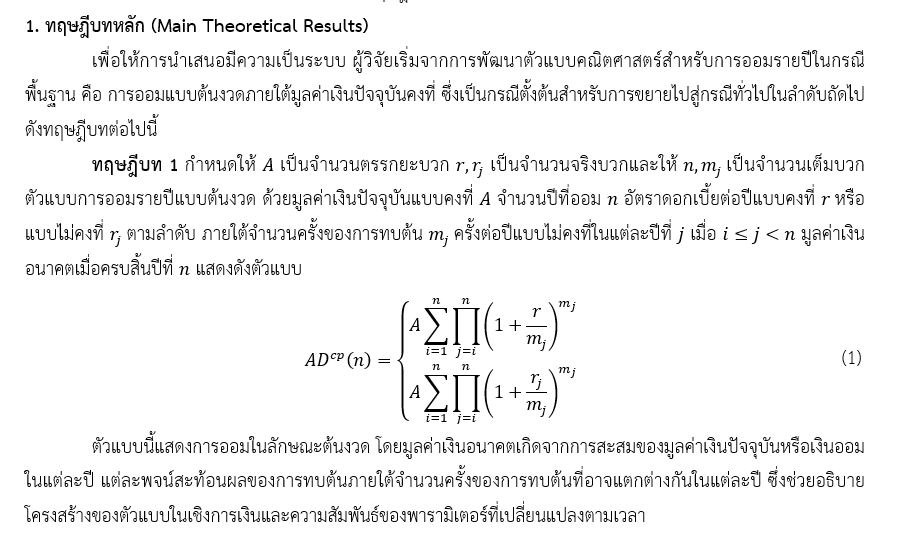
This research aims to develop mathematical models for annuity due and annuity immediate covering cases where the number of compounding periods per year, present value, and interest rate may be either constant or time-varying. A total of eight mathematical models are constructed, each consisting of present value, annual interest rate, number of years, and compounding frequency. The results show that four models for annuity due and four models for annuity immediate are obtained, which can be classified based on parameter characteristics as follows: (1) a time-varying compounding frequency with both present value and interest rate constant, (2) a time-varying compounding frequency with a constant present value and a nonconstant interest rate, (3) a time-varying compounding frequency with a nonconstant present value and a constant interest rate, and (4) a time-varying compounding frequency with both the present value and the interest rate varying over time. The proposed models can be regarded as generalizations of classical compound interest formulas and geometric series to the case of non-constant parameters, and their correctness is verified using mathematical induction. In addition, the models are further validated through numerical examples and applications under varying conditions.
Article Details

This work is licensed under a Creative Commons Attribution-NonCommercial-NoDerivatives 4.0 International License.
References
ณัฐ เลิศมงคล. (2564). ความมหัศจรรย์ของดอกเบี้ยทบต้น. แหล่งข้อมูล: https://www.setinvestnow.com/th/knowledge/article/173-the-power-of-compound-interest. ค้นเมื่อวันที่ 8 พฤศจิกายน 2568.
นราธิป อิสรานุสรณ์. (2563). ตัวแบบคณิตศาสตร์เชิงกำหนดเพื่อการออมเงินกลางปีด้วยอัตราดอกเบี้ยทบต้น. วารสารวิชาการพระจอมเกล้าพระนครเหนือ 30(2): 304 - 313 doi: 10.14416/j.kmutnb.2020.01.001.
นราธิป อิสรานุสรณ์. (2565). ตัวแบบคณิตศาสตร์สําหร์บการออมรายเดือนเพื่อการวางแผนการเงิน. วารสารวิชาการพระจอมเกล้าพระนครเหนือ 32(2): 469 - 477. doi: 10.14416/j.kmutnb.2021.11.007.
บุษราภรณ์ พวงปัญญา และปริวัตร ป้องพาล. (2564). การวางแผนการเงินส่วนบุคคลเพื่อสร้างภูมิคุ้มกันทางด้านเศรษฐกิจของครูและบุคลากรทางการศึกษา. วารสารสถาบันวิจัยพิมลธรรม 8(2): 155 - 164.
ยุวรีย์ พันธ์กล้า และกฤษณะ เนียมมณี. (2562). สู่เป้าหมายการออมด้วยลำดับเรขาคณิต. วารสารคณิตศาสตร์ MJ-MATH 64(698): 6 - 19. doi: 10.14456/mj-math.2019.7.
สร้อยเพชร ลิสนิ และฐิติพร พระโพธิ์. (2568). ปัจจัยการวางแผนทางการเงินที่ส่งผลต่อคุณภาพชีวิตทางการเงินที่ดีอย่างมีคุณค่าของผู้สูงอายุจังหวัดภาคกลางตอนล่าง 1. วารสารวิทยาการจัดการ มหาวิทยาลัยราชภัฏพิบูลสงคราม 7(2): 87 - 101.
Broverman, S.A. (2017). Mathematics of investment and credit (6th ed.). New Hartford, CT: ACTEX Learning.
Hull, J.C. (2021). Options, futures, and other derivatives (10th ed.). Pearson. 896 pages.
Issaranusorn, N. (2015). Future saving model by using mathematical technique. In: Proceedings of the 2nd National and International Research Conference. Thailand: Graduate School Nakhon Ratchasima Rajabhat University, 426 - 435.
Issaranusorn, N. (2016). Saving mathematical model with inconstant present value and inconstant compound interest rate. In: Proceedings of International Congress on Banking, Economics, Finance and Business. Japan, 241 - 251.
Kellison, S.G. (2008). The theory of interest (3rd ed.). McGraw-Hill.
McCutcheon, J.J. and Scott, W.F. (1986). An introduction to the mathematics of finance. London: Heinemann.
Pournara, C. (2013). Teachers’ knowledge for teaching compound interest. Pythagoras. 34(2): 1 - 10. doi: 10.4102/pythagoras.v34i2.238.
Vasicek, O. (1977). An equilibrium characterization of the term structure. Journal of Financial Economics 5(2): 177 - 188.
