
Genetic Relationship Analysis of 12 Bamboo Species in Phetchabun Province Using ISSR Markers
Article Sidebar
Main Article Content
Abstract
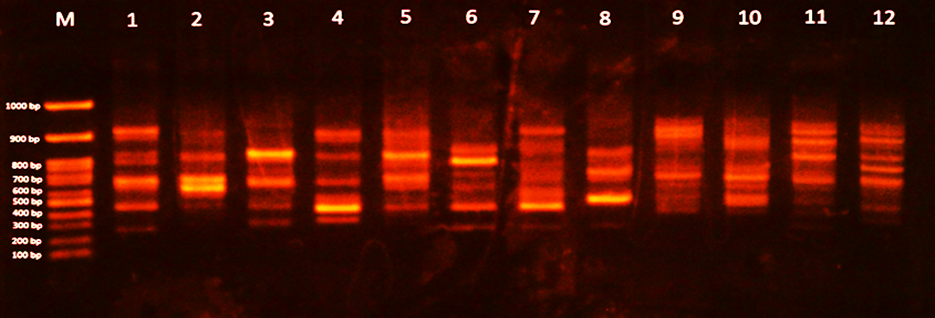
This study aimed to analyze the genetic relationships among 12 bamboo species using Inter-Simple Sequence Repeat (ISSR) markers to generate DNA fingerprinting and assess their evolutionary relatedness. Genomic DNA was extracted from 36 bamboo leaf samples using the RBC Genomic DNA Extraction Mini Kit (RBC Bioscience). The extracted DNA showed an average concentration of 6.5 ng/µL and an average purity value of 1.8. Polymerase Chain Reaction (PCR) amplification was performed using five ISSR primers, of which primer UBC807 produced the most distinct and clear DNA banding patterns. Genetic similarity indices were calculated based on the method and a dendrogram was constructed using the Unweighted Pair Group Method with Arithmetic Mean (UPGMA). The results revealed that the similarity coefficients ranged from 0.63 to 1.00, allowing the classification of the 12 bamboo species into five major groups: Group 1 included Dendrocalamus strictus, D. asper and Bambusa tulda. Cupulata; Group 2 consisted of Bambusa nutans, Arundinaria suberecta and Neohouzeaua mekongensis; Group 3 included Dendrocalamus giganteus, Gigantochloa albociliata and Bambusa ventricosa; Group 4 comprised Bambusa blumeana and Bambusa vulgaris; and Group 5 contained Gigantochloa compressa. The clustering revealed both close genetic affinities (similarity > 0.80) among certain species and clear differentiation in others, such as G. compressa, which formed a distinct group. These findings demonstrate the effectiveness of ISSR markers in distinguishing bamboo species and elucidating their genetic relationships. The results provide valuable insights for bamboo breeding, conservation of genetic diversity, and sustainable utilization of bamboo resources.
Article Details

This work is licensed under a Creative Commons Attribution-NonCommercial-NoDerivatives 4.0 International License.
References
กรมป่าไม้. (2545). รายงานความหลากหลายของพันธุ์ไม้ในประเทศไทย. กรุงเทพฯ: สำนักพิมพ์กรมป่าไม้.
Amom, T., Sharma, G.J., Nongdam, P. and Singh, R.K. (2018). Genetic diversity and relationship among bamboo species in Northeast India using ISSR markers. Journal of Genetic Resources 9(2): 101 - 112.
Banik, R.L. (2015). Bamboo diversity and conservation: A review. Bamboo Science and Culture 28(2): 101 - 112.
Bhattacharya, S., Das, M., Bar, R. and Pal, A. (2006). Morphological and Molecular Characterization of Bambusa tulda with a Note on Flowering. Annals of Botany 98(3): 529 - 535.
Bornet, B. and Branchard, M. (2001). Nonanchored inter simple sequence repeat (ISSR) markers: Reproducible and specific tools for genome fingerprinting. Plant Molecular Biology Reporter 19(3): 209 - 215. doi: 10.1007/BF02772892.
Canavan, S., Richardson, D.M., Visser, V., Le Roux, J.J., Vorontsova, M.S. and Wilson, J.R.U. (2017). The global distribution of bamboos: Assessing correlates of introduction and invasion. AoB PLANTS 9(1): plw078. doi: 10.1093/aobpla/plw078.
Clark, L.G., Londoño, X. and Ruiz-Sanchez, E. (2015). Bamboo taxonomy and habitat. In W. Liese & M. Köhl (Eds.), Bamboo: The plant and its uses. pp. 1 - 30. Springer. doi: 10.1007/978-3-319-14133-6_1.
Das, M., Bhattacharya, S., Basak, J. and Pal, A. (2007). Phylogenetic relationships among the bamboo species as revealed by morphological characters and polymorphism analyses. Biologia Plantarum 51: 667 - 672. doi: 10.1007/s10535-007-0140-7.
Goh, W.L., Chandran, S., Franklin, D.C., Isagi, Y., Koshy, K.C., Sungkaew, S., Yang, H.Q., Xia, N.H. and Wong, K. M. (2013). Multi-gene region phylogenetic analyses suggest reticulate evolution and a clade of Australian origin among paleotropical woody bamboos (Poaceae: Bambusoideae: Bambuseae). Plant Systematics and Evolution 299(1): 239 - 257. doi: 10.1007/s00606-012-0718-1.
Guo, W., Zhang, J., Sui, X., Hu, X., Lei, G., Zhou, Y., Li, M.H. and Qi, L. (2022). Compartment niche and bamboo variety influence the diversity, composition, network and potential keystone taxa functions of rhizobacterial communities. Rhizosphere 24: 100593. doi: 10.1016/j.rhisph.2022.100593.
Liese, W. and Kohl, M. (2015). Bamboo: The plant and its uses. Berlin: Springer. doi: 10.1007/978-3-319-14133-6.
Lobovikov, M., Paudel, S., Piazza, M., Ren, H. and Wu, J. (2007). World bamboo resources: A thematic study prepared in the framework of the Global Forest Resources Assessment 2005 (Non-Wood Forest Products No. 18). Food and Agriculture Organization of the United Nations. Source: https://www. fao.org/4/a1243e/a1243e00.htm. Retrieved date 22 November 2025.
Loh, J.P., Kiew, R., Set, O., Gan, L.H. and Gan, Y.Y. (2000). A study of genetic variation and relationships within the bamboo subtribe Bambusinae using amplified fragment length polymorphism. Annals of Botany 85(5): 607 - 612. doi: 10.1006/anbo.2000.1109.
Luz, G.C., Strioto, D.K., Mangolin, C.A. and Machado, M.F.P.S. (2020). ISSR markers to assess genetic diversity of cultivated populations from artificial selection of Stevia rebaudiana (Bert.) Bertoni. Breeding Science 70(4): 508 - 514. doi: 10.1270/jsbbs.20014.
Nayak, S., Rout, G.R. and Das, P. (2003). Evaluation of the genetic variability in bamboo using RAPD markers. Plant, Soil and Environment 49(1): 24 - 28. doi: 10.17221/4085-PSE.
Nei, M. (1978). Estimation of average heterozygosity and genetic distance from a small number of individuals. Genetics 89(3): 583 - 590. doi: 10.1093/genetics/89.3.583.
Ng, W.L. and Tan, S.G. (2015). Inter-simple sequence repeat (ISSR) markers: Are we doing it right? ASM Science Journal 9(1): 30 - 39.
Nirmala, C., Bisht, M.S., Bajwa, H.K. and Santosh, O. (2018). Bamboo: A rich source of natural antioxidants and its applications in the food and pharmaceutical industry. Trends in Food Science & Technology 77: 91 - 99. doi: 10.1016/j.tifs.2018.05.003.
Ramanayake, S.M.S.D., Meemaduma, V.N. and Weerawardene, T.E. (2007). Genetic diversity and relationships between nine species of bamboo in Sri Lanka, using random amplified polymorphic DNA. Plant Systematics and Evolution 269(1 - 2): 55 - 61. doi: 10.1007/s00606-007-0587-1.
Ravanfar, S.A., Abdul Aziz, M., Shabanimofrad, M. and Samarfard, S. (2013). Greenhouse evaluation on the performance of heat tolerant transgenic broccoli and genetic diversity analysis using inter simple sequence repeat (ISSR) markers. Electronic Journal of Biotechnology 16(5): 10 page. doi: 10.2225/vol16-issue5-fulltext-10.
Reddy, M.P., Sarla, N. and Siddiq, E.A. (2002). Inter simple sequence repeat (ISSR) polymorphism and its application in plant breeding. Euphytica 128: 9 - 17. doi: 10.1023/A:1020691618797.
Sudchaleaw, S., Saensouk, S., Saensouk, P. and Sungkaew, S. (2023). Species diversity and traditional utilization of bamboos (Poaceae) on the Phu Thai Ethnic Group in northeastern Thailand. Biodiversitas Journal of Biological Diversity 24(4): 2261 - 2271.
Triplett, J.K. and Clark, L.G. (2003). Ambiguity and an American bamboo: The Chusquea culeou species complex. Bamboo Science and Culture: The Journal of the American Bamboo Society 17(1): 21- 27.
Viehmannová, I., Bortlová, Z., Vitamvas, J., Hlásná Čepková, P., Eliášová, K., Svobodová, E. and Trávníčková, M. (2014). Assessment of somaclonal variation in somatic embryo-derived plants of yacon (Smallanthus sonchifolius (Poepp. & Endl.) H. Robinson) using inter simple sequence repeat analysis and flow cytometry. Electronic Journal of Biotechnology 17(2): 102 - 106. doi: 10.1016/j.ejbt.2013.12.011.
Vorontsova, M.S., Clark, L.G., Dransfield, J., Govaerts, R. and Baker, W.J. (2016). World checklist of bamboos and rattans. International Bamboo and Rattan Organisation (INBAR) & Royal Botanic Gardens, Kew.
Williams, J.G.K., Kubelik, A.R., Livak, K.J., Rafalski, J.A. and Tingey, S. V. (1990). DNA polymorphisms amplified by arbitrary primers are useful as genetic markers. Nucleic Acids Research 18(22): 6531 - 6535.
Yeasmin, L., Ali, M.N., Gantait, S. and Chakraborty, S. (2015). Bamboo: An overview on its genetic diversity and characterization. 3 Biotech 5: 1 - 11. doi: 10.1007/s13205-014-0201-5.
Yeh, F.C., Yang, R.C. and Boyle, T. (1999). POPGENE version 1.31: Microsoft Windows-based freeware for population genetic analysis. University of Alberta.
Zhang, Y.J., Ma, P.F. and Li, D.Z. (2011). High-throughput sequencing of six bamboo chloroplast genomes: Phylogenetic implications for temperate woody bamboos (Poaceae: Bambusoideae). PLoS ONE 6(5): e20596. doi: 10.1371/journal.pone.0020596.
Zietkiewicz, E., Rafalski, A. and Labuda, D. (1994). Genome fingerprinting by simple sequence repeat (SSR)-anchored polymerase chain reaction amplification. Genomics. 20(2): 176 - 183. doi: 10.1006/geno.1994.1151.
