
Extraction and Characterization of Mango Seed Oil from Mun Duean Kao Cultivar for Cosmetic Applications
Article Sidebar
Main Article Content
Abstract
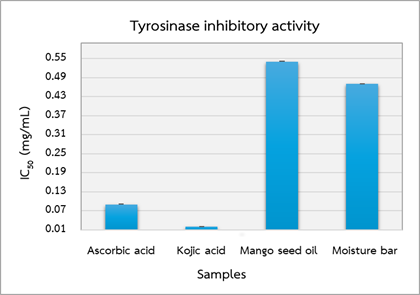
This research investigates the extraction and characterization of mango seed oil from the Mun Duean Kao (also known as Tawai Duean Kao) cultivar to enhance its value and utilize this oil in cosmetic products. The physicochemical properties and bioactive compounds of mango seed oil were analyzed and used as an active ingredient in a moisturizer bar product. Mango seed oil and the moisturizer bar were evaluated for antioxidant activity by the DPPH method and tyrosinase inhibitory activity. Reflux extraction using hexane as a solvent at a ratio of 1:3 at 55ºC yielded the highest amount of extracted mango seed oil (8.71%). The oil exhibited good quality and not rancid, with an iodine value of 40.17 ± 0.14 g I2/100 g oil, a saponification value of 200.46 ± 1.03 mg KOH/g oil, an acid value of 2.81 ± 0.06 mg KOH/g oil, a peroxide value of 2.98 ± 0.03 meq peroxide/kg oil, and a viscosity comparable to other vegetable oils (50.51 ± 0.01 cP). The oil contains bioactive compounds, including β-carotene at 3.48 mg/100 g, total phenolic contents at 4.57 mg GAE/g, and vitamin E at 1.51 mg/100 g. Both the oil and the moisturiser bar demonstrated strong antioxidant activity, with IC50 of 0.23 and 0.19 mg/mL, respectively, compared with ascorbic acid (0.18 mg/mL). However, the anti-tyrosinase activity of both remained relatively low, with IC50 of 0.54 and 0.47 mg/mL, respectively, compared with kojic acid (0.02 mg/mL) and ascorbic acid (0.09 mg/mL). The results indicated that mango seed oil can be used in cosmetic products, especially as a natural antioxidant.
Article Details

This work is licensed under a Creative Commons Attribution-NonCommercial-NoDerivatives 4.0 International License.
References
Abdalla, A.E.M., Darwish, S.M., Ayad, E.H.E. and El-Hamahmy, R.M. (2007). Egyptian mango by-product 2: Antioxidant and antimicrobial activities of extract and oil from mango seed kernel. Food Chemistry 103(4): 1141 - 1152. doi: 10.1016/j.foodchem.2006.10.026.
AOAC. (2000). Official method of analysis of AOAC International. 17th edition. Washington, DC: The Association of Official Analytical Chemists.
Britton, G., Liaaen-Jensen, S. and Pfander, H. (1995). Carotenoids: Volume 1B. Spectroscopy. Boston: Birkhäuser Verlag. 360 pp.
Chaichumpoo, P., Imsabai, W., Prayoonmahisorn, W., Plubjapoa, Y. and Auvuchanon, A. (2019). Beta-carotene content evaluation of F1 hybrid pumpkins for processing. King Mongkut’s Agricultural Journal 37(4): 581 - 589.
Codex Alimentarius. (2019). Codex standard for named vegetable oils (CODEX-STAN 210-1999). 1 - 10. Source: https://www.fao.org/3/y2774e/y2774e04.htm#bm4.1. Retrieved date 30 November 2023.
Honfo, F.G., Akissoe, N., Linnemann, A.R., Soumanou, M. and Van Boekel, M.A.J.S (2013). Nutritional composition of shea products and chemical properties of shea butter: A review. Critical Reviews in Food Science and Nutrition 54(5): 673 - 686. doi: 10.1080/10408398.2011.604142.
Kittiphoom, S. and Sutasinee, S. (2013). Mango seed kernel oil and its physicochemical properties. International Food Research Journal 20(3): 1145 - 1149.
Langkapin, J., Parnsakhorn, S. and Oupathumpanont, O. (2023). Effect of drying temperature and time on β-carotene content and physical properties of osmotic marian plum products. Burapha Science Journal 28(3): 2034 - 2053.
Let, M.B., Jacobsen, C. and Meyer, A.S. (2005). Sensory stability and oxidation of fish oil enriched milk is affected by milk storage temperature and oil quality. International Dairy Journal 15(2): 173 - 182. doi: 10.1016/j.idairyj.2004.06.003.
Mahato, N., Sinha, M., Sharma, K., Koteswararao, R., Sinha, A.K., Baral, E. and Cho, S. (2019). Bioactive compounds in mango (Mangifera indica L.) kernel and their pharmaceutical properties: A review. Food Chemistry 277: 92 - 107.
Maisuthisakul, P. and Gordon, M.H. (2009). Antioxidant and tyrosinase inhibitory activity of mango seed kernel by product. Food chemistry 117(2): 332 - 341. doi: 10.1016/j.foodchem.2009.04.010.
Masuda, T., Yonemori, S., Oyama, Y., Takeda, Y., Tanaka, T., Andoh, T., Shinohara, A. and Nakata, M. (1999). Evaluation of the antioxidant activity of environmental plants: activity of the leaf extracts from seashore plants. Journal of Agricultural and Food Chemistry 47: 1749 - 1754. doi: 10.1021/jf980864s.
Mas'ud, F., Mahendradatta, M., Laga, A. and Zainal, Z. (2018). Physicochemical properties and fatty acid composition of mango seed kernel oil. International journal of engineering sciences & research technology 7(1): 361 - 369. doi: 10.5281/zenodo.1147523.
Mitsikaris, P.D., Kokokiris, L., Pritsa, A., Papadopoulos, A.N. and Kalogiouri, N.P. (2022). Investigating the tocopherol contents of walnut seed oils produced in different European countries analyzed by HPLC-UV: A comparative study on the basis of geographical origin. Foods 11(22): 3719.
Mwaurah, P.W., Kumar, S., Kumar, N., Panghal, A., Attkan, A.K., Singh, V.K. and Garg, M.K. (2020). Physicochemical characteristics, bioactive compounds and industrial applications of mango kernel and its products: A review. Comprehensive Reviews in Food Science and Food Safety 19(5): 2421 - 2446. doi: 10.1111/1541-4337.12598.
Nader, J., Fawaz, N., Afif, C. and Louka, N. (2016). A novel process for preparing low-fat peanuts: Optimization of the oil extraction yield with limited structural and organoleptic damage. Food Chemistry 197: 1215 - 1225. doi: 10.1016/j.foodchem.2015.11.079.
Nagata, M. and Yamashita, I. (1992). Simple method for simultaneous determination of chlorophyll and carotenoids in tomato fruit. Nippon Shokuhin Kogyo Gakkaishi 39(10): 925 - 928. doi: 10.3136/nskkk 1962.39.925.
Namngam, C., Boonyuen, S. and Pinsirodom, P. (2018). Fractionation, antioxidant and inhibitory activity of Thai mango seed kernel extracts. Czech Journal of Food Sciences 36(1): 8 - 15. doi: 10.17221/225/20 17-CJFS.
Nwaokobia, K., Idibie, C.A., Ogboror, O. and Okolie, P. L. (2018). Effects of extraction solvents on the yield and physicochemical properties of Mangifera indica L. seed oil. Dev Sanskriti Interdisciplinary International Journal 12: 43 - 51. doi: 10.36018/dsiij.v12i0.104.
Nzikou, J.M., Kimbonguila, A., Matos, L., Loumouamou, B., Pambou-Tobi, N.P.G., Ndangui, C.B., Abena, A.A., Silou, Th., Scher, J. and Desobry, S. (2010). Extraction and characteristics of seed kernel oil from mango (Mangifera indica). Research Journal of Environmental and Earth Sciences 2(1): 31 - 35.
Olajumoke, O.E. (2013). Extraction and characterization of vegetable oil from mango. IOSR Journal of Applied Chemistry 5(3): 6 - 8.
Puravankara, D., Boghra, V. and Sharma, R.S. (2000). Effect of antioxidant principles isolated from mango (Mangifera indica L.) seed kernels on oxidative stability of buffalo ghee (butter-fat). Journal of the Science of Food and Agriculture 80(4): 522 - 526. doi: 10.1002/(SICI)1097-0010(200003)80:4<522::AID-JSFA560>3.0.CO;2-R.
Rao, A.V., and Rao, L.G. (2007). Carotenoids and human health. Pharmacological Research 55(3): 207 - 216. doi: 10.1016/j.phrs.2007.01.012.
Ribeiro, S.M.R. and Schieber, A. (2010). Chapter 34 - Bioactive compounds in mango (Mangifera indica L.). Bioactive foods in promoting health. Academic Press. 507 - 523. doi: 10.1016/B978-0-12-374628-3.00034-7.
Quintana, S.E., Salas, S. and García-Zapateiro, L.A. (2021). Bioactive compounds of mango (Mangifera indica L.): A review of extraction technologies and chemical constituents. Journal of the Science of Food and Agriculture 101(15): 6186 - 6192. doi: 10.1002/jsfa.11455.
Schieber, A., Berardini, N. and Carle, R. (2003). Identification of flavanols and xanthone glycosides from mango (Mangifera indica L. Cv.“Tommy Atkins”) peels by high-performance liquid chromatography-electrospray ionization mass spectrometry. Journal of Agricultural and Food Chemistry 51(17): 5006 - 5011. doi: 10.1021/jf030218f.
Shahidi, F., and Ambigaipalan, P. (2015). Phenolics and polyphenolics in foods, beverages and spices: Antioxidant activity and health effects – A review. Journal of Functional Foods 18: 820 - 897.
Sogi, D.S., Siddiq, M., Greiby, I. and Dolan, K.D. (2013). Total phenolics, antioxidant activity, and functional properties of “Tommy Atkins” mango peel and kernel as affected by drying methods. Food Chemistry 141(3): 2649 - 2655. doi: 10.1016/j.foodchem.2013.05.053.
Srisook, K., Salee, P, Charoensuk, Y. and Srisook, E. (2010). In vitro anti-oxidant and anti-tyrosinase activities of rhizomal extracts from Amomum biflorum Jack. Thai Journal of Botany 2(Special Issue): 143 - 150.
Sultana, B. and Ashraf, R. (2019). Mango (Mangifera indica L.) seed oil. In: Ramadan, M. (eds) Fruit Oils: Chemistry and Functionality. 561 - 575. Cham: Springer. doi: 10.1007/978-3-030-12473-1_28.
Traber, M.G. and Atkinson, J. (2007). Vitamin E, antioxidant and nothing more. Free Radical Biology and Medicine 43(1): 4 - 15. doi: 10.1016/j.freeradbiomed.2007.03.024.
Tsai, P.J., McIntosh, J., Pearce, P., Camden, B. and Jordan, B.R. (2002). Anthocyanin and antioxidant capacity in Roselle (Hibiscus sabdariffa L.) extract. Food Research International 35(4): 351 - 356. doi: 10.1016 /S0963-9969(01)00129-6.
