
การสกัดและการวิเคราะห์คุณลักษณะของน้ำมันเมล็ดมะม่วงจากสายพันธุ์มันเดือนเก้าสำหรับการใช้ในเครื่องสำอาง
Article Sidebar
Main Article Content
บทคัดย่อ
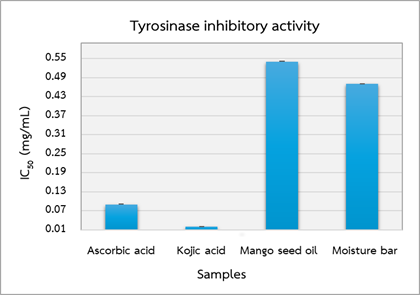
งานวิจัยนี้มุ่งเน้นการสกัดและวิเคราะห์คุณสมบัติของน้ำมันจากเนื้อในเมล็ดมะม่วงสายพันธุ์มันเดือนเก้าหรือทวายเดือนเก้า เพื่อเพิ่มมูลค่าและนำไปใช้ประโยชน์ในผลิตภัณฑ์เครื่องสำอาง ทำการวิเคราะห์คุณสมบัติทางเคมีกายภาพและสารออกฤทธิ์ทางชีวภาพของน้ำมันเมล็ดมะม่วง และประยุกต์ใช้น้ำมันเมล็ดมะม่วงสกัดในผลิตภัณฑ์มอยเจอร์บาร์ จากนั้นทดสอบฤทธิ์ต้านอนุมูลอิสระด้วยวิธี DPPH รวมถึงวิเคราะห์ฤทธิ์ในการยับยั้งเอนไซม์ไทโรซิเนสของผลิตภัณฑ์มอยเจอร์บาร์และน้ำมันเมล็ดมะม่วงที่สกัดได้ ผลการศึกษาพบว่าวิธีสกัดแบบ Reflux extraction โดยใช้เฮกเซนเป็นตัวทำละลายในอัตราส่วน 1:3 ที่อุณหภูมิ 55 องศาเซลเซียส ให้ปริมาณน้ำมันเมล็ดมะม่วงสกัดสูงสุด (ร้อยละ 8.71) น้ำมันที่ได้มีคุณภาพดีไม่เหม็นหืน มีค่าไอโอดีน 40.17 ± 0.14 g I2/100g oil ค่าสปอนนิฟิเคชัน 200.46 ± 1.03 mg KOH/g oil ค่าความเป็นกรด 2.81 ± 0.06 mg KOH/g oil ค่าเพอร์ออกไซด์ 2.98 ± 0.03 meq peroxide/Kg oil และมีค่าความหนืดใกล้เคียงกับน้ำมันพืชชนิดอื่น (50.51 ± 0.01 cP) มีปริมาณสารสำคัญของบีตาแคโรทีน 3.48 mg/100g ฟีนอลิกทั้งหมด 4.57 mg GAE/g และ วิตามินอี 1.51 mg/100g น้ำมันเมล็ดมะม่วงสกัดและผลิตภัณฑ์มอยเจอร์บาร์ที่พัฒนาขึ้นมีฤทธิ์ต้านอนุมูลอิสระสูง พบว่ามีค่า IC50 0.23 และ 0.19 มิลลิกรัม/มิลลิลิตร ตามลำดับ เมื่อเทียบกับกรดแอสคอร์บิก (0.18 มิลลิกรัม/มิลลิลิตร) อย่างไรก็ตามฤทธิ์ยับยั้งเอนไซม์ไทโรซิเนสของน้ำมันเมล็ดมะม่วงสกัดและผลิตภัณฑ์มอยเจอร์บาร์ยังอยู่ในระดับต่ำ มีค่า IC50 0.54 และ 0.47 มิลลิกรัม/มิลลิลิตร ตามลำดับ เมื่อเทียบกับกรดโคจิก (0.02 มิลลิกรัม/มิลลิลิตร) และกรดแอสคอร์บิก (0.09 มิลลิกรัม/มิลลิลิตร) ผลการศึกษานี้ชี้ให้เห็นว่าน้ำมันเมล็ดมะม่วงเป็นส่วนผสมจากธรรมชาติที่สามารถนำไปใช้พัฒนาผลิตภัณฑ์เครื่องสำอาง โดยเฉพาะอย่างยิ่งเป็นสารต้านอนุมูลอิสระ
Article Details

อนุญาตภายใต้เงื่อนไข Creative Commons Attribution-NonCommercial-NoDerivatives 4.0 International License.
เอกสารอ้างอิง
Abdalla, A.E.M., Darwish, S.M., Ayad, E.H.E. and El-Hamahmy, R.M. (2007). Egyptian mango by-product 2: Antioxidant and antimicrobial activities of extract and oil from mango seed kernel. Food Chemistry 103(4): 1141 - 1152. doi: 10.1016/j.foodchem.2006.10.026.
AOAC. (2000). Official method of analysis of AOAC International. 17th edition. Washington, DC: The Association of Official Analytical Chemists.
Britton, G., Liaaen-Jensen, S. and Pfander, H. (1995). Carotenoids: Volume 1B. Spectroscopy. Boston: Birkhäuser Verlag. 360 pp.
Chaichumpoo, P., Imsabai, W., Prayoonmahisorn, W., Plubjapoa, Y. and Auvuchanon, A. (2019). Beta-carotene content evaluation of F1 hybrid pumpkins for processing. King Mongkut’s Agricultural Journal 37(4): 581 - 589.
Codex Alimentarius. (2019). Codex standard for named vegetable oils (CODEX-STAN 210-1999). 1 - 10. Source: https://www.fao.org/3/y2774e/y2774e04.htm#bm4.1. Retrieved date 30 November 2023.
Honfo, F.G., Akissoe, N., Linnemann, A.R., Soumanou, M. and Van Boekel, M.A.J.S (2013). Nutritional composition of shea products and chemical properties of shea butter: A review. Critical Reviews in Food Science and Nutrition 54(5): 673 - 686. doi: 10.1080/10408398.2011.604142.
Kittiphoom, S. and Sutasinee, S. (2013). Mango seed kernel oil and its physicochemical properties. International Food Research Journal 20(3): 1145 - 1149.
Langkapin, J., Parnsakhorn, S. and Oupathumpanont, O. (2023). Effect of drying temperature and time on β-carotene content and physical properties of osmotic marian plum products. Burapha Science Journal 28(3): 2034 - 2053.
Let, M.B., Jacobsen, C. and Meyer, A.S. (2005). Sensory stability and oxidation of fish oil enriched milk is affected by milk storage temperature and oil quality. International Dairy Journal 15(2): 173 - 182. doi: 10.1016/j.idairyj.2004.06.003.
Mahato, N., Sinha, M., Sharma, K., Koteswararao, R., Sinha, A.K., Baral, E. and Cho, S. (2019). Bioactive compounds in mango (Mangifera indica L.) kernel and their pharmaceutical properties: A review. Food Chemistry 277: 92 - 107.
Maisuthisakul, P. and Gordon, M.H. (2009). Antioxidant and tyrosinase inhibitory activity of mango seed kernel by product. Food chemistry 117(2): 332 - 341. doi: 10.1016/j.foodchem.2009.04.010.
Masuda, T., Yonemori, S., Oyama, Y., Takeda, Y., Tanaka, T., Andoh, T., Shinohara, A. and Nakata, M. (1999). Evaluation of the antioxidant activity of environmental plants: activity of the leaf extracts from seashore plants. Journal of Agricultural and Food Chemistry 47: 1749 - 1754. doi: 10.1021/jf980864s.
Mas'ud, F., Mahendradatta, M., Laga, A. and Zainal, Z. (2018). Physicochemical properties and fatty acid composition of mango seed kernel oil. International journal of engineering sciences & research technology 7(1): 361 - 369. doi: 10.5281/zenodo.1147523.
Mitsikaris, P.D., Kokokiris, L., Pritsa, A., Papadopoulos, A.N. and Kalogiouri, N.P. (2022). Investigating the tocopherol contents of walnut seed oils produced in different European countries analyzed by HPLC-UV: A comparative study on the basis of geographical origin. Foods 11(22): 3719.
Mwaurah, P.W., Kumar, S., Kumar, N., Panghal, A., Attkan, A.K., Singh, V.K. and Garg, M.K. (2020). Physicochemical characteristics, bioactive compounds and industrial applications of mango kernel and its products: A review. Comprehensive Reviews in Food Science and Food Safety 19(5): 2421 - 2446. doi: 10.1111/1541-4337.12598.
Nader, J., Fawaz, N., Afif, C. and Louka, N. (2016). A novel process for preparing low-fat peanuts: Optimization of the oil extraction yield with limited structural and organoleptic damage. Food Chemistry 197: 1215 - 1225. doi: 10.1016/j.foodchem.2015.11.079.
Nagata, M. and Yamashita, I. (1992). Simple method for simultaneous determination of chlorophyll and carotenoids in tomato fruit. Nippon Shokuhin Kogyo Gakkaishi 39(10): 925 - 928. doi: 10.3136/nskkk 1962.39.925.
Namngam, C., Boonyuen, S. and Pinsirodom, P. (2018). Fractionation, antioxidant and inhibitory activity of Thai mango seed kernel extracts. Czech Journal of Food Sciences 36(1): 8 - 15. doi: 10.17221/225/20 17-CJFS.
Nwaokobia, K., Idibie, C.A., Ogboror, O. and Okolie, P. L. (2018). Effects of extraction solvents on the yield and physicochemical properties of Mangifera indica L. seed oil. Dev Sanskriti Interdisciplinary International Journal 12: 43 - 51. doi: 10.36018/dsiij.v12i0.104.
Nzikou, J.M., Kimbonguila, A., Matos, L., Loumouamou, B., Pambou-Tobi, N.P.G., Ndangui, C.B., Abena, A.A., Silou, Th., Scher, J. and Desobry, S. (2010). Extraction and characteristics of seed kernel oil from mango (Mangifera indica). Research Journal of Environmental and Earth Sciences 2(1): 31 - 35.
Olajumoke, O.E. (2013). Extraction and characterization of vegetable oil from mango. IOSR Journal of Applied Chemistry 5(3): 6 - 8.
Puravankara, D., Boghra, V. and Sharma, R.S. (2000). Effect of antioxidant principles isolated from mango (Mangifera indica L.) seed kernels on oxidative stability of buffalo ghee (butter-fat). Journal of the Science of Food and Agriculture 80(4): 522 - 526. doi: 10.1002/(SICI)1097-0010(200003)80:4<522::AID-JSFA560>3.0.CO;2-R.
Rao, A.V., and Rao, L.G. (2007). Carotenoids and human health. Pharmacological Research 55(3): 207 - 216. doi: 10.1016/j.phrs.2007.01.012.
Ribeiro, S.M.R. and Schieber, A. (2010). Chapter 34 - Bioactive compounds in mango (Mangifera indica L.). Bioactive foods in promoting health. Academic Press. 507 - 523. doi: 10.1016/B978-0-12-374628-3.00034-7.
Quintana, S.E., Salas, S. and García-Zapateiro, L.A. (2021). Bioactive compounds of mango (Mangifera indica L.): A review of extraction technologies and chemical constituents. Journal of the Science of Food and Agriculture 101(15): 6186 - 6192. doi: 10.1002/jsfa.11455.
Schieber, A., Berardini, N. and Carle, R. (2003). Identification of flavanols and xanthone glycosides from mango (Mangifera indica L. Cv.“Tommy Atkins”) peels by high-performance liquid chromatography-electrospray ionization mass spectrometry. Journal of Agricultural and Food Chemistry 51(17): 5006 - 5011. doi: 10.1021/jf030218f.
Shahidi, F., and Ambigaipalan, P. (2015). Phenolics and polyphenolics in foods, beverages and spices: Antioxidant activity and health effects – A review. Journal of Functional Foods 18: 820 - 897.
Sogi, D.S., Siddiq, M., Greiby, I. and Dolan, K.D. (2013). Total phenolics, antioxidant activity, and functional properties of “Tommy Atkins” mango peel and kernel as affected by drying methods. Food Chemistry 141(3): 2649 - 2655. doi: 10.1016/j.foodchem.2013.05.053.
Srisook, K., Salee, P, Charoensuk, Y. and Srisook, E. (2010). In vitro anti-oxidant and anti-tyrosinase activities of rhizomal extracts from Amomum biflorum Jack. Thai Journal of Botany 2(Special Issue): 143 - 150.
Sultana, B. and Ashraf, R. (2019). Mango (Mangifera indica L.) seed oil. In: Ramadan, M. (eds) Fruit Oils: Chemistry and Functionality. 561 - 575. Cham: Springer. doi: 10.1007/978-3-030-12473-1_28.
Traber, M.G. and Atkinson, J. (2007). Vitamin E, antioxidant and nothing more. Free Radical Biology and Medicine 43(1): 4 - 15. doi: 10.1016/j.freeradbiomed.2007.03.024.
Tsai, P.J., McIntosh, J., Pearce, P., Camden, B. and Jordan, B.R. (2002). Anthocyanin and antioxidant capacity in Roselle (Hibiscus sabdariffa L.) extract. Food Research International 35(4): 351 - 356. doi: 10.1016 /S0963-9969(01)00129-6.
