
Application of First-order Integer-valued Autoregressive Model for Forecasting Number of Truck Accidents in Surin Province, Thailand
Article Sidebar
Main Article Content
Abstract
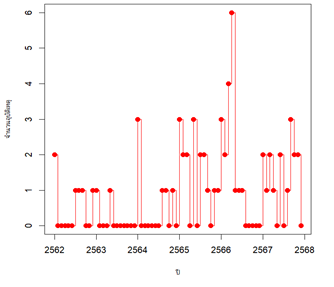
This study aims to forecast the monthly number of truck-related accidents in Surin Province. The accident data are non-negative integers, as time series count data, which differ from conventional time series that are typically real numbers. In the presence of a large number of zeros, models suitable for zero-inflated data may be considered. Therefore, this study employed the First-order Integer-valued Autoregressive (INAR1) model and then compared it with the Zero-inflated Poisson INAR1 (ZIPINAR1) model and the Zero-inflated Negative Binomial INAR1 (ZINBINAR1) model. Model selection was based on the Akaike Information Criterion (AIC). The dataset comprised 72 monthly observations of truck accidents in Surin Province from January 2019 to December 2024. The results indicated that the ZIPINAR1 model provided the best fit, yielding the lowest AIC value of 183.6693 compared to the other models.
Article Details

This work is licensed under a Creative Commons Attribution-NonCommercial-NoDerivatives 4.0 International License.
References
วรชัย บุญฤทธิผล. (2559). การวิเคราะห์ปัจจัยเชิงสาเหตุที่มีอิทธิพลต่อการเกิดอุบัติเหตุของพนักงานขับรถบรรทุก. วิทยานิพนธน์หลักสูตรวิทยาศาสตรมหาบัณฑิต, มหาวิทยาลัยบูรพา. ชลบุรี. 132 หน้า.
วุฒิ พลบูรณ์. (2562). คู่มือนักสืบอุบัติเหตุรถโดยสารขนาดใหญ่. ศูนย์วิชาการเพื่อความปลอดภัยทางถนน (ศวปถ.).มหาวิทยาลัยเทคโนโลยีสุรนารี. นครราชสีมา. 76 หน้า.
ศูนย์เทคโนโลยีสารสนเทศและการสื่อสาร สำนักงานปลัดกระทรวงคมนาคม. (2568). ปริมาณการขนส่งสินค้าภายในประเทศ.แหล่งข้อมูล: https://datagov.mot.go.th/dataset/freight-dom. ค้นเมื่อวันที่ 17 กันยายน 2568.
สำนักอำนวยความปลอดภัย กรมทางหลวง. (2567). จำนวนอุบัติเหตุของรถบรรทุกที่เกิดในจังหวัดสุรินทร์. แหล่งข้อมูล: http://bhs.doh.go.th/download/accident. ค้นเมื่อวันที่ 27 เมษายน 2567.
สุชิราภรณ์ บุนยะริส และ จิราพรรณ สุนทรโชติ (2564). ตัวแบบการถดถอยในตัวอันดับหนึ่งที่มีค่าเป็นจำนวนเต็มด้วยการแจกแจงปัวซงลินด์เลย์สองพารามิเตอร์นัยทั่วไปบนฐานของตัวดำเนินการทำให้บางทวินามลบ. วารสารคณิตศาสตร์. 66(704): 63 - 77.
Aghababaei Jazi, M., Jones, G. and Lai, C.D. (2022). Integer valued AR (1) with geometric innovations. Journal of the Iranian Statistical Society 11(2): 173 - 190.
Al-Osh, M.A. and Alzaid, A.A. (1987). First-order integer-valued autoregressive (INAR (1)) process. Journal of Time Series Analysis 8(3): 261 - 275. doi: 10.1111/j.1467-9892.1987.tb00438.x.
Al-Osh, M.A. and Aly, E.E.A. (1992). First order autoregressive time series with negative binomial and geometric marginals. Communications in Statistics-Theory and Methods 21(9): 2483 - 2492. doi: 10.1080/03610929208830925.
Barreto-Souza, W. (2015). Zero-modified geometric INAR(1) process for modelling count time series with deflation or inflation of zeros. Journal of Time Series Analysis 36(6): 839 - 852. doi: 10.1111/jtsa. 12131.
Brijs, T., Karlis, D. and Wets, G. (2008). Studying the effect of weather conditions on daily crash counts using a discrete time-series model. Accident Analysis & Prevention 40(3): 1180 - 1190. doi: 10.1016/j.aap. 2008.01.001.
Cai, B., Quddus, M., Wang, X. and Miao, Y. (2024). New modeling approach for predicting disaggregated time-series traffic crashes. Transportation research board 2678(3): 637 - 648. doi: 10.1177/036119812311 82703
Dadashova, B., Arenas-Ramírez, B., Mira-McWilliams, J. and Aparicio-Izquierdo, F. (2016). Methodological development for selection of significant predictors explaining fatal road accidents. Accident Analysis & Prevention 90: 82 - 94.
Feng, C.X. (2021). A comparison of zero-inflated and hurdle models for modeling zero-inflated count data. Journal of statistical distributions and applications 8(1): 8. doi: 10.1186/s40488-021-00121-4.
Freeland, R.K. and McCabe, B.P. (2004). Analysis of low count time series data by Poisson autoregression. Journal of time series analysis 25(5): 701 - 722.
Garay, A.M., Medina, F.L., Jales I.C.S. and Bertail, P. (2021). First-order integer valued AR processes with zero-inflated innovations. In: Nonstationary Systems: Theory and Applications: Contributions to the 13th Workshop on Nonstationary Systems and Their Applications, February 3 - 5, 2020, Grodek nad Dunajcem, Poland. Cham: Springer. 19 - 40.
Jazia, M.A., Jones, G. and Lai, C.D. (2012). First-order integer valued AR processes with zero-inflated Poisson innovations. Journal of Time Series Analysis 33(6): 954 - 963.
Leonenko, N.N., Savani, V. and Zhigljavsky, A.A. (2007). Autoregressive negative binomial processes. In Annales de l'ISUP 51(1 - 2): 25 - 47.
Lord, D. and Mannering, F. (2010). The statistical analysis of crash-frequency data: A review and assessment of methodological alternatives. Transportation research part A: policy and practice 44(5): 291 - 305.
McKenzie, E. (1985). Some simple models for discrete variate time series 1. JAWRA Journal of the American Water Resources Association 21(4): 645 - 650. doi: 10.1111/j.1752-1688.1985.tb05379.x.
Orozco, D.L.R., Sales, L.O.F., Fernández, L.M.Z. and Pinho, A.L.S. (2021). A new mixed first-order integer-valued autoregressive process with Poisson innovations. AStA Advances in Statistical Analysis 105(4): 559 - 580.
Parvareh, M., Karimi, A., Rezaei, S., Woldemichael, A., Nili, S., Nouri, B. and Nasab, N.E. (2018). Assessment and prediction of road accident injuries trend using time-series models in Kurdistan. Burns & trauma 6: 9. doi: 10.1186/s41038-018-0111-6.
Prasetijo, J. and Musa, W.Z. (2016). Modeling zero-inflated regression of road accidents at Johor federal road F001. In MATEC Web of Conferences 47: 03001. doi: 10.1051/matecconf/20164703001.
Quddus, M. A. (2008). Time series count data models: an empirical application to traffic accidents. Accident analysis & prevention 40(5): 1732 - 1741.
Rabbani, M.B.A., Musarat, M.A., Alaloul, W.S., Rabbani, M.S., Maqsoom, A., Ayub, S., Bukhari, H. and Altaf, M. (2021). A comparison between seasonal autoregressive integrated moving average (SARIMA) and exponential smoothing (ES) based on time series model for forecasting road accidents. Arabian Journal for Science and Engineering 46(11): 11113 - 11138.
Ramstedt, M. (2008). Alcohol and fatal accidents in the United States-a time series analysis for 1950-2002. Accident Analysis & Prevention 40(4): 1273 - 1281. doi: 10.1016/j.aap.2008.01.008.
Sanusi, R.A., Adebola, F.B., and Adegoke, N.A. (2016). Cases of road traffic accident in Nigeria: a time series approach. Mediterranean journal of social sciences 7(2): 542 - 552.
Shankar, V., Milton, J. and Mannering, F. (1997). Modeling accident frequencies as zero-altered probability processes: An empirical inquiry. Accident Analysis & Prevention 29(6): 829 - 837. doi: 10.1016/S0001-4575(97)00052-3.
Simmachan, T., Wongsai, N., Wongsai, S. and Lerdsuwansri, R. (2022). Modeling road accident fatalities with underdispersion and zero-inflated counts. PLOS ONE 17(11): e0269022. doi: 10.1371/journal.pone. 0269022.
Weiss, C.H., Homburg, A. and Puig, P. (2019). Testing for zero inflation and overdispersion in INAR (1) models. Statistical Papers 60: 823 - 848.
Zheng, X. and Liu, M. (2009). An overview of accident forecasting methodologies. Journal of Loss Prevention in the process Industries 22(4): 484 - 491. doi: 10.1016/j.jlp.2009.03.005.
