
การประยุกต์ใช้ตัวแบบการถดถอยในตัวอันดับที่หนึ่งที่มีค่าเป็นจำนวนเต็มในการพยากรณ์จำนวนอุบัติเหตุของรถบรรทุก จังหวัดสุรินทร์
Article Sidebar
Main Article Content
บทคัดย่อ
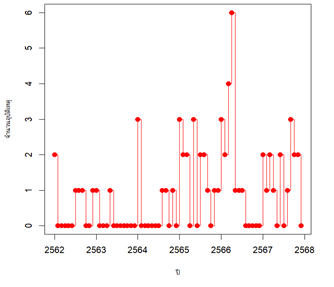
การศึกษาครั้งนี้มีวัตถุประสงค์เพื่อพยากรณ์จำนวนอุบัติเหตุของรถบรรทุกรายเดือนที่เกิดขึ้นในจังหวัดสุรินทร์ซึ่งข้อมูลการเกิดอุบัติเหตุเป็นข้อมูลจำนวนเต็มที่มีค่าตั้งแต่ 0 เป็นต้นไป จึงจัดเป็นข้อมูลแบบอนุกรมเวลาที่เป็นจำนวนนับ (Time Series or Count Data) ที่มีรูปแบบแตกต่างจากข้อมูลอนุกรมเวลาทั่วไปที่มักเป็นจำนวนจริง และเมื่อข้อมูลมีตัวเลขที่เป็นศูนย์รวมอยู่ในชุดข้อมูลจำนวนมากจึงเลือกตัวแบบสำหรับข้อมูลที่มีค่าศูนย์เฟ้อมาใช้ในการพยากรณ์ได้ ดังนั้นในการศึกษาครั้งนี้จึงได้นำตัวแบบการถดถอยในตัวอันดับที่หนึ่งที่มีค่าเป็นจำนวนเต็ม (INAR1) มาเปรียบเทียบกับตัวแบบการถดถอยในตัวอันดับที่หนึ่งที่มีค่าเป็นจำนวนเต็มด้วยการแจกแจงปัวซงที่มีค่าศูนย์เฟ้อ (ZIPINAR1) และตัวแบบการถดถอยในตัวอันดับที่หนึ่งที่มีค่าเป็นจำนวนเต็มด้วยการแจกแจงทวินามเชิงลบ (ZINBINAR(1)) โดยใช้เกณฑ์ค่าสนเทศของอะกะอิเกะ (AIC) ในการคัดเลือกตัวแบบ จากข้อมูลจำนวนอุบัติเหตุของรถบรรทุก ในจังหวัดสุรินทร์ ตั้งแต่เดือนมกราคม ปี พ.ศ. 2562 ถึงเดือนธันวาคม ปี พ.ศ. 2567 จำนวนทั้งหมด 72 ค่า มาสร้างตัวแบบการพยากรณ์ จากผลการศึกษาพบว่า ตัวแบบการถดถอยในตัวอันดับที่หนึ่งที่มีค่าเป็นจำนวนเต็มด้วยการแจกแจงปัวซงค่าศูนย์เฟ้อ (ZIPINAR1) เหมาะสมที่สุดเมื่อเทียบกับตัวแบบอื่น ๆ โดยมีค่า AIC ต่ำที่สุดเท่ากับ 183.6693
Article Details

อนุญาตภายใต้เงื่อนไข Creative Commons Attribution-NonCommercial-NoDerivatives 4.0 International License.
เอกสารอ้างอิง
วรชัย บุญฤทธิผล. (2559). การวิเคราะห์ปัจจัยเชิงสาเหตุที่มีอิทธิพลต่อการเกิดอุบัติเหตุของพนักงานขับรถบรรทุก. วิทยานิพนธน์หลักสูตรวิทยาศาสตรมหาบัณฑิต, มหาวิทยาลัยบูรพา. ชลบุรี. 132 หน้า.
วุฒิ พลบูรณ์. (2562). คู่มือนักสืบอุบัติเหตุรถโดยสารขนาดใหญ่. ศูนย์วิชาการเพื่อความปลอดภัยทางถนน (ศวปถ.).มหาวิทยาลัยเทคโนโลยีสุรนารี. นครราชสีมา. 76 หน้า.
ศูนย์เทคโนโลยีสารสนเทศและการสื่อสาร สำนักงานปลัดกระทรวงคมนาคม. (2568). ปริมาณการขนส่งสินค้าภายในประเทศ.แหล่งข้อมูล: https://datagov.mot.go.th/dataset/freight-dom. ค้นเมื่อวันที่ 17 กันยายน 2568.
สำนักอำนวยความปลอดภัย กรมทางหลวง. (2567). จำนวนอุบัติเหตุของรถบรรทุกที่เกิดในจังหวัดสุรินทร์. แหล่งข้อมูล: http://bhs.doh.go.th/download/accident. ค้นเมื่อวันที่ 27 เมษายน 2567.
สุชิราภรณ์ บุนยะริส และ จิราพรรณ สุนทรโชติ (2564). ตัวแบบการถดถอยในตัวอันดับหนึ่งที่มีค่าเป็นจำนวนเต็มด้วยการแจกแจงปัวซงลินด์เลย์สองพารามิเตอร์นัยทั่วไปบนฐานของตัวดำเนินการทำให้บางทวินามลบ. วารสารคณิตศาสตร์. 66(704): 63 - 77.
Aghababaei Jazi, M., Jones, G. and Lai, C.D. (2022). Integer valued AR (1) with geometric innovations. Journal of the Iranian Statistical Society 11(2): 173 - 190.
Al-Osh, M.A. and Alzaid, A.A. (1987). First-order integer-valued autoregressive (INAR (1)) process. Journal of Time Series Analysis 8(3): 261 - 275. doi: 10.1111/j.1467-9892.1987.tb00438.x.
Al-Osh, M.A. and Aly, E.E.A. (1992). First order autoregressive time series with negative binomial and geometric marginals. Communications in Statistics-Theory and Methods 21(9): 2483 - 2492. doi: 10.1080/03610929208830925.
Barreto-Souza, W. (2015). Zero-modified geometric INAR(1) process for modelling count time series with deflation or inflation of zeros. Journal of Time Series Analysis 36(6): 839 - 852. doi: 10.1111/jtsa. 12131.
Brijs, T., Karlis, D. and Wets, G. (2008). Studying the effect of weather conditions on daily crash counts using a discrete time-series model. Accident Analysis & Prevention 40(3): 1180 - 1190. doi: 10.1016/j.aap. 2008.01.001.
Cai, B., Quddus, M., Wang, X. and Miao, Y. (2024). New modeling approach for predicting disaggregated time-series traffic crashes. Transportation research board 2678(3): 637 - 648. doi: 10.1177/036119812311 82703
Dadashova, B., Arenas-Ramírez, B., Mira-McWilliams, J. and Aparicio-Izquierdo, F. (2016). Methodological development for selection of significant predictors explaining fatal road accidents. Accident Analysis & Prevention 90: 82 - 94.
Feng, C.X. (2021). A comparison of zero-inflated and hurdle models for modeling zero-inflated count data. Journal of statistical distributions and applications 8(1): 8. doi: 10.1186/s40488-021-00121-4.
Freeland, R.K. and McCabe, B.P. (2004). Analysis of low count time series data by Poisson autoregression. Journal of time series analysis 25(5): 701 - 722.
Garay, A.M., Medina, F.L., Jales I.C.S. and Bertail, P. (2021). First-order integer valued AR processes with zero-inflated innovations. In: Nonstationary Systems: Theory and Applications: Contributions to the 13th Workshop on Nonstationary Systems and Their Applications, February 3 - 5, 2020, Grodek nad Dunajcem, Poland. Cham: Springer. 19 - 40.
Jazia, M.A., Jones, G. and Lai, C.D. (2012). First-order integer valued AR processes with zero-inflated Poisson innovations. Journal of Time Series Analysis 33(6): 954 - 963.
Leonenko, N.N., Savani, V. and Zhigljavsky, A.A. (2007). Autoregressive negative binomial processes. In Annales de l'ISUP 51(1 - 2): 25 - 47.
Lord, D. and Mannering, F. (2010). The statistical analysis of crash-frequency data: A review and assessment of methodological alternatives. Transportation research part A: policy and practice 44(5): 291 - 305.
McKenzie, E. (1985). Some simple models for discrete variate time series 1. JAWRA Journal of the American Water Resources Association 21(4): 645 - 650. doi: 10.1111/j.1752-1688.1985.tb05379.x.
Orozco, D.L.R., Sales, L.O.F., Fernández, L.M.Z. and Pinho, A.L.S. (2021). A new mixed first-order integer-valued autoregressive process with Poisson innovations. AStA Advances in Statistical Analysis 105(4): 559 - 580.
Parvareh, M., Karimi, A., Rezaei, S., Woldemichael, A., Nili, S., Nouri, B. and Nasab, N.E. (2018). Assessment and prediction of road accident injuries trend using time-series models in Kurdistan. Burns & trauma 6: 9. doi: 10.1186/s41038-018-0111-6.
Prasetijo, J. and Musa, W.Z. (2016). Modeling zero-inflated regression of road accidents at Johor federal road F001. In MATEC Web of Conferences 47: 03001. doi: 10.1051/matecconf/20164703001.
Quddus, M. A. (2008). Time series count data models: an empirical application to traffic accidents. Accident analysis & prevention 40(5): 1732 - 1741.
Rabbani, M.B.A., Musarat, M.A., Alaloul, W.S., Rabbani, M.S., Maqsoom, A., Ayub, S., Bukhari, H. and Altaf, M. (2021). A comparison between seasonal autoregressive integrated moving average (SARIMA) and exponential smoothing (ES) based on time series model for forecasting road accidents. Arabian Journal for Science and Engineering 46(11): 11113 - 11138.
Ramstedt, M. (2008). Alcohol and fatal accidents in the United States-a time series analysis for 1950-2002. Accident Analysis & Prevention 40(4): 1273 - 1281. doi: 10.1016/j.aap.2008.01.008.
Sanusi, R.A., Adebola, F.B., and Adegoke, N.A. (2016). Cases of road traffic accident in Nigeria: a time series approach. Mediterranean journal of social sciences 7(2): 542 - 552.
Shankar, V., Milton, J. and Mannering, F. (1997). Modeling accident frequencies as zero-altered probability processes: An empirical inquiry. Accident Analysis & Prevention 29(6): 829 - 837. doi: 10.1016/S0001-4575(97)00052-3.
Simmachan, T., Wongsai, N., Wongsai, S. and Lerdsuwansri, R. (2022). Modeling road accident fatalities with underdispersion and zero-inflated counts. PLOS ONE 17(11): e0269022. doi: 10.1371/journal.pone. 0269022.
Weiss, C.H., Homburg, A. and Puig, P. (2019). Testing for zero inflation and overdispersion in INAR (1) models. Statistical Papers 60: 823 - 848.
Zheng, X. and Liu, M. (2009). An overview of accident forecasting methodologies. Journal of Loss Prevention in the process Industries 22(4): 484 - 491. doi: 10.1016/j.jlp.2009.03.005.
