
A Study on the Mechanical Properties and Water Absorption of Unfired Clay Bricks Containing Rice Husk Ash
Article Sidebar
Main Article Content
Abstract
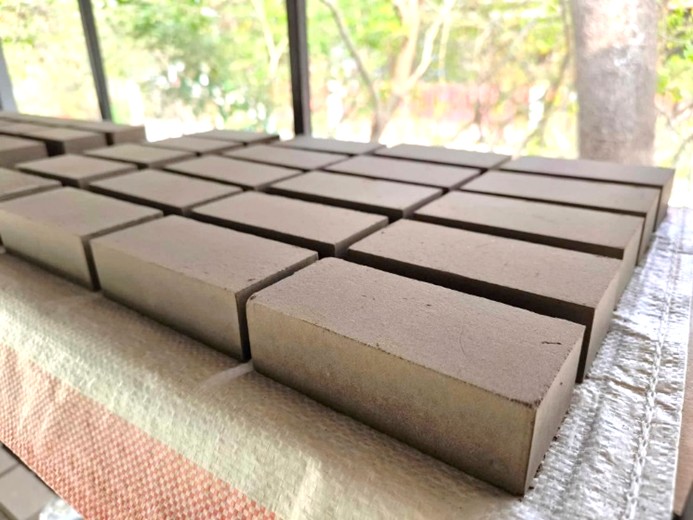
Clay bricks are widely used as wall construction materials; however, their conventional production involves a firing process lasting 7 to 15 days, which contributes to environmental issues such as smoke emission and odor, and often results in inconsistent product quality due to uneven firing. This study investigates the mechanical and physical properties of unfired clay bricks incorporating cement and laterite in a 1:6 ratio, with finely ground rice husk ash (RHA) used as a partial cement replacement at levels of 0%, 10%, 20%, 30%, 40%, and 50% by weight. The water-to-binder ratio was varied between 0.40 and 0.55. Brick specimens were molded to the dimensions specified in Thai Industrial Standard (TIS) 77-2565 (65 × 140 × 40 cubic millimeters). Compressive strength tests were conducted at 7, 14, and 28 days, while water absorption and modulus of rupture were evaluated at 28 days. The results indicate that increasing RHA content leads to a reduction in both compressive strength and modulus of rupture, while water absorption increases. The mixtures with 0%, 10%, and 20% RHA replacement achieved average 28-day compressive strengths of 158, 121, and 111 kg/cm², respectively, with water absorption values below 10%. These three formulations complied with the TIS 77-2565 requirements for Class C bricks. The optimal mix is identified as the one containing 20% RHA replacement, which maximizes RHA utilization while maintaining compliance with the standard.
Article Details

This work is licensed under a Creative Commons Attribution-NonCommercial-NoDerivatives 4.0 International License.
References
ก้องรัฐ นกแก้ว, ศราวุธ ไผ่แก้ว, คมศักดิ์ หารไชย, เมธากุล มีธรรม และนาถ สุขศีล (2565). การประเมินคุณภาพของอิฐมอญที่ผลิตในพื้นที่จังหวัดกลุ่มสนุก. ใน: การประชุมวิชาการวิศวกรรมโยธาแห่งชาติ ครั้งที่ 27. วิศวกรรมสถานแห่งประเทศไทย ในพระบรมราชูปถัมภ์, เชียงราย. MAT04-1-MAT04-7.
ณฐพงศ์ จันทร์เพ็ชร์. (2562). การปรับปรุงคุณภาพอิฐมอญแบบไม่ต้องเผาด้วยเส้นใยฟางข้าวเหลือทิ้งในพื้นที่ภาคกลาง
เพื่อเชิงพาณิชย์อย่างยั่งยืน. รายงานการวิจัยสาขาวิศวกรรมโยธา คณะวิศวกรรมศาสตร์และสถาปัตยกรรมศาสตร์, มหาวิทยาลัยเทคโนโลยีราชมงคลสุวรรณภูมิ, พระนครศรีอยุธยา.
ณฐพงศ์ จันทร์เพ็ชร์. (2565). การพัฒนาคุณภาพอิฐมอญแบบไม่ต้องเผาด้วยวัสดุพอลิเมอร์จากน้ำยางธรรมชาติ. ใน: รายงานการวิจัยที่ได้รับทุนจากสำนักงานการวิจัยแห่งชาติ. มหาวิทยาลัยเทคโนโลยีราชมงคลสุวรรณภูมิ, พระนครศรีอยุธยา.
ภราดร ชุไชยสงค์ และสุพรรณ วงทอง. (2552). การศึกษาสมบัติของอิฐมอญที่ผลิตในจังหวัดชลบุรี. ปริญญานิพนธ์ปริญญาตรี, มหาวิทยาลัยบูรพา. ชลบุรี. 53 หน้า.
Andreola, F., Lancellotti, I., Manfredini, T., Bondioli, F. and Barbieri, L. (2018). Rice husk ash (RHA) recycling in brick manufacture: effects on physical and microstructural properties. Waste and Biomass Valorization 9: 2529 - 2539.
Ani, F.M. and Nahid, A.M. (2023). Development of brick by utilizing rice husk ash as the partial replacement for clay. Multidisciplinary Science Journal 5(1): 2023004.
Babaso, P. and H. Sharanagouda. (2017). Rice Husk and Its Applications: Review. International Journal of Current Microbiology and Applied Sciences 6(10): 1144 - 1156.
Bheel, N., Abro, A.W., Shar, I.A., Dayo, A.A., Shaikh, S. and Shaikh, Z.H. (2019). Use of rice husk ash as cementitious material in concrete. Engineering, Technology & Applied Science Research 9(3): 4209 - 4212.
Damanhuri, A.A.M., Lubis, A.M.H.S., Hariri, A., Herawan, S.G., Roslan, M.H.I. and Hussin, M.S.F. (2020). Mechanical properties of rice husk ash (RHA) brick as partial replacement of clay. Journal of Physics: Conference Series 1529: 042034
Endale, S.A., Taffese, W.Z., Vo, D.H. and Yehualaw, M.D. (2022). Rice husk ash in concrete. Sustainability 15(1): 137.
Ganesan, K., Rajagopal, K. and Thangavel, K. (2008). Rice husk ash blended cement: Assessment of optimal level of replacement for strength and permeability properties of concrete. Construction and Building Materials 22(8): 1675 - 1683.
Habeeb, G.A. and Mahmud, H.B. (2010). Study on properties of rice husk ash and its use as cement replacement material. Materials Research 13(2): 185 - 190.
Kamau, J., Ahmed, A. and Ngong, K. (2018). Sulfate resistance of rice husk ash concrete. In: MATEC Web of Conferences 199: 02006
Kazmi, S.M., Abbas, S., Saleem, M.A., Munir, M.J. and Khitab, A. (2016). Manufacturing of sustainable clay bricks: Utilization of waste sugarcane bagasse and rice husk ashes. Construction and building materials 120: 29 - 41.
Kumar S., Sangwan P., Dhankhar R. Mor V. and Bidra S. (2013). Utilization of rice husk and their ash: A review. Research Journal of Chemical and Environmental Sciences 1(5): 126 - 129.
More, A.S., Tarade, A. and Anant, A. (2014). Assessment of suitability of fly ash and rice husk ash burnt clay bricks. International Journal of Scientific and Research Publications 4(7): 1 - 6.
Siddika, A., Mamun, M.A.A. and Ali, M.H. (2018). Study on concrete with rice husk ash. Innovative Infrastructure Solutions 3: 1 - 9.
Varshney, H. (2016). Utilization of Rice Husk Ash in concrete as cement replacement. IOSR Journal of Mechanical and Civil Engineering 1: 28 - 33.
Zareei, S.A., Ameri, F., Dorostkar, F. and Ahmadi, M. (2017). Rice husk ash as a partial replacement of cement in high strength concrete containing micro silica: Evaluating durability and mechanical properties. Case Studies in Construction Materials 7: 73 - 81.
