Synthesis of Silver Nanoparticles from Kaffir Lime Leaf Extract for Crystal Violet Dye Degradation
Article Sidebar
Main Article Content
Abstract
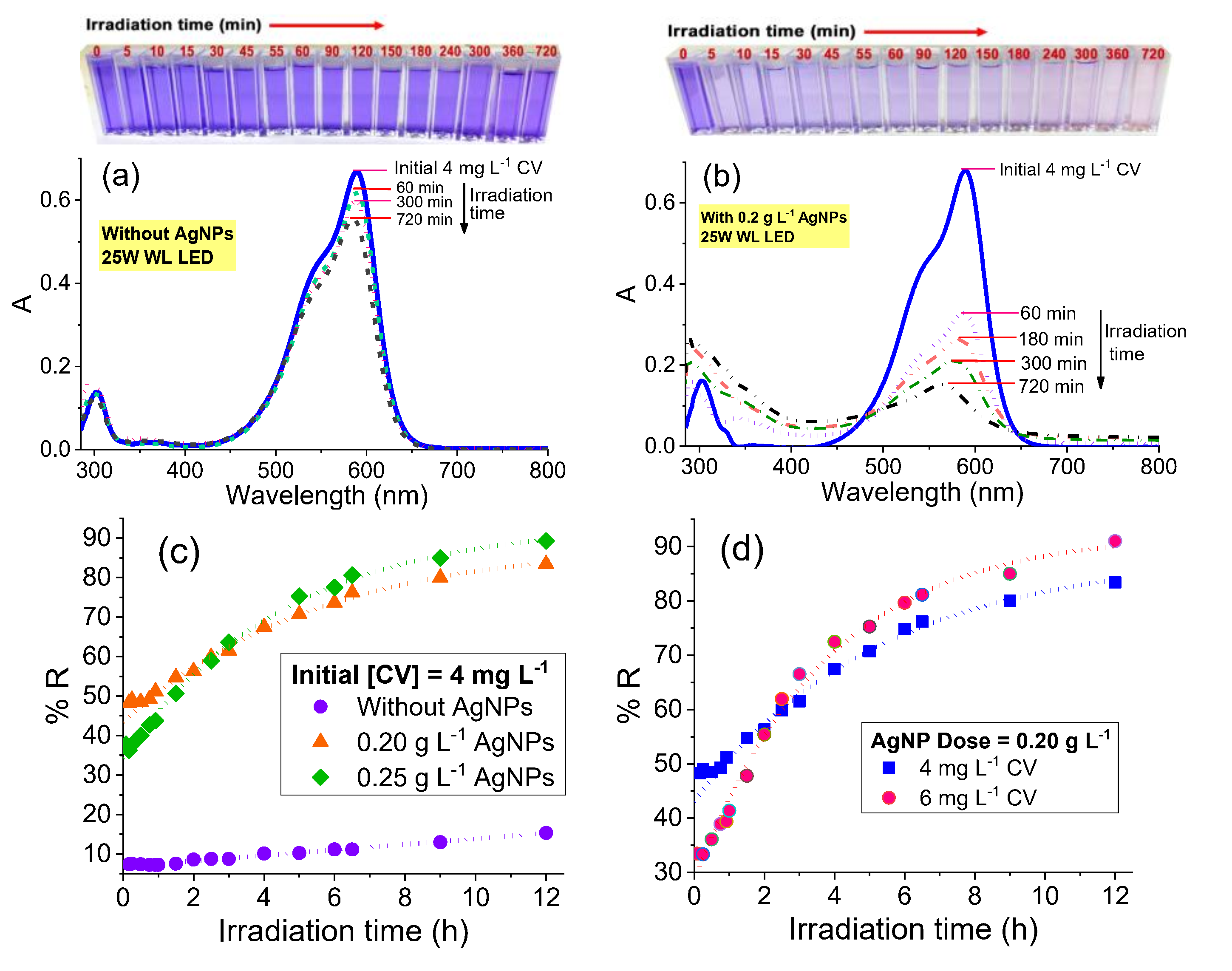
This study presents a green synthesis method for silver nanoparticles (AgNPs) using kaffir lime leaf extract (KLLE) as a natural reductant and stabilizer. Influence of synthesis parameters, including AgNO3 concentration, KLLE percentage, temperature, and pH was investigated. Optimal conditions (55ºC, 20 mM AgNO3, 20% KLLE and pH ~7) led to the formation of spherical AgNPs with an average diameter of 7.5 ± 1.9 nm. The photocatalytic performance of AgNPs was evaluated through crystal violet (CV) dye degradation under white light from an LED bulb and sunlight. The degradation catalyzed by AgNPs followed first-order kinetics. LED irradiation for 12 hours resulted in a maximum CV removal of 89%, whereas sunlight exposure for only 6.5 hours achieved a comparable CV removal of 85%. These findings highlight the potential of KLLE-derived AgNPs as efficient photocatalysts for environmental remediation.
Article Details

This work is licensed under a Creative Commons Attribution-NonCommercial-NoDerivatives 4.0 International License.
References
Ashkar, M.A., Babu, A., Joseph, R., Kutti Rani, S. and Vasimalai, N. (2023). Ecofriendly synthesis of silver nanoparticles using Radish microgreens extract and their potential photocatalytic degradation of toxic crystal violet and pyronin Y dyes and antibacterial studies. Inorganic Chemistry Communications 156: 111225.
Brandão, A.T., Rosoiu-State, S., Costa, R., Enache, L.B., Mihai, G.V., Vázquez, J.A. and Pereira, C.M. (2025). Unlocking the power of amorphous TiO2-decorated biocarbon composite: Enhanced photocatalytic performance for crystal violet dye degradation. Journal of Water Process Engineering 71: 107288.
Catauro, M., Papale, F., Bollino, F., Piccolella, S., Marciano, S., Nocera, P., and Pacifico, S. (2015). Silica/quercetin sol-gel hybrids as antioxidant dental implant materials. Science and technology of advanced materials.
Gattuso, G., Barreca, D., Gargiulli, C., Leuzzi, U. and Caristi, C. (2007). Flavonoid composition of citrus juices. Molecules 12(8): 1641 - 1673.
Gebre, S.H. (2023). Bio-inspired synthesis of metal and metal oxide nanoparticles: the key role of phytochemicals. Journal of Cluster Science 34: 665 - 704.
Kanes, K., Tisserat, B., Berhow, M. and Vandercook, C. (1993). Phenolic composition of various tissues of Rutaceae species. Phytochemistry 32(4): 967 - 974.
Kumar, I., Gangwar, C., Yaseen, B., Pandey, P.K., Mishra, S.K. and Naik, R.M. (2022). Kinetic and mechanistic studies of the formation of silver nanoparticles by nicotinamide as a reducing agent. ACS Omega 7(16): 13778 - 13788.
Mandal, K., Das, D., Bose, S.K., Chaudhuri, A., Chakraborty, A., Mandal, S., and Roy, S. (2024). Spectroscopic approach to optimize the biogenic silver nanoparticles for photocatalytic removal of ternary dye mixture and ecotoxicological impact of treated wastewater. Scientific Reports 14(1): 31174.
Marimuthu, S., Antonisamy, A.J., Malayandi, S., Rajendran, K., Tsai, P.C., Pugazhendhi, A. and Ponnusamy, V.K. (2020). Silver nanoparticles in dye effluent treatment: A review on synthesis, treatment methods, mechanisms, photocatalytic degradation, toxic effects and mitigation of toxicity. Journal of Photochemistry and Photobiology B: Biology 205: 111823 (1 - 13).
Mirza, A. and Ahmad, R. (2020). An efficient sequestration of toxic crystal violet dye from aqueous solution by Alginate/Pectin nanocomposite: A novel and ecofriendly adsorbent. Groundwater for Sustainable Development 11: 100373 (1 - 7).
Mushran, S.P., Agrawal, M.C., Mehrotra, R.M. and Sanehi, R. (1974). Kinetics and mechanism of reduction of silver (I) by ascorbic acid. Journal of the Chemical Society, Dalton Transactions 14: 1460 - 1462.
Qi, Y., Jiang, M., Cui, Y.L., Zhao, L. and Liu, S. (2015). Novel reduction of Cr(VI) from wastewater using a naturally derived microcapsule loaded with rutin–Cr(III) complex. Journal of Hazardous Materials 285: 336 - 345.
Sahu, N., Soni, D., Chandrashekhar, B., Satpute, D.B., Saravanadevi, S., Sarangi, B.K. and Pandey, R.A. (2016). Synthesis of silver nanoparticles using flavonoids: hesperidin, naringin and diosmin, and their antibacterial effects and cytotoxicity. International Nano Letters 6(3): 173 - 181.
Sana, S.S., Haldhar, R., Parameswaranpillai, J., Chavali, M. and Seong-Cheol Kim. (2022). Silver nanoparticles-based composite for dye removal: A comprehensive review. Cleaner Materials 6: 100161(1 - 14).
Srilatha, D., Nasare, M., Nagasandhya, B., Prasad, V., and Diwan, P. (2013). Development and Validation of UV Spectrophotometric Method for Simultaneous Estimation of Hesperidin and Diosmin in the Pharmaceutical Dosage Form. ISRN Spectroscopy 2013: 534830 (1 - 4).
