
Modeling Erythemal Ultraviolet Radiation in Thailand using Artificial Neural Networks (ANN) and Extreme Gradient Boosting (XGBoost)
Article Sidebar
Main Article Content
Abstract
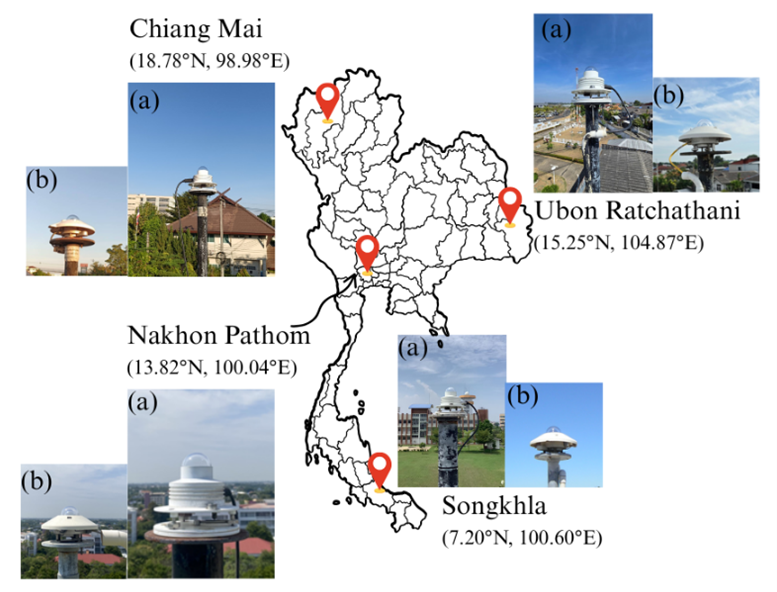
This study proposes machine learning models to estimate erythemal ultraviolet (EUV) radiation under all sky conditions using several available atmospheric and meteorological parameters. Data at four ground-based stations in key regions of Thailand namely, Chiang Mai, Ubon Ratchathani, Songkhla, and Nakhon Pathom, were collected from 2019 to 2023. Two well-known machine learning techniques, Artificial Neural Networks (ANN) and Extreme Gradient Boosting (XGBoost), were developed and employed, and their performance was compared. The results show that XGBoost outperformed ANN in terms of accuracy, with the best performance at each site yielding normalized root mean square errors (nRMSE) ranging from 8.56% to 14.32%. This superior performance suggests that XGBoost is more effective for estimating EUV radiation in Thailand and could be further improved for radiation forecasting.
Article Details

This work is licensed under a Creative Commons Attribution-NonCommercial-NoDerivatives 4.0 International License.
References
Ahmed, A.A.M., Ahmed, M.H., Saha, S.K., Ahmed, O. and Sutradhar, A. (2022). Optimization algorithms as training approach with hybrid deep learning methods to develop an ultraviolet index forecasting model. Stochastic Environmental Research and Risk Assessment 36: 3011 - 3039. doi: 10.1007/s004 77-022-02177-3.
Antón, M., Serrano, A., Cancillo, M.L. and García, J.A. (2009). An empirical model to estimate ultraviolet erythemal transmissivity. Annales Geophysicae 27(4): 1387 - 1398. doi: 10.5194/angeo-27-1387-2009.
Bilbao, J. and de Migue, A. (2020). Erythemal Solar Irradiance, UVER, and UV Index from Ground-Based Data in Central Spain. Applied Sciences 10(18): 6589. doi: 10.3390/app10186589.
Bilbao, J., Román, R., Yousif, C., Mateos, D. and de Miguel, A. (2014). Total ozone column, water vapour and aerosol effects on erythemal and global solar irradiance in Marsaxlokk, Malta. Atmos Environ. 99: 508 - 518. doi: 10.1016/j.atmosenv.2014.10.005.
Commission Internationale de l’éclairage (2006). Action Spectrum for the Production of Previtamin D3 in Human Skin. CIE 174:2006. International Commission on Illumination.
Demir, V. and Citakoglu, H. (2023). Forecasting of solar radiation using different machine learning approaches. Neural Computing and Applications 35: 887 - 906. doi: 10.1007/s00521-022-07841-x.
Dieste-Velasco, M.I., García-Rodríguez, S., García-Rodríguez, A., Díez-Mediavilla, M. and Alonso-Tristán, C. (2023). Modeling horizontal ultraviolet irradiance for all sky conditions by using Artificial Neural Networks and regression models. Applied Sciences 13(3): 1473. doi: 10.3390/app13031473.
Elmets, C.A., Lim, H.W., Stoff, B., Connor, C., Cordoro, K.M., Lebwohl, M., Armstrong, A.W., Davis, D.M.R., Elewski, B.E., Gelfand, J.M., Gordon, K.B., Gottlieb, A.B., Kaplan, D.H., Kavanaugh, A., Kiselica, M., Kivelevitch, D., Korman, N.J., Kroshinsky, D., Leonardi, C.L., Lichten, J., Mehta, N.N., Paller, A.S., Parra, S.L., Pathy, A.L., Farley Prater, E.A., Rupani, R.N., Siegel, M., Strober, B.E., Wong, E.B., Wu, J.J., Hariharan, V. and Menter, A. (2019). Joint American Academy of Dermatology-National Psoriasis Foundation guidelines of care for the management of psoriasis with phototherapy. Journal of the American Academy of Dermatology 81(3): 775 - 804. doi: 10.1016/j.jaad.2019.11.024.
García-Rodríguez, S., García-Rodríguez, A., Granados-López, D., García, I. and Alonso-Tristán, C. (2023). Ultraviolet erythemal irradiance (UVER) under different sky conditions in Burgos, Spain: Multilinear regression and Artificial Neural Network models. Applied Sciences 13(19): 10979. doi: 10.3390/app 131910979.
Janjai, S., Buntoung, S., Wattan, R. and Masiri, I. (2010a). Mapping solar ultraviolet radiation from satellite data in a tropical environment. Remote Sensing of Environment 114(3): 682 - 691. doi: 10.1016/j.rs e.2009.11.008.
Janjai, S., Kirdsiri, K., Masiri, I. and Nunez, M. (2010b). An investigation of solar erythemal ultraviolet radiation in the tropics: a case study at four stations in Thailand. International Journal of Climatology 30: 1893 - 1903. doi: 10.1002/joc.2006.
Juzeniene, A. and Moan, J. (2012). Beneficial effects of UV radiation other than via vitamin D production. Dermato-Endocrinology 4(2): 109 - 117. doi: 10.4161/derm.20013.
Kalnay, E., Kanamitsu, M., Kistler, R., Collins, W., Deaven, D., Gandin, L., Iredell, M., Saha, S., White, G., Woollen, J., Zhu, Y., Chelliah, M., Ebisuzaki, W., Higgins, W., Janowiak, J., Mo, K.C., Ropelewski, C., Wang, J., Leetmaa, A., Reynolds, R., Jenne, R. and Joseph, D. (1996). The NCEP/NCAR 40-year reanalysis project. Bulletin of the American Meteorological Society 77(3): 437 - 472.
Laiwarin, P., Buntoung, S. and Janjai, S. (2024). Development of empirical models for calculating global and diffuse erythemal weighted solar ultraviolet radiation under clear sky conditions in Thailand. Science, Engineering and Health Studies 18: 24020003.
Levelt, P.F., van den Oord, G.H.J., Dobber, M.R., Malkki, A., Visser, H., de Vries, J., Stammes, P., Lundell, J.O.V. and Saari, H. (2006). The ozone monitoring instrument. IEEE Transactions on Geoscience and Remote Sensing 44(5): 1093 - 1101. doi: 10.1109/TGRS.2006.872333.
Prasad, S.S., Deo, R.C., Salcedo-Sanz, S., Downs, N.J., Casillas-Pérez, D. and Parisi, A.V. (2023). Enhanced joint hybrid deep neural network explainable artificial intelligence model for 1-hr ahead solar ultraviolet index prediction. Computer Methods and Programs in Biomedicine 241: 107737. doi: 10.1016 /j.cmpb.2023.107737.
Prasad, S.S., Joseph, L.P., Ghimire, S., Deo, R.C., Downs, N.J., Acharya, R. and Yaseen, Z.M. (2025). Explainable hybrid deep learning framework for enhancing multi-step solar ultraviolet-B radiation predictions. Atmospheric Environment 343: 120951. doi: 10.1016/j.atmosenv.2024.120951.
Rainio, O., Teuho, J. and Klén, R. (2024). Evaluation metrics and statistical tests for machine learning. Scientific Reports 14: 6086. doi: 10.1038/s41598-024-56706-x.
Raksasat, R., Sri-iesaranusorn, P., Pemcharoen, Laiwarin, P., Buntoung, S., Janjai, S., Boontaveeyuwat, E., Asawanonda, P., Sriswasdi, S. and Chuangsuwanich, E. (2021). Accurate surface ultraviolet radiation forecasting for clinical applications with deep neural network. Scientific Reports 11: 5031. doi: 10.10 38/s41598-021-84396-2.
Rivas, M., Calaf, G.M., Laroze, D., Rojas, E., Mendez, J., Honeyman, J. and Araya, M.C. (2020). Solar ultraviolet A radiation and nonmelanoma skin cancer in Arica, Chile. Journal of Photochemistry and Photobiology B: Biology 212: 112047. doi: 10.1016/j.jphotobiol.2020.112047.
Roshan, D.R., Koç, M., Abdallah, A.A., Pomares, L.M., Isaifan, R. and Fountoukis, C. (2020). UV index forecasting under the influence of desert dust: Evaluation against surface and satellite-retrieved data. Atmosphere 11(1): 96.
Webb, A., Gröbner, J. and Blumthaler, M. (2006). COST-726: A practical guide to operating broadband instruments measuring erythemally weighted irradiance. EU Publications Office. No. EUR22595.
Webb, A.R., Alghamdi, R., Kift, R. and Rhodes, L.E. (2021). 100 YEARS OF VITAMIN D: Dose-response for change in 25-hydroxyvitamin D after UV exposure: outcome of a systematic review. Endocrine Connections 10(10): R248 - R266. doi: 10.1530/EC-21-0308.
WHO (2002). Global solar UV index: A practical guide (A joint recommendation of World Health Organization, World Meteorological Organization, United Nations Environment Programme, International Commission on Non-Ionizing Radiation Protection). Geneva: World Health Organization.
