
Development of Black Powder from a Coconut Shell for Detection of Latent Fingerprints on Non-Porous Surface Materials
Article Sidebar
Main Article Content
Abstract
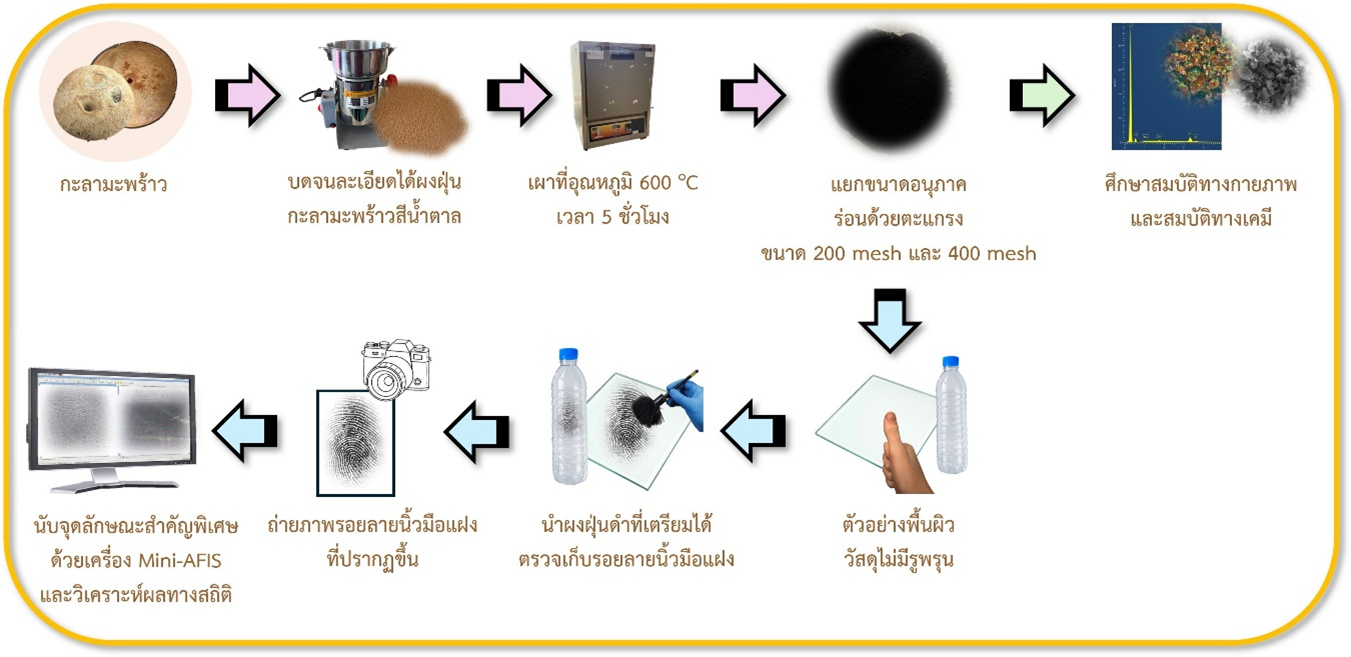
This research presents the development of black fingerprint powder derived from agricultural waste, specifically coconut shells, for latent fingerprint detection on non-porous surfaces. The coconut shells were carbonized at 600°C for 5 hours, finely ground, and sieved through 200 and 400 mesh screens to obtain two types of powders: 200 mesh (1) and 400 mesh (2). Fourier Transform Infrared Spectroscopy (FTIR) confirmed the removal of cellulose functional groups after carbonization. Morphological and elemental analyses using Scanning Electron Microscopy (SEM) showed that powders (1), (2), and a commercial black powder (3) had average particle sizes of 46.3, 10.6 and 29.9 µm, respectively. Latent fingerprint development was assessed on clear glass and plastic bottle surfaces. All powders successfully revealed latent fingerprints; however, powder (2) provided superior ridge clarity and completeness compared to powders (1) and (3). The results demonstrate the potential of bio-based black powder as an effective and sustainable alternative for forensic fingerprint detection.
Article Details

This work is licensed under a Creative Commons Attribution-NonCommercial-NoDerivatives 4.0 International License.
References
กรรณิการ์ เอื้อทยา, กมลทิพย์ ขัตติยะวงศ์ และพิเชษฐ อนุรักษ์อุดม. (2558). การพัฒนาการหาลายนิ้วมือแฝงด้วยวัสดุ ผสมซิงค์ออกไซด์/พีพีวี. ใน: การประชุมวิชาการระดับชาติ มหาวิทยาลัยเกษตรศาสตร์ วิทยาเขตกำแพงแสน ครั้งที่ 12: ตามรอยพระยุคลบาท เกษตรศาสตร์กำแพงแสน. มหาวิทยาลัยเกษตรศาสตร์ วิทยาเขตกำแพงแสน, นครปฐม. 517 - 523.
กิตตินันท์ ขำสอาด, วีรมลล์ ไวลิขิต และพิเชษฐ อนุรักษ์อุดม. (2567). การพัฒนาการตรวจหารอยลายนิ้วมือแฝง
บนวัตถุไม่มีรูพรุน โดยใช้ผงมะเกลือนำไปใช้ทางด้านนิติวิทยาศาสตร์. ใน: การประชุมวิชาการระดับชาติมหาวิทยาลัยเกษตรศาสตร์ วิทยาเขตกำแพงแสน ครั้งที่ 21. มหาวิทยาลัยเกษตรศาสตร์ วิทยาเขตกำแพงแสน, นครปฐม. 3398 - 3407.
กิรดา ขานโบ, กิตติธัช ธนสิวะวงษ์, เขมฤทัย ถามะพัฒน์, ศิริประภา รัตตัญญู, สุรินทร์ ชมเสาร์หัศ, พัชรา สินลอยมา และ พิเชษฐ ลิ้มสุวรรณ (2564). ผงฝุ่นวาวแสงจากแกลบสำหรับเพิ่มความคมชัดของรอยลายนิ้วมือแฝง. วารสารวิจัยราชภัฏ พระนคร สาขาวิทยาศาสตร์และเทคโนโลยี 16(2): 67 - 80.
เกตน์นิภา บุญงาม และปริญญา สีลานันท์. (2563). การเปรียบเทียบวิธีการลอกเก็บลายนิ้วมือแฝงบนผิวผลไม้โดยใช้ผงฝุ่นแม่เหล็ก. วารสารวิชาการอาชญาวิทยาและนิติวิทยาศาสตร์ โรงเรียนนายร้อยตำรวจ 6(2): 31 - 44.
ทิฆัมพร ภูที, สาธิกา นวลพลกรัง, เบญจศิลป์ เปลี่ยนสันเที๊ยะ และธนพงษ์ ผุยบัวค้อ. (2567). คุณภาพรอยลายนิ้วมือแฝงบนกระดาษต่างชนิดด้วยวิธีสารเคมีนินไฮดรินและ 1,2-อินเดนไดโอน. วารสารวิชาการอาชญาวิทยาและนิติวิทยาศาสตร์ โรงเรียนนายร้อยตำรวจ 10(1): 34 - 47.
นัฐ กองแก้ว. (2562). การศึกษาการเปรียบเทียบปรากฏของรอยลายนิ้วมือแฝงบนปลอกกระสุนปืนที่อยู่ในสภาพความชื้นสัมพัทธ์ต่างกัน. วารสารวิชาการอาชญาวิทยาและนิติวิทยาศาสตร์ โรงเรียนนายร้อยตำรวจ 5(2): 180 - 195.
รุ้งวรีย์ ทองธรรมชาติ และวรธัช วิชชุวาณิชย์. การพัฒนาผงฝุ่นจากแกลบดำในการตรวจหารอยลายนิ้วมือแฝงบนพื้นผิวที่แตกต่างกัน. วารสารวิชาการอาชญาวิทยาและนิติวิทยาศาสตร์ โรงเรียนนายร้อยตำรวจ 5(2): 87 - 103.
สมหมาย แสงแก้ว. (2556). การผลิตผงฝุ่นจากถ่านหินและการประเมินผลการใช้ตรวจหารอยลายนิ้วมือแฝง. วารสารวิชาการ Veridian E-Journal, Silpakorn University สาขามนุษยศาสตร์ สังคมศาสตร์และศิลปะ 6(1): 829 - 839.
สัมฤทธิ์ โม้พวง. (2551). การผลิตผงฝุ่นดำถ่านกัมมันต์เปลือกกล้วยตรวจลายนิ้วมือแฝง. คณะวิทยาศาสตร์ มหาวิทยาลัยนเรศวร.หน้า 1 - 34.
สุพิชฌา แสงแก้วสุข และ ปริญญา สีลานันท์. การพัฒนาผงฝุ่นคาร์บอนจากกาบมะพร้าวเผาสำหรับการตรวจหารอยลายนิ้วมือแฝง. วารสารศรีปทุมปริทัศน์ ฉบับวิทยาศาสตร์และเทคโนโลยี 16(1): 26 - 38.
หทัยทิพย์ ทิพย์รงค์. (2558). การพัฒนาผงฝุ่นดำจากถ่านไม้เพื่อใช้ในการตรวจรอยลายนิ้วมือแฝงบนถ้วยที่ทำจากเซรามิค พลาสติกและกระดาษ. วิทยานิพนธ์วิทยาศาสตรมหาบัณฑิต, มหาวิทยาลัยศิลปากร. นครปฐม. 54 หน้า
อนุสรณ์ สินสะอาด. (2560). การพัฒนาประสิทธิภาพเตาเผาถ่านกัมมันต์จากกะลามะพร้าว. วารสารวิชาการคณะเทคโนโลยีอุตสาหกรรม มหาวิทยาลัยราชภัฏลำปาง 10(2): 95 - 108.
Ikumapayi, O.M., Akinlabi, E.T., Majumdar, J.D. and Akinlabi, S.A. (2020). Chapter four - Applications of coconut shell ash/particles in modern manufacturing: a case study of friction stir processing. In Woodhead Publishing Reviews: Mechanical Engineering Series. Woodhead Publishing, Cambridge. pp. 69 - 95.
Leman, A.Z., Shahidan, S., Senin, M.S.Raihan., N.I. and Hannan, R. (2016). A preliminary study on chemical and physical properties of coconut shell powder as a filler in concrete. IOP Conference Series: Materials Science and Engineering. 160: 012059. doi: 10.1088/1757-899X/160/1/012059.
Li, J., Zhang, L.P., Peng, F., Bian, J., Yuan, T.Q., Xu, F. and Sun, R.C. (2009). Microwave-assisted solvent-free acetylation of cellulose with acetic anhydride in the presence of iodine as a catalyst. Molecules 14(9): 3551 - 3566.
Moreno, S., Brown, G., Klein, M., Wang, Q., Markiewwicz, J.T., Alemán, E.A., Rushton, C.G. and Quiñones, R. (2021). Chemical composition effect on latent print development using black fingerprint powders. Forensic Chemistry 26(14): 1 - 13.
Ponsunthia, N. and Vichuwanich, W. (2020). The quality appearance of latent fingerprint on various metals by using black dust powder. Journal of Applied Research on Science and Technology 19(2): 34 - 44.
Sodhi, G.S. and Kaur, J. (2001). Powder method for detecting latent fingerprints: a review. Forensic Science International 120(3): 172 - 176.
