
Effect of 6-benzylaminopurine on Shoot Multiplication of Gac Fruit (Momordica cochinchinensis (Lour.) Spreng.) by Tissue Culture
Article Sidebar
Main Article Content
Abstract
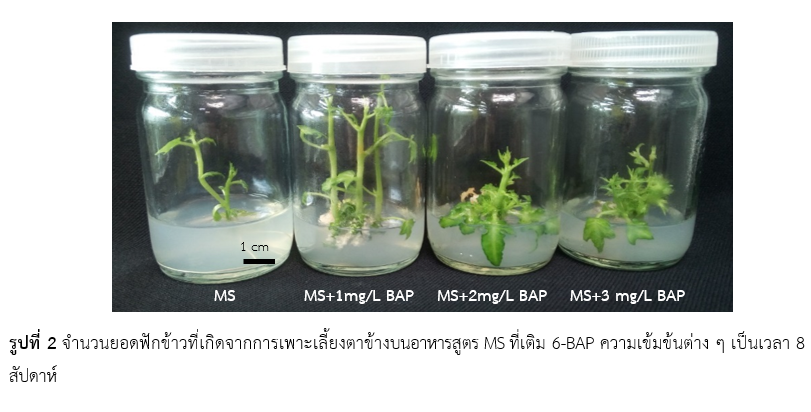
This research aimed to study the effect of suitable concentrations of 6-BAP on the induction of shoot multiplication in Gac fruit seed tissue culture. Gac fruit seeds were sterilized by soaking in 70% ethyl alcohol for 1 min and then soaked in 2.5% sodium hypochlorite solution for 10 min. The seeds were cultured on Murashige and Skoog (1962) medium without added 6-BAP for 8 weeks to study the germination percentage and shoot number. The resulting shoots were then cultured on MS medium supplemented without 6-BAP for 8 weeks. The shoots with uniform size and vigor were selected and transferred to MS medium supplemented with 6-BAP at concentrations of 0, 1, 2 and 3 mg/L to study the changes in shoot number, leaf number, shoot length and root formation. From the results, it was found that the cultivation of Gac fruit seeds on MS medium supplemented with 6-BAP at concentrations of 1 and 2 mg/L could induce the highest germination, which was 100 percent. In addition, it was found that they could induce the highest shoot formation, which was 3.00 ± 0.82 and 3.10 ± 0.91 shoots per seed, respectively. The cultivation of the Gac fruit shoots from tissue culture on MS medium supplemented with 1 mg/L 6-BAP was able to induce the highest average number of shoots (12.60 ± 1.83 shoots), the highest average number of leaves (46.20 ± 1.69 leaves per plant group). In addition, the highest average shoot length and number of roots were 3.74 ± 1.76 cm and 0.40 ± 0.84 roots per shoot, respectively. However the length of the shoot and the number of roots were not significantly different statistically. This research can be basic information to be used as a guideline for propagation of Gac fruit by tissue culture method.
Article Details

This work is licensed under a Creative Commons Attribution-NonCommercial-NoDerivatives 4.0 International License.
References
กฤษดา นิลวดี, สุกัญญา ศรีจําปา, พัชราภรณ์ ทิพยวัฒน์ และรัฐพล ไกรกลาง. (2565). ฤทธิ์ของสารสกัดหยาบจากลูกหม่อนและเยื่อหุ้มเมล็ดของฟักข้าวในการยับยั้งการสร้างโปรตีน Interleukin 1β และ Interleukin 6. วารสารวิจัยสาธารณสุขศาสตร์มหาวิทยาลัยขอนแก่น 15(4): 44 - 55.
กาพย์แก้ว แก้วนาบอน, ธัญญะ เตชะศีลพิทักษ์, ทัศไนย จารุวัฒนพันธ์, ณัฐพงค์ จันจุฬา และนุชรัฐ บาลลา. (2562). การชักนำให้เกิดแคลลัสจากชิ้นส่วนต่าง ๆ ของต้นลินเดอร์เนียในสภาพปลอดเชื้อ. Thai Journal of Science and Technology 8(2): 137 - 145.
ปริฉัตร ปักษี, ศุภลักษณ์ ฟักคำ, สรรใจ แสงวิเชียร, ธารา ชินะกาญจน์ และพีรยา อานมณี. (2566). การศึกษาพฤกษเคมีและฤทธิ์ในยับยั้งเชื้อจุลชีพจากสารสกัดเมล็ดฟักข้าว. วารสารมหาวิทยาลัยนราธิวาสราชนครินทร์ 15(1): 1 - 17.
พรทิพย์ เทิดบารมี. (2562). ผลของโคลชิซีนที่มีต่อการเปลี่ยนแปลงสัณฐานวิทยาและโครโมโซมของแตงโม (Citrulluss lanatus Mat & Nakai) พันธุ์ปลูกตอปิโดจากการเพาะเลี้ยงเนื้อเยื่อ. วารสารก้าวทันโลกวิทยาศาสตร์ 19 (1): 31 - 48.
อรทัย เข่งดี, อลงกรณ์ สมศรี และกชวรรณ กล่อมเกลี้ย. (2566). การพัฒนาผลิตภัณฑ์โยเกิร์ตกะทิผสมฟักข้าว. วารสารวิจัยและนวัตกรรมทางวิทยาศาสตร์และเทคโนโลยี 3(4): 70 - 78.
Al-Amery, L.K.J., Al-Shamari, M.A., Mohammed, I.H., Al-Jubori, H.S.A. (2023). Developing a protocols to micropropagate Gac fruit (Momordica cochinchinensis Spreng.) in vitro. Euphrates Journal of Agricultural Science 15(2): 517 - 526.
Ariyarathna, M. P. and Gamage S. D. H. (2024). Gac (Momordica cochinchinensis Spreng) fruit as a promising functional food: A comprehensive review. International Journal of Science and Research Archive 11(1): 2227 - 2236. doi: 10.30574/ijsra.2024.11.1.0299.
Buranrat, B. and Kraiklang, R. (2023). Momordica cochinchinensis Suppresses the Human Breast Cancer Cells Growth and Migration by Inhibiting Mevalonate Pathway. Pharmacognosy Magazine. 19(2): 284 - 294. doi: 10.1177/09731296231157982.
Darapong, P. Tachai, S. Atthaisong, J. Jaikla, N. Rabiab, B. and Srimoon, R. (2023). Tyrosinase Inhibitory Efficiency and Antioxidant Activity of Gac Fruit (Momordica cochinchinensis Spreng.) Extract. RMUTP Research Journal (17)2: 149 - 156. doi: 10.14456/jrmutp.2023.29.
Mangena, P. (2020). Benzyl adenine in plant tissue culture-succinct analysis of the overall influence in soybean [Glycine max (L.) Merrill.] seed and shoot culture establishment. Journal of Biotech Research. 11(1): 23 - 34.
Mok, D.W.S. and Mok, M.C. (1994). Cytokinins: Chemistry, Activity, and Fuction. Florida: CRC Press. Inc. 129 - 137.
Murashige, T. and Skoog, F. (1962). A revised medium for rapid growth and bioassays with tobacco tissue culture. Physiologia Plantarum 15(3): 473 - 479. doi: 10.1111/j.1399-3054.1962.tb08052.x.
Svolacchia, N. and Sabatini, S. (2023). Cytokinins. Current Biology. 33(1): R10 - R13. doi: 10.1016/j.cub.2022. 11.022
Thavamany, J.P. Chew, L.H. Sreeramanan, S. Chew, L. B. Thong Ong, M. (2020). Momordica cochinchinensis Spreng (Gac fruit): An abundant source of nutrient, phytochemicals and its pharmacological activities. Australian Journal of Crop Science 14(12): 1844 - 1854.
Wimalasiri, D. Piva, T. Urban, S. and Huynh, T. (2016). Morphological and genetic diversity of Momordica cochinchinensis (Cucurbitaceae) in Vietnam and Thailand. Genetic Resources and Crop Evolution 663(1): 19 - 33. doi: 10.1007/s10722-015-0232-8.
