
THE DEVELOPMENT OF A CAUSAL MODEL AFFECTING CHANGE MANAGEMENT TOWARD THE ORGANIZATIONAL PERFORMANCE SUSTAINABLE OF THE PLASTIC PACKAGING INDUSTRY.
Article Sidebar
Main Article Content
บทคัดย่อ
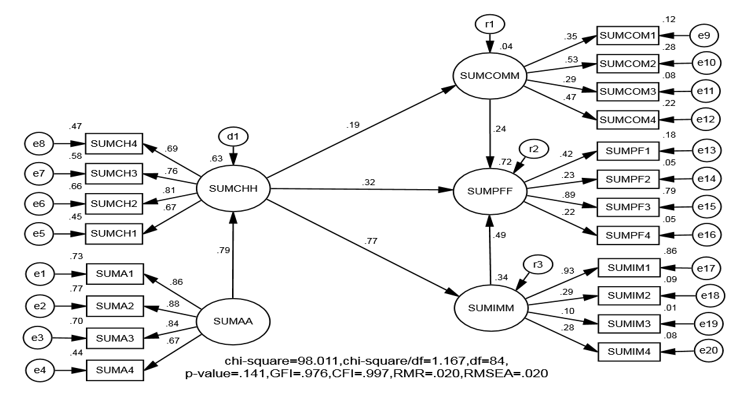
The objective of this research was to examine the coherence of the development of a causal model affecting change management conditions on the sustainable organizational performance of the plastic packaging industry with empirical data. By conducting a quantitative research study, data were collected with executives of plastic packaging manufacturers. The sample size was determined by using the 1:20 variable estimation method, equal to 400 people by random sampling using proportional probability. The research tool was a questionnaire with a total reliability of 0.943. Data were collected and statistical analyzes were carried out such as frequency, percentage, mean, standard deviation, and data were analyzed using inferential statistics with analytical techniques. structural equation The results showed that The results of the corroborative component model analysis. The composition weight ranges from 0.10-0.93, which is statistically significant at 0.01, and the causal model fit index affecting change management conditions for sustainable organizational performance of the plastic packaging industry. The model is appropriate and harmonious with the empirical data ( = 98.011 (98.011/84) = 1.167, p-value = 0.141 GFI = 0.976 AGFI = 0.940 NFI = 0.980 CFI = 0.997 RMR = 0.020 RMSEA = 0.020) and can be combined to predict. up to 71.7 percent
Article Details

อนุญาตภายใต้เงื่อนไข Creative Commons Attribution-NonCommercial-NoDerivatives 4.0 International License.
เนื้อหาและข่อมูลในบทความที่ลงตีพิมพ์ในวารสารวิชาการ เทคโนโลยี พลังงาน และสิ่งแวดล้อม บัณฑิตวิทยาลัย วิทยาลัยเทคโนโลยีสยาม ถือเป็นข้อคิดเห็นและความรับผิดชอบของผู้เขียนบทความโดยตรง ซึ่งกองบรรณาธิการวารสารไม่จำเป็นต้องเห็นด้วย หรือว่าร่วมรับผิดชอบใด ๆ
บทความ ข้อมูล เนื้อหา รูปภาพ ฯลฯ ที่ได้รับการตีพิมพ์ในวารสารวิชาการ เทคโนโลยี พลังงาน และสิ่งแวดล้อม บัณฑิตวิทยาลัย วิทยาลัยเทคโนโลยีสยาม ถือเป็นลิขสิทธิ์ของวารสารวิชาการ เทคโนโลยี พลังงาน และสิ่งแวดล้อม บัณฑิตวิทยาลัย วิทยาลัยเทคโนโลยีสยาม หากบุคคล หรือหน่วยงานใดต้องการนำทั้งหมด หรือส่วนหนึ่งส่วนใดไปเผยแพร่ต่อ หรือเพื่อกระทำการใด ๆ จะต้องได้รับอนุญาต เป็นลายลักษณ์อักษรจากวารสารวิชาการ เทคโนโลยี พลังงาน และสิ่งแวดล้อม บัณฑิตวิทยาลัย วิทยาลัยเทคโนโลยีสยาม เท่านั้น
เอกสารอ้างอิง
Kesara Sakmaneewongsa. (2021 August 25). Business adaptation to meet changing consumer demand. [ระบบออนไลน์], แหล่งที่มา: https://www.bangkokbiznews.com/blog/detail/645723
Chiraphong Photaphan. (2021 August 25). Technology change. [ระบบออนไลน์], แหล่งที่มา: https://www.krui3.com/content/change-of-technology/
กระทรวงอุตสาหกรรม. (2021 August 9). แผนแม่บทการพัฒนาอุตสาหกรรมไทย พ.ศ. 2555-2574. กรุงเทพฯ, 2555.
Charusiri, W. (2021 August 9). “Municipal waste disposal management to become alternative energyresources by converting waste plastic into liquid fuel”. Srinakharinwirot University Journal of Science and Technology, 4(7), 2012, 125-144.
Veerathaworn, P. (2021 August 9). “Forecast of Bioplastics Industry”. Plastics Foresight, 8(2), 2013, 12-16.
Kotler, P. and Keller, K.L. (2016). “Marketing Management”. 15th Global edition. Edinburgh: Pearson Education.
Auka, O. D. (2021 August 4). “Service quality, satisfaction,perceived value and loyalty among customers in commercial banking in Nakuru Municipality,Kenya”. African Journal of Marketing Management, 4(5), 2012, 185-203.
ศิริวรรณ เสรีรัตน์ และวุฒิศักดิ์ พิศสุวรรณ. “การบริหารการตลาดยุดใหม่”. บริษัท ธีระฟิล์มและไซเท็กซ์ จำกัด, กรุงเทพฯ. 2551.
ทิพวรรณ หล่อสุวรรณรัตน์. “องค์กรแห่งความรู้: จากแนวคิดสู่การปฏิบัติ”. พิมพ์ครั้งที่ 2. กรุงเทพฯ : แซท์โฟร์พริ้นติ้ง. 2548.
Schermerhorn, J., R. “Management”. 8th ed. New York: John Wiley & Sons. 2005.
Daft R. L. “New Era of Management”. 2nd ed. China: China Translation and Printing Services. 2008.
Kaplan, R. S., & Norton, D. P. “Alignment: Using the balanced scorecard to create corporate synergies”. Harvard Business Press. 2006. [ระบบออนไลน์], Available from: https://books.google.co.th/books?
hl=th&lr=&id=blIiUrbN77sC&oi=fnd&pg=PP7&dq=Kaplan+%26+Norton,+(2006)& ots=v4hS_zGPbu&sig=sY
ZqBI0hBLdQpanl5NI_WqAaaEA&redir_esc=y#v=onepage&q=Kaplan%20%26%20Norton%2C%20(2006)&f=false
สาคร สุขศรีวงศ์. “การจัดการ: จากมุมมองนักบริหาร”. พิมพ์ครั้งที่ 6. กรุงเทพฯ: จี.พี. ไซเบอร์พรินท์. 2553.
Kline, R. B. “Principles and Practice of Structural Equation Modeling”. 3ed. New York: Guilford Press. 2010.
กัลยา วานิชบัญชา. “การใช้ SPSS for windows ในการวิเคราะห์ข้อมูล”. กรุงเทพฯ: จุฬาลงกรณ์มหาวิทยาลัย. 2550.
ธานินทร์ ศิลป์จารุ. “การวิจัยและวิเคราะห์ข้อมูลทางสถิติด้วย SPSS”. กรุงเทพมหานคร: บริษัท วี อินเตอร์
พริ้นท์. 2548.
Hair, J. F., Black, W. C., Babin, B. J., & Anderson, R. E. “Multivariate data analysis: A global perspective”. (7th ed.). Upper Saddle River, NJ Pearson: Prentice Hall. 2010.
Byrne, B. M. “Structural Equation Modeling with AMOS: Basic concepts, Applications, and Programming”. 2nd Edition. New York: Routledge Taylor & Francis Group. 2010.
Schumacker, R. E., & Lomax, R. G. “A Beginners Guide to Structural Equation Modeling”. 3 ed. New York: Routledge. 2010.
Ferreira, J., Coelho, A., & Moutinho, L. (2021 August 4). “Dynamic capabilities, creativity and innovation capability and their impact on competitive advantage and firm performance: The moderating role of entrepreneurial orientation”. Technovation, 2020, 92, 1-18.
Kanchanarote, R., & Teerathanachaiyakun, K. (2021 August 4). “The Causal and Effect Factors Influencing Business Transformation and Business Performance of Small and Transformation and Business Performance of Small and Medium Enterprises under the Production Sector in Thailand”. Journal of Research and Development Institute Rajabhat Maha Sarakham University, 7(2), 2020, 275-290.
Sijabat, E. A. S., Nimran, U., Utami, H. N., & Prasetya, A. (2021 August 4). “Ambidextrous innovation in mediating entrepreneurial creativity on firm performance and competitive advantage”. The Journal of Asian Finance, Economics, and Business, 7(11), 2020. 737-746.
Poranee Loatong. (2021 August 8). “The Competitiveness Enhancement Development Models of Small and Micro-Community Enterprise: Sme of Fabric and Clothes in Thailand. (การจัดการดุษฎีบัณฑิต มหาวิทยาลัยศรีปทุม).
