
การเตือนภัยจากระดับน้ำในทะเลสาบล่วงหน้าด้วยข้อมูลการตรวจวัดฝนทั่วโลก: กรณีศึกษาทะเลสาบหนองหาร
Article Sidebar
Main Article Content
บทคัดย่อ
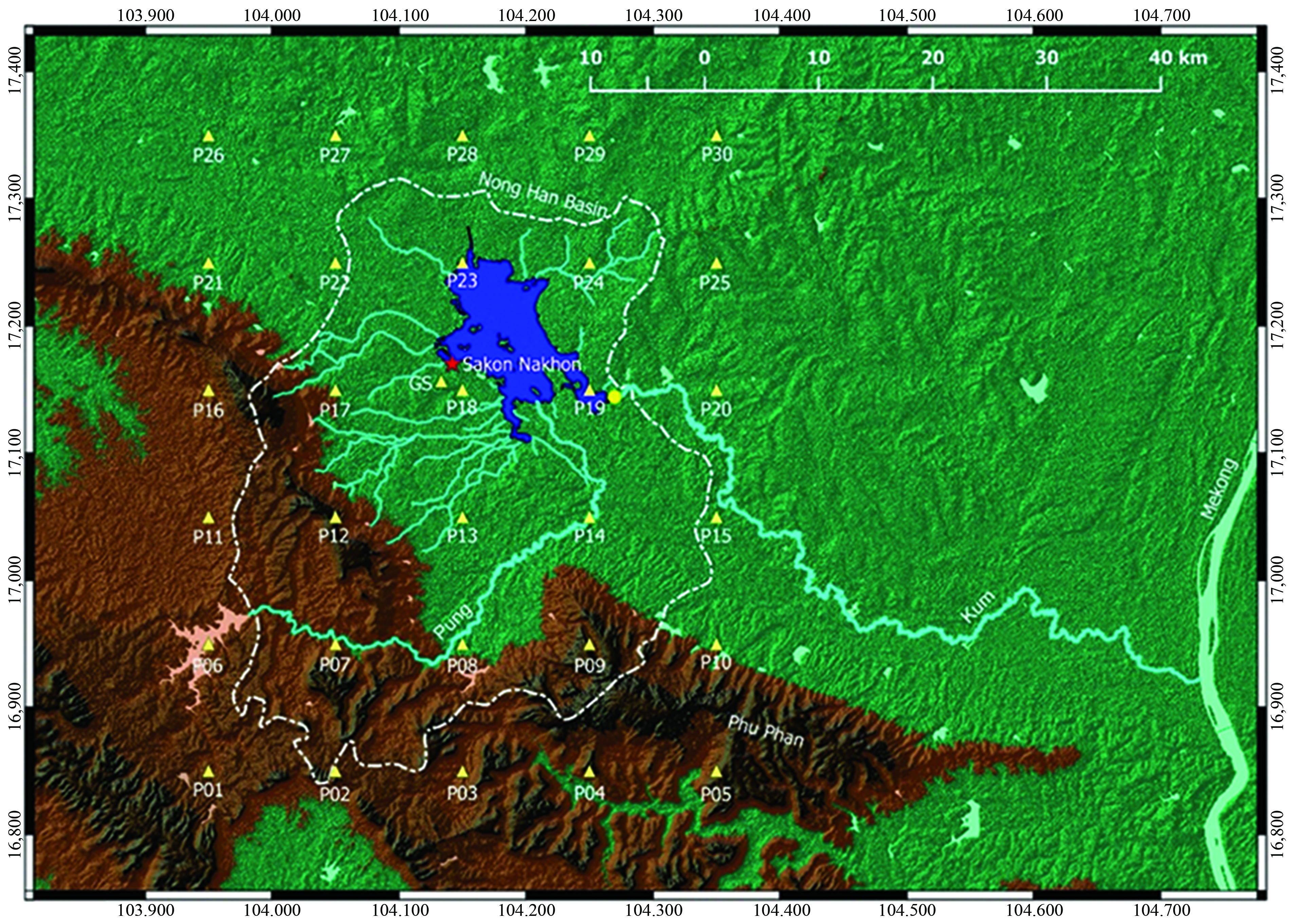
บทความวิจัยนี้มีวัตถุประสงค์ในการศึกษาความเป็นไปได้ของการใช้ข้อมูลการตรวจวัดฝนทั่วโลก (จีพีเอ็ม) ในการเตือนภัยล่วงหน้า จากการเปลี่ยนแปลงระดับน้ำในทะเลสาบหนองหาร โดยทำการวิเคราะห์ความสัมพันธ์อย่างง่ายระหว่างตัวแปรนำเข้า ได้แก่ ระดับน้ำในวันปัจจุบัน อัตราการระบายน้ำ อัตราการระเหย ปริมาณฝน และข้อมูลจีพีเอ็มกับตัวแปรเป้าหมาย คือ ดัชนีการเตือนภัยจากระดับนํ้าทะเลสาบหนองหารในวันรุ่งขึ้น อีกทั้งยังสร้างตัวแบบการทำนายด้วยการจัดการข้อมูลวิธีกลุ่ม แบบเครือข่ายประสาท (GMDH-Type Neural Networks) ผลการศึกษาพบว่า การขึ้นลงของน้ำในทะเลสาบหนองหารในวันรุ่งขึ้นมีความสัมพันธ์ในระดับสูงกับระดับน้ำในวันปัจจุบันและอัตราการระบายน้ำมีความสัมพันธ์ในระดับปานกลางค่อนไปทางต่ำกับอัตราการระเหย ปริมาณฝนและข้อมูลจีพีเอ็ม นอกจากนี้การประเมินผลลัพธ์การทำนายของตัวแบบที่ได้ด้วย ข้อมูลที่ตัวแบบไม่เคยพบมาก่อน พบว่าตัวแบบนี้มีประสิทธิภาพในการทำนายค่อนข้างสูง โดยมีความเที่ยงตรงของการทำนายเท่ากับร้อยละ 90.5 แสดงให้เห็นว่าการใช้ข้อมูลจีพีเอ็มมีศักยภาพในการนำมาใช้งานเตือนภัย จากการเปลี่ยนแปลงระดับนํ้าในทะเลสาบ
Article Details
เอกสารอ้างอิง
[2] Lehner, B., Döll, P., Alcamo, J., Henrichs, T., and Kaspar, F. (2006). Estimating the Impact of Global Change on Flood and Drought Risks in Europe: A Continental, Integrated Analysis. Climatic Change. Vol. 75, Issue 3, pp. 273-299. DOI: 10.1007/s10584-006-6338-4
[3] Wiering, M. and Winnubst, M. (2017). The Conception of Public Interest in Dutch Flood Risk Management: Untouchable or Transforming?. Environmental Science & Policy. Vol. 73, pp. 12-19. DOI: 10.1016/j.envsci.2017.03.002
[4] Zhang, Q., Zhang, J., and Wang, C. (2017). Risk Assessment of Drought Disaster in Typical Area of Corn Cultivation in China. Theoretical and Applied Climatology. Vol. 128, Issue 3-4, pp. 533-540. DOI: 10.1007/s00704-015-1723-4
[5] Reynard, N. S., Kay, A. L., Anderson, M., Donovan, B., and Duckworth, C. (2017). The Evolution of Climate Change Guidance for Fluvial Flood Risk Management in England. Physical Geography. Vol. 41, Issue 2, pp. 222-237. DOI: 10.1177/0309133317702566
[6] Singkran, N. (2017). Flood Risk Management in Thailand: Shifting from a Passive to a Progressive Paradigm. International Journal of Disaster Risk Reduction. Vol. 25, pp. 92-100. DOI: 10.1016/j.ijdrr.2017.08.003
[7] Stratford, C., Brewin, P., Acreman, M., and Mountford, O. (2015). A Simple Model to Quantify the Potential Trade-Off Between Water Level Management for Ecological Benefit and Flood Risk. Ecohydrology & Hydrobiology. Vol. 15, Issue 3, pp. 150-159. DOI: 10.1016/j.ecohyd.2015.06.002
[8] Sun, G., Zheng, H., Huang, Y., and Li, C. (2016). Parameter Inversion and Deformation Mechanism of Sanmendong Landslide in the Three Gorges Reservoir Region Under the Combined Effect of Reservoir Water Level Fluctuation and Rainfall. Engineering Geology. Vol. 205, pp. 133-145. DOI: 10.1016/j.enggeo.2015.10.014
[9] Zhao, Q., Liu, S., Deng, L., Dong, S., and Wang, C. (2014). Soil Degradation Associated with Water-Level Fluctuations in the Manwan Reservoir, Lancang River Basin. CATENA. Vol. 113, pp. 226-235. DOI: 10.1016/j.catena.2013.08.007
[10] Mettrop, I. S., Rutte, M. D., Kooijman, A. M., and Lamers, L. P. M. (2015). The Ecological Effects of Water Level Fluctuation and Phosphate Enrichment in Mesotrophic Peatlands are Strongly Mediated by Soil Chemistry. Ecological Engineering. Vol. 85, pp. 226-236. DOI: 10.1016/j.ecoleng.2015.09.077
[11] Qian, K., Liu, X., and Chen, Y. (2016). Effects of Water Level Fluctuation on Phytoplankton Succession in Poyang Lake, China - A Five Year Study. Ecohydrology & Hydrobiology. Vol. 16, pp. 175-184. DOI: DOI: 10.1016/j.ecohyd.2016.08.001
[12] Wang, P., Zhang, Q., Xu, Y.-S., and Yu, F. H. (2016). Effects of Water Level Fluctuation on the Growth of Submerged Macrophyte Communities. Flora. Vol. 223, pp. 83-89. DOI: 10.1016/j.flora.2016.05.005
[13] Grabas, G. P. and Rokitnicki-Wojcik, D. (2015). Characterizing Daily Water-Level Fluctuation Intensity and Water Quality Relationships with Plant Communities in Lake Ontario Coastal wetlands. Journal of Great Lakes Research. Vol. 41, Issue 1, pp. 136-144. DOI: 10.1016/j.jglr.2014.12.019
[14] Menouer, M. A. and Moussaoui, A. (2016). Effects of Consecutive Water Level Fluctuations and Harvesting on Predator-Prey Interactions. Chaos, Solitons & Fractals. Vol. 91, pp. 434-442. DOI: 10.1016/j.chaos.2016.07.001
[15] Yadav, B. and Eliza, K. (2017). A Hybrid Wavelet-Support Vector Machine Model for Prediction of Lake Water Level Fluctuations Using Hydro-Meteorological Data. Measurement. Vol. 103, pp. 294-301. DOI: 10.1016/j.measurement.2017.03.003
[16] Tapiador, F. J., Turk, F. J., Petersen, W., Hou, A. Y., García-Ortega, E., Machado, L. A. T., Angelis, C. F., Salio, P., Kidd, C., Huffman, G. J., and de Castro, M. (2012). Global Precipitation Measurement: Methods, Datasets and Applications. Atmospheric Research. Vol. 104, pp. 70-97
[17] Tapiador, F. J., Navarro, A., Levizzani, V., García-Ortega, E., Huffman, G. J., Kidd, C., Kucera, P. A., Kummerow, C. D., Masunaga, H., Petersen, W.A., Roca, R., Sánchez, J.-L., Tao, W. -K., and Turk, F. J. (2017). Global Precipitation Measurements for Validating Climate Models. Atmospheric Research. Vol. 197, pp. 1-20. DOI: 10.1016/j.atmosres.2017.06.021
[18] Wang, Z., Zhong, R., Lai, C., and Chen, J. (2017). Evaluation of the GPM IMERG Satellite-based Precipitation Products and the Hydrological Utility. Atmospheric Research. Vol. 196, pp. 151-163. DOI: 10.1016/j.atmosres.2017.06.018
[19] Casella, D., Panegrossi, G., Sanò, P., Marra, A. C., Dietrich, S., Johnson, B. T., and Kulie, M. S. (2017). Evaluation of the GPM-DPR Snowfall Detection Capability: Comparison with CloudSat-CPR. Atmospheric Research. Vol. 197, pp. 64-75. DOI: 10.1016/j.atmosres.2017.06.018
[20] Prakash, S., Mitra, A. K., Pai, D. S., and AghaKouchak, A. (2016). From TRMM to GPM: How well can heavy rainfall be detected from space?. Advances in Water Resources. Vol. 88, pp. 1-7. DOI: 10.1016/j.advwatres.2015.11.008
[21] Siswanto, van der Schrier, G., Jan van Oldenborgh, G., van den Hurk, B., Aldrian, E., Swarinoto, Y., Sulistya, W., and Eka Sakya, A. (2017). A Very Unusual Precipitation Event Associated with the 2015 Floods in Jakarta: An Analysis of the Meteorological Factors. Weather and Climate Extremes. Vol. 16, pp. 23-28. DOI: 10.1016/j.wace.2017.03.003
[22] Case, J. L. (2016). From Drought to Flooding in Less Than a Week Over South Carolina. Results in Physics. Vol. 6, pp. 1183-1184. DOI: 10.1016/j.rinp.2016.11.012
